
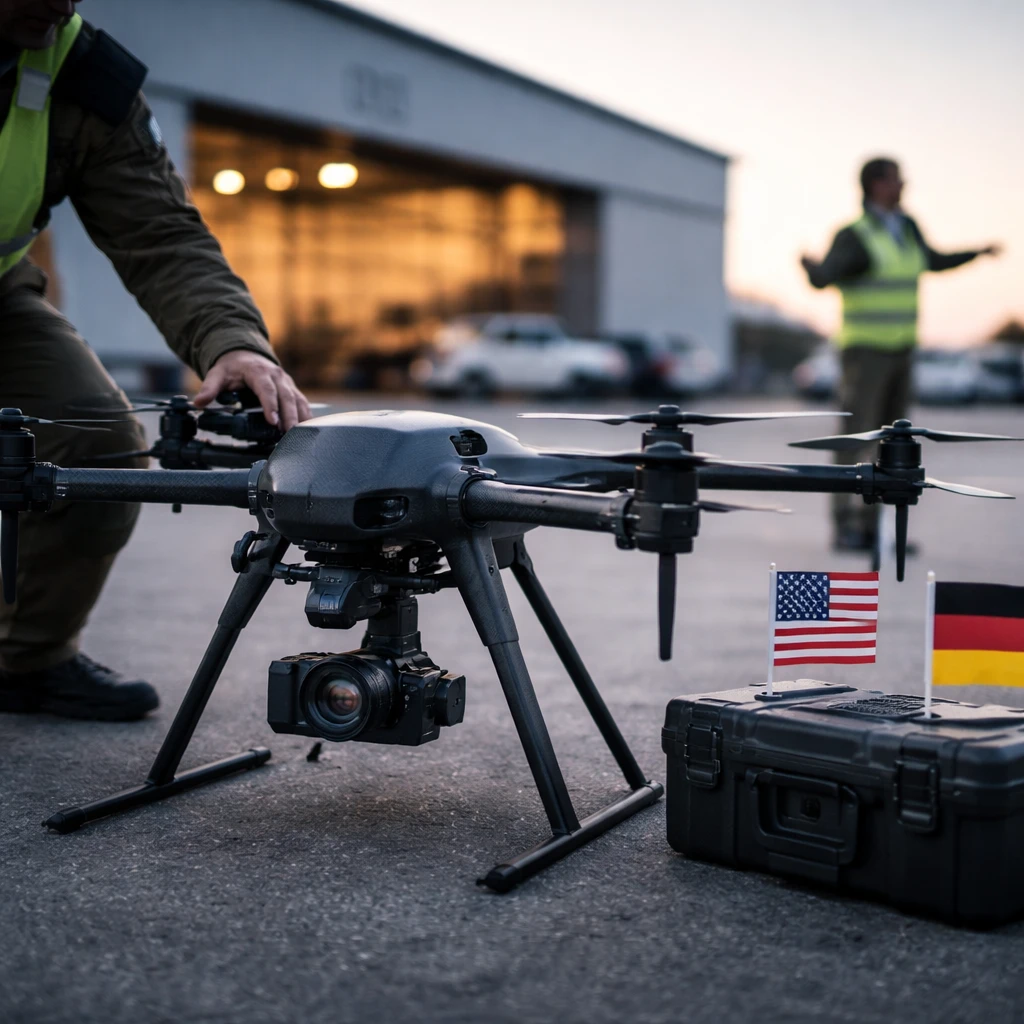
Quantum Systems, a Munich-based maker of reconnaissance, attack and interceptor drones, gained important early traction in the United States with backing and connections from U.S. investors, including In-Q-Tel (IQT), the company’s co-CEO said.
The co-CEO said those U.S. investors helped open doors in Washington and contributed to landing work with the Central Intelligence Agency and the Federal Bureau of Investigation. He described the resulting business from a reconnaissance contract with U.S. intelligence agencies as modest in financial terms but valuable in helping to establish the firm’s credibility in the U.S. market.
"It made it easier to get started in the U.S. with clients CIA and FBI," the co-CEO said. "There were routes that opened up. That’s how we found the way to the USA. We were stronger in the U.S. early on, where the German customer was much weaker."
The comments, disclosed for the first time, underscore the continuing importance of U.S. capital and the relationships that accompany it for some European defence startups, even as governments across the continent push for greater independence from Washington on security and procurement.
Quantum Systems now ranks among Europe’s largest defence startups with a valuation around $8 billion. Its customer list includes Germany and Ukraine, and it sells a range of unmanned systems designed for reconnaissance, strike, and interception roles.
In-Q-Tel’s role and reach
In-Q-Tel, commonly referred to by the acronym IQT and founded by U.S. intelligence officials to identify and invest in technologies relevant to national security, has stakes in a number of companies, including the German defence firm Stark. Its portfolio also includes prominent U.S. technology and defence players.
IQT’s investments are typically small, often less than $3 million, one person familiar with its operations said, but the firm’s significance derives from the connections it can provide to major U.S. defence and intelligence buyers. Jennifer Nelson, executive vice president international at IQT, responded to questions by saying, "Europe’s deep-tech ecosystem is a critical source of mission-relevant innovation," and that "Germany is a particularly important innovation partner and strategic ally." She added that "IQT continues to expand investments in German dual-use innovators ... so allied government teams can evaluate and adopt breakthrough capabilities faster."
IQT’s remit reaches across technologies including cybersecurity, energy and satellite systems. The firm has backed companies spanning data analytics to advanced military systems. The name IQT is a nod to a fictional gadget maker, reflecting its role in sourcing advanced tools and capabilities.
Limits and regulatory constraints
Like other companies that have received U.S. investment or worked in the U.S., Quantum faces restrictions on selling technology developed on U.S. soil without U.S. approval. The co-CEO acknowledged that such constraints apply, noting that the company cannot export technology developed in the United States to other countries without U.S. sign-off.
He also pointed to a separate U.S. requirement that foreign defence suppliers establish local operations in the United States, and said that is why Quantum maintains factories and staff in the U.S.
Political context and concerns
European governments are attempting to reduce reliance on U.S. military power, a push that has accelerated amid political tensions. The article notes that Germany is seeking to lessen dependence after a period in which the then-U.S. president had threatened to step away from NATO, which underpins Europe’s defence posture.
At the same time, building up Europe’s defence industrial base without access to U.S. capital and U.S. defence markets presents a major challenge for Berlin and other capitals.
Those overlapping dynamics have produced scrutiny of IQT’s expanding presence in Europe. Marie-Agnes Strack-Zimmermann, chair of the European Parliament’s security and defence committee, urged that IQT be seen differently from conventional investors because of its ties to U.S. intelligence agencies. "In-Q-Tel is not a purely financial investor but has a mandate to secure access to the best technologies for the U.S. intelligence services," she said, adding that strategic influence can extend beyond commercial ties through investment stakes, observation rights, development and licence deals, and access to government contracts.
Earlier this year, CIA Director John Ratcliffe said the agency was "optimizing our approach to working with the private sector." The CIA declined to comment for this story.
Germany’s defence ministry said it takes investor influence in the defence sector seriously and that shareholders should not interfere with a company’s operations, technology or research.
Company perspective on investor networks
The Quantum co-CEO described the practical reality companies face when taking on investors, saying, "Every investor ... has a network behind it and, logically, you try to use this." He acknowledged other investors had helped the company as well and emphasized that, ultimately, a product must perform on its merits. "At the end of the day, your products have to be convincing. But for sure, American investors ... know the administration that rules and make it possible to open up communication," he said.
He also noted that IQT had not sent him a "proactive email" in the past two years.
Implications for Europe’s defence innovation ecosystem
The Quantum case highlights how U.S. capital and institutional links continue to shape the trajectory of some European defence firms. As Europe debates how to strengthen its own defence industrial base and investment mechanisms, the presence of U.S.-linked investors such as IQT raises questions about strategic alignment, access to markets, and the pace at which mission-relevant technologies are adopted by allied governments.
For Quantum Systems, the early U.S. foothold appears to have been formative in building credibility and commercial relationships in Washington, while also creating operational ties that include U.S.-based factories and staff.