
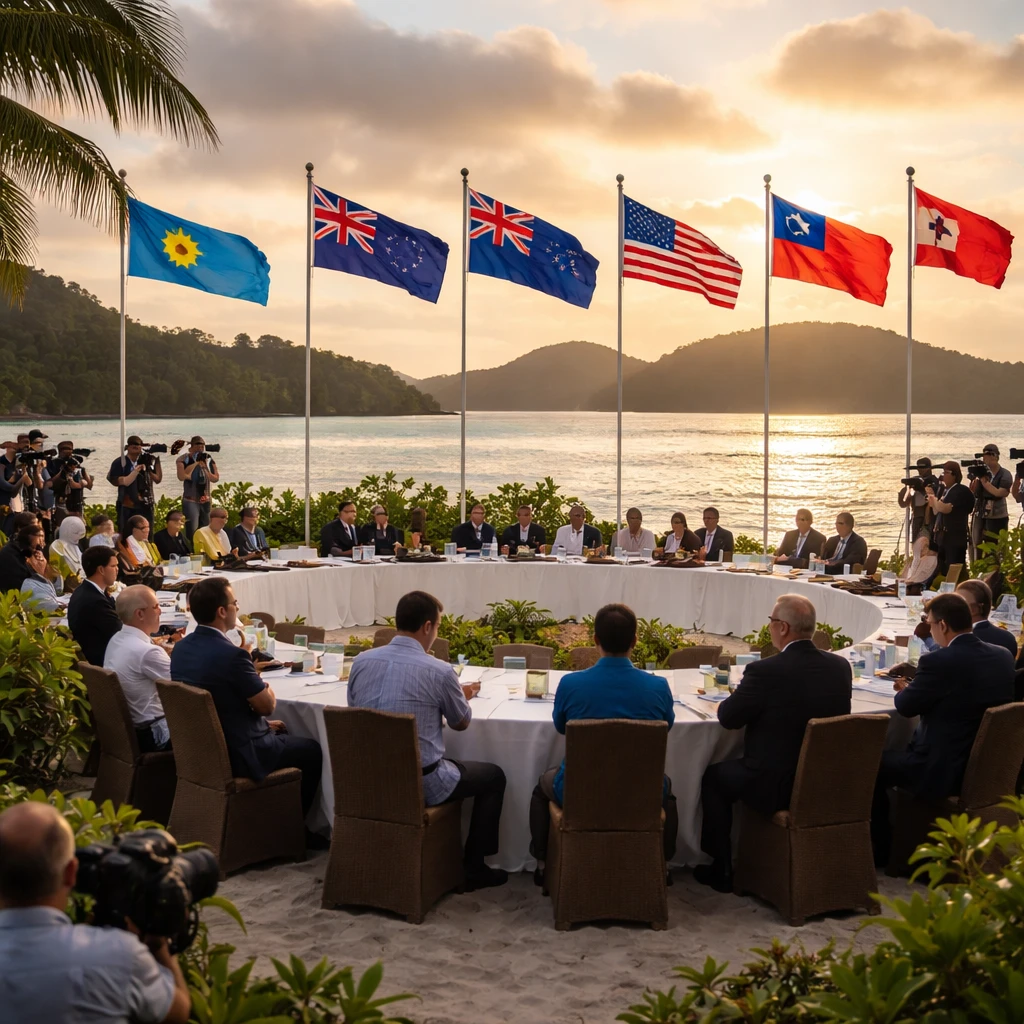
China voiced serious concern about Taiwan's participation in the opening ceremony of the annual Pacific Islands Forum held in Palau, warning of "consequences" while not specifying what actions might follow. The comment from Qian Bo, China’s special envoy for Pacific island affairs, underscored how Sino-Taiwan tensions are dominating discussions at a summit intended to show regional cohesion.
Qian said Taiwan’s attendance was opposed by all and "very inappropriate to do so." When asked to clarify what he meant by "consequences," he replied: "There will always be consequences" and added "It’s not a threat," without offering further details.
Palau, an archipelago of more than 500 islands, has maintained formal diplomatic ties with Taiwan. Taiwan’s foreign minister, Lin Chia-lung, said on Monday that "Taiwan is honoured to serve as a partner in the Pacific, continuing to stand with everyone and work together to make the Pacific more prosperous and peaceful." Lin was invited for meetings and side events that took place alongside the forum.
Although Taiwan participates as a development partner, it is not a formal dialogue partner of the forum in the way China is. The forum counts 21 dialogue partners that include countries and entities such as the United States, the European Union, Britain, Canada, India and Japan.
Only three Pacific Island countries now maintain formal diplomatic relations with Taipei - Palau, Tuvalu and the Marshall Islands - after years in which China has gradually reduced the number of its diplomatic competitors in the region.
Australia’s prime minister, Anthony Albanese, responded to the Chinese envoy’s remarks by stressing the forum’s autonomy, saying "the Pacific Islands Forum determines what happens here, not any other country." He described the gathering as "primarily a gathering of the Pacific family" and expressed his anticipation for engagement among members.
New Zealand’s foreign minister, Winston Peters, echoed that position, noting that the forum does not take instructions from outside countries. Leaders from several Pacific nations - Fiji, Vanuatu, Samoa, the Solomon Islands and Kiribati - were absent from the leaders’ meeting; ministers from those countries are attending in their stead.
China’s growing engagement in the South Pacific has become a point of concern for Canberra despite China being Australia’s largest trading partner. Australian officials have stepped up security and development cooperation with island nations in efforts intended to discourage any permanent Chinese military presence in the region.
In a related development announced during the summit, New Zealand and the United States issued a joint statement saying they would jointly finance a major upgrade of a World War Two port on an atoll in the Cook Islands. That announcement came as part of broader moves by regional powers to bolster infrastructure and security ties with Pacific nations.
Summary of the key developments:
- China warned of unspecified consequences following Taiwan’s attendance at the opening ceremony of the Pacific Islands Forum in Palau.
- Palau, which maintains diplomatic ties with Taiwan, hosted the forum where Taiwan participated as a development partner.
- Australia and New Zealand affirmed that the forum sets its own agenda and does not accept external direction, while some Pacific leaders sent ministers instead of attending themselves.
- New Zealand and the United States announced joint funding to upgrade a World War Two port in the Cook Islands during the summit.