
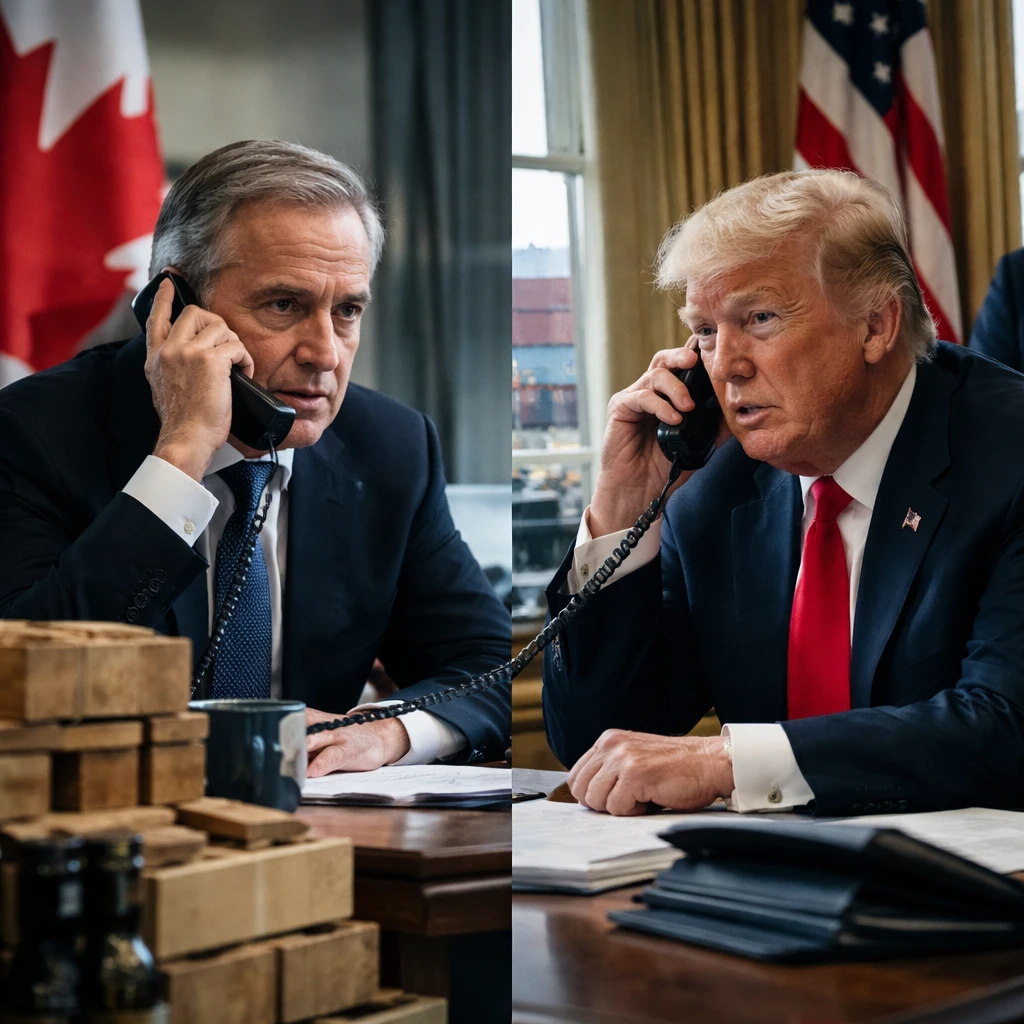
Prime Minister Mark Carney placed a call to U.S. President Donald Trump on Monday as Canadian and American officials continued negotiations aimed at avoiding the imposition of fresh U.S. tariffs, Carney's office said on Tuesday. The potential duties - set at 50% - would take effect at midnight on Wednesday unless a last-minute agreement is reached.
Carney's office provided a brief statement on Tuesday, saying: "Prime Minister Carney and President Trump spoke on the phone yesterday afternoon about the ongoing trade negotiations," but offered no additional details on the substance or outcome of the discussion.
According to two industry sources familiar with the talks, existing U.S. auto tariffs remain a crucial sticking point in the discussions. The proposed set of U.S. tariffs would target roughly $20 billion of imports and would be applied regardless of whether Canadian goods qualify for preferential treatment under the U.S.-Mexico-Canada Agreement (USMCA), which previously insulated many Canadian sectors from earlier U.S. tariff actions.
Business groups warn of broad economic exposure
Trade experts and sector representatives say the new duties could threaten jobs and business viability in several vulnerable industries. Lumber, wine and dairy are among the sectors cited as susceptible to job losses and closures. Critics also warn the move could weaken protections that Canadian exporters had enjoyed under the continental trade pact and complicate broader USMCA talks.
Candace Laing, chief executive officer of the Canadian Chamber of Commerce, emphasized the scale of the potential disruption, saying: "There are billions in goods per year that were not impacted before, but now are at risk of being impacted significantly." She added that many businesses have been hesitant to hire, invest or expand in Canada while the trade dispute has lingered: "Business have been doing a high-wire act for well over a year, holding off on hiring, investment and growing in Canada."
Canadian negotiating team in Washington
Canada's minister responsible for U.S. trade, Dominic LeBlanc, and chief trade negotiator Janice Charette have been in Washington since last week to hold discussions with U.S. officials. LeBlanc's office did not immediately respond to requests for comment about whether another meeting was planned for Tuesday or about the current status of negotiations.
On Monday, the Canadian delegation met for nearly two hours with U.S. Trade Representative Jamieson Greer and Commerce Secretary Howard Lutnick. Greer has repeatedly pointed to several U.S. grievances during talks, including Canadian tariffs that followed initial U.S. duties, some provincial bans on stocking U.S. liquor, and Canada's dairy supply management system.
Sticking point: how to count vehicle content
Two sources said a central issue in the talks is U.S. tariffs on Canadian vehicles. The parties have discussed reducing U.S. Section 232 tariffs on vehicles imported from Canada from 25% to 15%, with the possibility of further tariff reductions tied to the proportion of U.S. content in each vehicle.
A specific point of contention is the method for calculating content. U.S. negotiators are said to prefer deducting only U.S.-made content from the tariff calculation, mirroring the current U.S. approach. Canada is pushing for recognition of all North American content - including Canadian and Mexican parts - to be excluded from the tariff calculation.
A Canadian government source told officials last week that if the new tariffs do take effect, Ottawa has a range of options available, including potential government support for affected domestic industries and even the suspension of bilateral trade talks. That source nonetheless expressed a hope that U.S. negotiators remain eager to reach an agreement before the deadline.
As the clock runs down toward the midnight deadline, negotiators on both sides face concrete decisions about tariff levels, content definitions and the immediate economic consequences for sectors reliant on cross-border trade.