
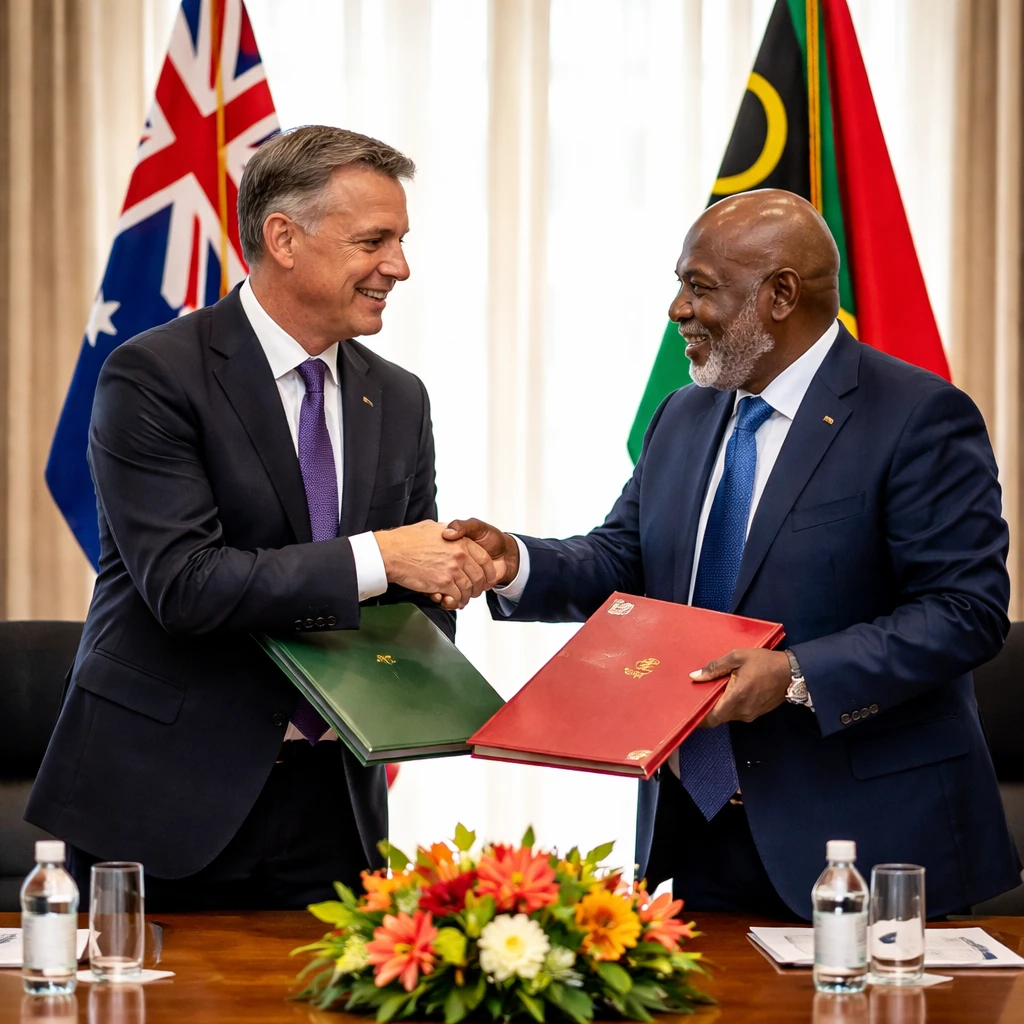
Sydney, June 29 - Australia and Vanuatu on Monday completed a development and security agreement known as the Nakamal Agreement after months of delay caused by concerns within Vanuatu about how the pact might affect its ability to attract outside investment.
The agreement specifies that Australia will be consulted before any third party makes investments in Vanuatu's critical infrastructure, and it confirms Australia as Vanuatu's preferred partner for security and policing cooperation. Canberra has also announced funding of A$500 million over a 10-year period to support the pact.
At a joint news conference, Australian Prime Minister Anthony Albanese described the accord as encapsulating Vanuatu's sovereign decision not to allow its territory to be used for foreign military bases or military infrastructure, and as ensuring that Vanuatu's critical infrastructure remains free from militarisation. He made these remarks alongside Vanuatu's prime minister, Jotham Napat.
The pact had been slated for signature in September, but the timetable slipped after Napat said concerns were raised by a coalition partner that the deal could limit Vanuatu's ability to secure infrastructure financing from other countries. Those concerns prompted the delay and further consultations before the agreement was ultimately signed.
China is Vanuatu's largest external creditor. The country has received loans routed through Chinese banks that financed Chinese contractors responsible for major infrastructure projects in Vanuatu, including the presidential office complex, the parliament building and the road network. Separately, Vanuatu is pursuing an economic deal with China that, according to Napat, was awaiting approval from Beijing at the time of the announcement.
Responding to a question about whether the Nakamal Agreement contained security elements, Napat said, "We will share the agreement, there is nothing to hide." The exchange rate cited in coverage of the pact is ($1 = 1.4514 Australian dollars).
This agreement codifies a consultative role for Australia on third-party infrastructure proposals in Vanuatu and establishes a preferred security partnership, while leaving open Vanuatu's engagement with other partners for economic arrangements subject to its domestic approvals and ongoing external negotiations.