
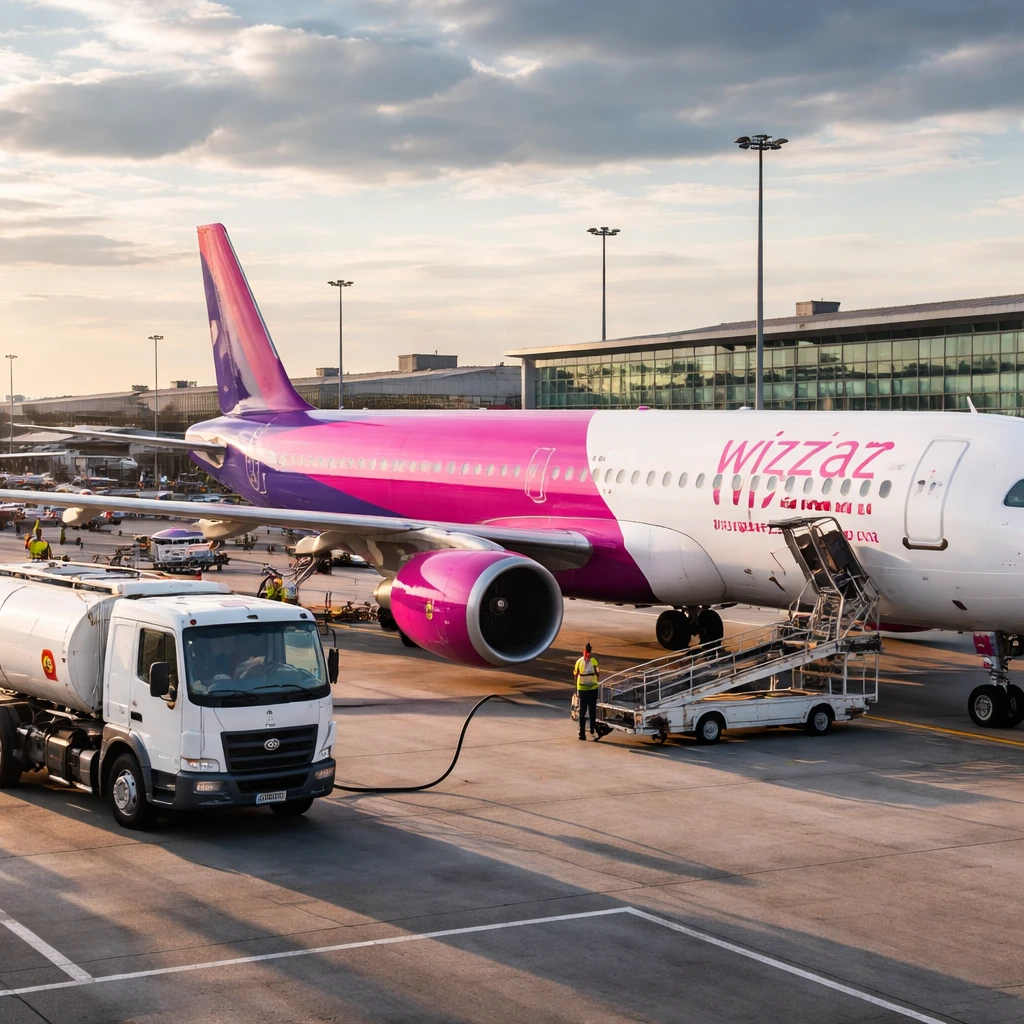
Wizz Air's shares fell sharply during the trading session, sliding 4.1% to 1,100p after the airline reported a wider-than-expected first-quarter loss. For the three months ended June 30, the Budapest-headquartered ultra-low-cost carrier recorded a net loss of €198 million, missing the company-compiled consensus estimate of a €171 million loss by about 15.9%.
Total revenue for the quarter stood at €1.51 billion, roughly 1% below the €1.52 billion consensus figure. Adjusted EBITDA came in at €147 million, underperforming analysts' expectations by 6.7% versus the €158 million forecast. These top-line and profitability shortfalls coincided with a headline loss that outpaced market projections.
The most significant cost pressure came from fuel. Wizz Air reported fuel expenses of €610.5 million for the quarter, a 39.4% increase year on year. That escalation overwhelmed revenue gains driven by higher capacity and was the dominant factor widening the quarterly loss beyond what investors and analysts had been expecting.
This pattern is consistent with recent developments across the European low-cost carrier segment. The report noted that peer Ryanair had already disclosed a pronounced profit decline in its own Q1 FY27 results in late July, with fuel cost pressures cited as a key factor. That suggests Wizz Air's earnings shortfall is part of a sector-wide dynamic rather than an isolated operational failure.
Market conditions outside the company announcement provided little explanation for the price move. U.S. equity benchmarks were relatively subdued, with the S&P 500 marginally positive and the NASDAQ slightly lower, indicating there was no broad risk-off event to account for Wizz Air's decline. Investors therefore focused on the earnings release as the proximate catalyst for the share drop.
Combining a materially larger-than-expected headline loss, a fuel bill approaching 40% higher than a year earlier, and revenue that did not keep pace with rapid capacity expansion created an immediate negative impulse for Wizz Air's stock, pulling it down to 1,100p. That level sits well under the carrier's 52-week high of 1,453p and reinforces investor caution about the company's near-term earnings outlook.
Clear summary
Wizz Air reported a Q1 net loss of €198 million, missed revenue and adjusted EBITDA expectations, and was hit by a 39.4% rise in fuel costs to €610.5 million. The results were the principal driver of a 4.1% share price decline to 1,100p.
Key points
- Net loss of €198 million for Q1 ended June 30, missing consensus by roughly 15.9%.
- Revenue of €1.51 billion and adjusted EBITDA of €147 million both fell short of consensus.
- Fuel expenses surged 39.4% year on year to €610.5 million, pressuring margins and profit.
Risks and uncertainties
- Persistently elevated fuel costs could continue to pressure airline profitability - affecting the airlines and energy-linked sectors.
- Revenue growth that fails to match rapid increases in capacity may worsen margin dilution - impacting airline earnings and equity valuations.
- Investor reaction to further earnings disappointments could exert downward pressure on share prices - relevant to equity markets and aviation sector sentiment.