
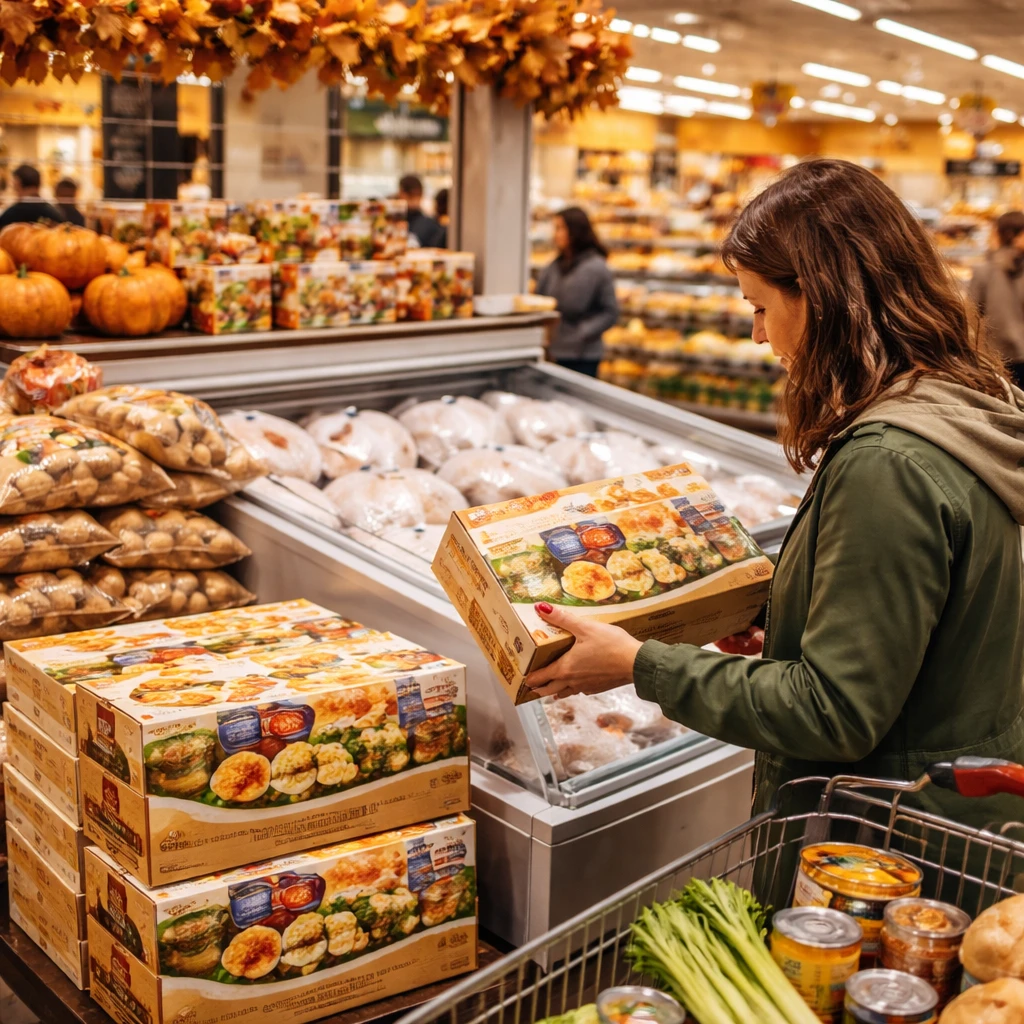
Retailers across the United States are promoting Thanksgiving meal packages that, in many cases, cost no more than last year’s offerings despite a backdrop of rising wholesale prices for the season’s hallmark items. Big chains are betting that low advertised prices for turkeys and bundled dinners will bring consumers into stores, where they are likely to buy additional items such as snacks, beverages and desserts.
Wholesale data show a disconnect between input costs and shelf prices. Commodity assessments from data firm Expana put frozen tom turkey prices about 12% higher than a year earlier, at a record high of $2.00 per pound as of November 9. Wholesale russet potato prices have jumped more than 40%, roughly 46% year over year, according to Expana.
Despite those wholesale increases, retail prices in the weeks leading up to Thanksgiving have not risen in lockstep. NielsenIQ data covering the four weeks to November 7 indicate whole-bird frozen turkeys were 6.3% cheaper per pound than during the same period a year earlier. The same NielsenIQ window showed a 3-pound bag of russet potatoes cost about 2.9% more year over year.
Retailers are using those visible staples as promotional tools. "Turkey and other highly visible Thanksgiving staples are important price signals for shoppers," said Sally Lyons Wyatt, consumer packaged goods lead at research firm Circana. "Retailers have an incentive to promote aggressively or absorb some cost pressure to reinforce the value of the overall meal."
Prominent examples of this pricing strategy are already in market. Walmart introduced a 26-item Thanksgiving meal kit priced at $35 that it says will feed 10 people. The package, which includes turkeys ranging from 10 to 16 pounds, is $5 less than the company’s comparable bundle from the prior year and carries four additional items. German discounter Lidl rolled out a 29-item package for 10 people that includes a 14-pound turkey priced at $33.56. Lidl initially listed the kit at a price $2 higher, then reduced it in November with a message on its website that it "will not be beaten ... by Walmart."
At Aldi, a $39, 10-person dinner is slightly cheaper than last year’s $40 deal but contains only 15 items versus 26 in the prior offering and does not include russet potatoes. Aldi Chief Commercial Officer Scott Patton said the change reflected the retailer’s decision to align its bundle with an annual American Farm Bureau Federation benchmark of a traditional Thanksgiving meal, adding that a direct year-to-year comparison "isn’t apples-to-apples and doesn’t reflect the value we’re delivering." The Farm Bureau put the average cost of a Thanksgiving dinner for 10 people at $58.63, up 6% from the previous year, and estimated the cost of a 16-pound turkey at about $1.48 per pound while noting shoppers could find deals as low as $0.69 per pound.
Analysts describe these offers as classic loss-leading tactics aimed at increasing foot traffic. Michael Swanson, chief agricultural economist at Wells Fargo, characterized the promotional bundles as loss-leading strategies intended to draw shoppers into stores, where they are likely to pick up higher-margin extras. As Swanson put it, "you also load up on chocolates and sweets ... and suddenly you’ll be spending quite a bit of money." Wells Fargo’s forecast for the average 10-person Thanksgiving meal sits at $79 this year, a figure that is well above the value-focused bundles but translates to less than $8 per person for a multi-course meal.
Retailers have levers to limit margin erosion. Some grocers can include items in kits whose wholesale costs have softened. Expana data showed wholesale ham prices down about 32% year over year as of October, and retailers can offset higher turkey and potato input costs by bundling in products with lower or stable costs.
Major chains also exercise bargaining power with suppliers. "Retailers like Kroger and Walmart, they have the upper hand," said Alexis Villacis, an agricultural economist at Ohio State University. "If they want to push the turkey industry to give them discounts, they have the power to do so." That negotiation leverage can blunt some of the pinch from rising upstream expenses.
Still, not all cost pressure can be negotiated away. Both suppliers and grocers may be forced to absorb higher input costs such as increased diesel fuel and other expenses. "If consumers pay similar prices as last year, and you have input costs that are higher, the costs have to be absorbed somewhere," said Scott Vinson, an executive vice president at turkey company Butterball.
The competitive push to keep advertised prices low carries trade-offs. Retailers offering smaller bundles or changing item mixes may be attempting to reconcile marketing claims of affordability with the reality of supplier and operational cost increases. For consumers, the headline price of a bundle is only part of the calculation; differences in item counts and product quality can alter perceived value.
Analysts warn there are limits to what customers will accept. Swanson noted shoppers are prepared to make trade-offs to save money, but they will react negatively if they feel they have been misled on quality or value: "People are open to trade-offs. They’re not open to rip-offs."
As supermarkets and discounters finalize their holiday assortments and pricing, the immediate objective is clear for retailers: present a compelling value proposition at the shelf to win discretionary spending in a season when household budgets remain under pressure. The approach combines aggressive price signaling on marquee items with the expectation that the in-store basket will expand to include higher-margin incidental purchases.