
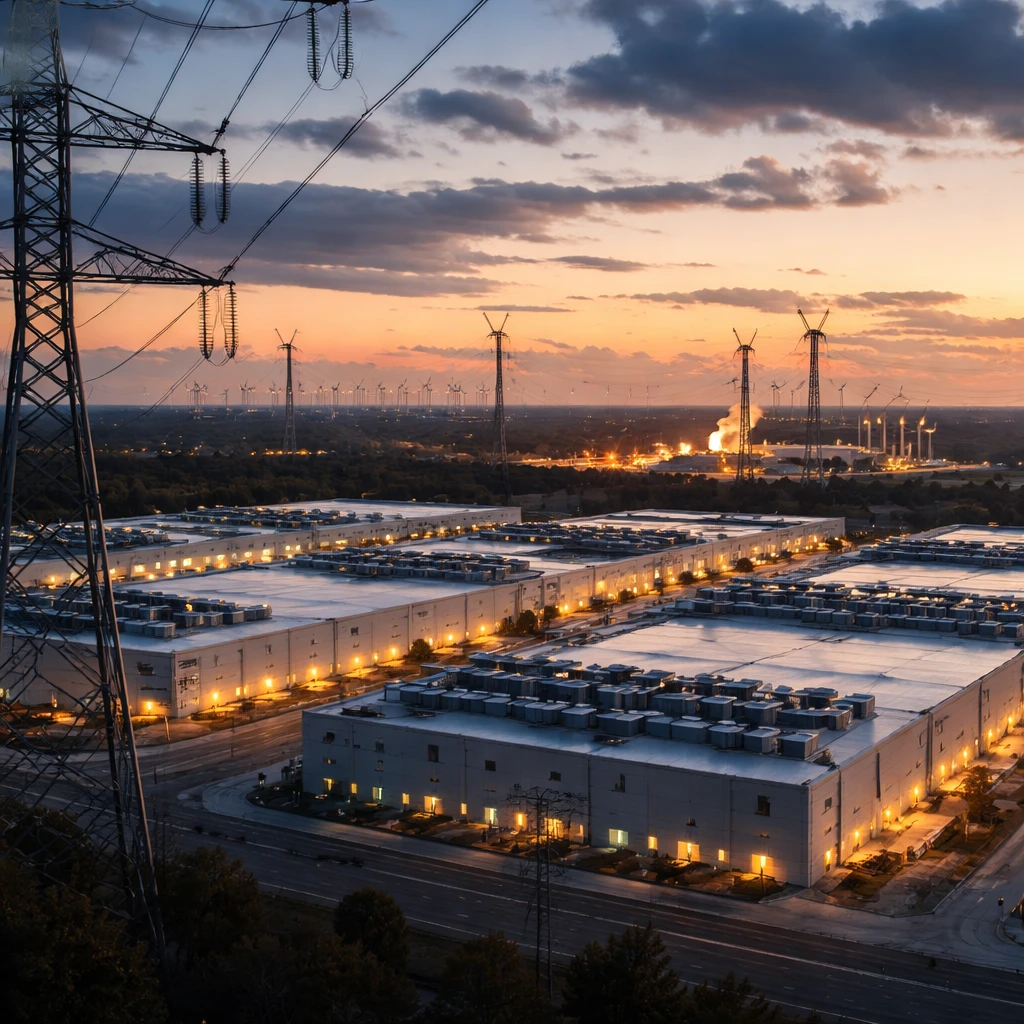
Overview
The rapid expansion of AI workloads is translating into material new electricity demand across hyperscaler campuses and gigawatt-class data centers. Analysts estimate the U.S. grid will need about +15-20% more capacity just to serve the announced data center buildout through 2030. That widening gap between existing infrastructure and expected load is creating an extended revenue tailwind for utilities and power-infrastructure firms that sit in the right places and own the necessary assets.
Why the grid is the chokepoint
Training and running large language models consume large quantities of electricity. A single LLM training run can use as much power as thousands of homes in a year. Scale that across multiple hyperscaler campuses expanding toward gigawatt-scale facilities, and the conclusion is straightforward: a grid designed for gradual demand increases will struggle to keep pace. Companies that build generation, transformers, turbines and transmission gear or that operate transmission-constrained service territories will see near-term demand for their services rise.
How the market lines up
Below is a snapshot of selected companies discussed in this theme, reflecting market caps, recent returns and valuation metrics cited by analysts:
- GE Vernova (GEV) - Market Cap $268B - 1Y Return +51.2% - YTD +51.8% - Fwd P/E 67.2x - Div Yield 0.2% - Fair Value Upside -21.9% - Analyst Upside +24.8%
- NextEra Energy (NEE) - Market Cap $181B - 1Y Return +27.0% - YTD +9.8% - Fwd P/E 21.4x - Div Yield 2.9% - Fair Value Upside -9.0% - Analyst Upside +16.7%
- American Electric Power (AEP) - Market Cap $70B - 1Y Return +16.1% - YTD +12.6% - Fwd P/E 19.9x - Div Yield 3.0% - Fair Value Upside -16.9% - Analyst Upside +13.0%
- Dominion Energy (D) - Market Cap $60B - 1Y Return +19.6% - YTD +20.5% - Fwd P/E 19.0x - Div Yield 3.9% - Fair Value Upside +1.6% - Analyst Upside +2.1%
- Entergy (ETR) - Market Cap $50B - 1Y Return +23.1% - YTD +17.8% - Fwd P/E 24.4x - Div Yield 2.4% - Fair Value Upside -12.9% - Analyst Upside +17.1%
- PG&E (PCG) - Market Cap $38B - 1Y Return +24.4% - YTD +8.8% - Fwd P/E 10.4x - Div Yield 1.1% - Fair Value Upside +18.1% - Analyst Upside +35.0%
GE Vernova - the turbine and grid hardware play
GE Vernova is positioned as the sector’s backbone supplier rather than a traditional utility. The company was trading at $1,006.76 (pre-market: $1,038.09, +3.1%) in the data cited. Over three years revenue increased from $33.2B to $38.1B, and the firm reported a return on equity of 91.5%, signaling material pricing power amid constrained supply for gas turbines and grid transformers. William Blair added GE Vernova to its conviction list, arguing the market underestimates the scale of the grid buildout and that semiconductor efficiency improvements could paradoxically boost overall electricity demand by enabling broader AI deployment. The forward P/E of 67.2x reflects elevated growth expectations; the company is framed as a momentum and earnings-growth story rather than a traditional value pick. Analysts cited an upside of +24.8%.
NextEra Energy - large renewable and load pipeline
NextEra Energy is executing a major AI-focused infrastructure commitment, including a $100B data center campus in Paducah, Kentucky, developed with Brookfield Asset Management as announced. The company reported 21GW of large-load interest in its pipeline, 12GW in advanced discussions and a renewable backlog of 35.1GW. Bernstein SocGen increased its price target to $108 and noted Q2 adjusted EPS of $1.15 beat consensus. NextEra trades at a forward P/E of 21.4x and yields 2.9% on the dividend, a set of metrics described as the cleanest large-cap risk/reward in the sector. The potential NEE-Dominion merger, expected in H2 2027, would create a very large utility if completed.
American Electric Power - Texas load exposure
AEP has put forward a $78B five-year capital plan and holds letters of agreement for up to 41GW of potential new load additions in Texas through 2030. Revenue grew from $18.98B to $21.88B, reflecting solid underlying top-line movement. Goldman Sachs downgraded AEP to Neutral, arguing that data center catalysts are largely priced in; Goldman referenced a forward earnings multiple of 19.1x versus peers at 17.8x even as the company is listed at a 19.9x forward P/E in the snapshot above. Q2 earnings were flagged as the next test for the thesis.
PG&E - the value proposition
PG&E is presented here as the value pick. Trading at $17.43 in the cited figures, the company’s forward P/E of 10.4x is materially lower than peers. Analysts show a consensus upside of +35.0% and a fair value upside of +18.1%. PG&E serves Silicon Valley and the Bay Area, major data center demand centers, and has signaled continued infrastructure spending with a recent $50M dam spillway contract. The company carries legacy discounts arising from wildfire liabilities and prior bankruptcy, but the data-center demand tail could act as a re-rating catalyst.
Entergy - Gulf Coast and Southeast optionality
Entergy, with a one-year return of +23.1% and trading at $108.06 in the referenced data, benefits from serving the Gulf Coast and Southeast — regions gaining share as data center corridors due to lower land costs and energy availability. The company shows an analyst upside of +17.1% and a forward P/E of 24.4x, representing one of the more favorable upside profiles among the pure-play utilities in the group.
Bull and bear considerations
- Bull case - AI power demand is portrayed as a multi-decade structural theme, with interconnection queues and permitting timelines measured in years, creating durable competitive advantages for incumbents. Utilities with data-center-adjacent geographies such as California, Texas and the Southeast capture meaningful optionality.
- Bear case - Much of the AI-driven opportunity is already reflected in share prices; many names trade above fair value. Interest-rate sensitivity is a genuine risk for the sector because utilities often carry sizable debt loads - a factor cited explicitly for AEP, NEE and Dominion.
- Wildcard - A U.S. ban on Chinese power inverters could accelerate domestic manufacturing and buildout timelines, a development identified as particularly favorable to a supplier like GE Vernova.