
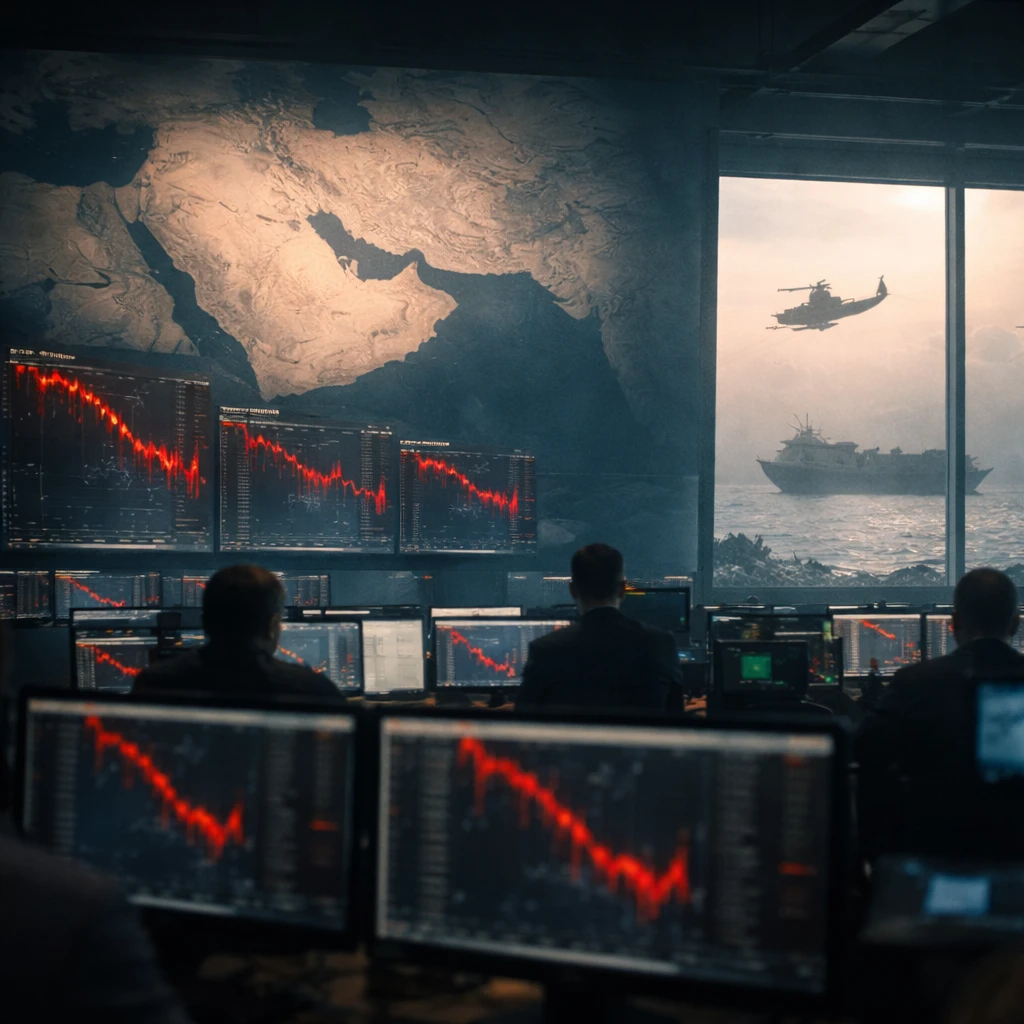
British stocks fell in early trade on Tuesday as investors digested a fragile, US-mediated pause in hostilities between Iran and Israel and a separate, unexplained military incident in the Gulf region.
At 03:23 ET (07:23 GMT) the FTSE 100 was down 0.41%, with broader European markets mixed: Germany's DAX was lower by 0.14% and France's CAC 40 was up 0.30%. Sterling strengthened modestly, trading 0.19% higher against the U.S. dollar at 1.3367.
U.S. President Donald Trump told reporters at JFK Airport on Monday that Iran and Israel "were going back and forth and now they both agreed, through me, to stop," and said the agreement could take "two or three days." Both countries, however, reserved the right to resume attacks, leaving the arrangement fragile.
The uncertainty intensified after reports that a U.S. Army Apache helicopter went down near the Strait of Hormuz on Monday. The New York Times reported the incident; the cause was described as unclear, and President Trump later confirmed both pilots were safe.
Separately, U.S. Central Command disclosed it had disabled an empty oil tanker in the Gulf of Oman after the vessel attempted to breach the U.S. naval blockade by trying to sail to an Iranian port.
Iran's military command announced a halt to operations on Monday after it had fired approximately 30 ballistic missiles at Israel since Sunday evening, framing the strikes as a "painful response" in defence of Lebanon. Israel stood down at Washington's request, though Prime Minister Benjamin Netanyahu warned that if Iran "make[s] the mistake of resuming attacks against us, we will respond with full force."
The wider diplomatic process remained tense. A senior U.S. official told Axios that the political calculations were fraught on both sides, saying, "Bibi needs the war to continue to stay politically alive in Israel, and Trump needs the war to end to stay politically alive in the U.S."
Iran's U.N. ambassador, Amir Saeid Iravani, told the Associated Press he hoped a final outcome would come "soon." At the same time, an Iranian official speaking to Al Jazeera described U.S. changes to the draft memorandum as unacceptable, saying that "without the release of frozen assets and the lifting of sanctions, no deal is possible."
On the diplomatic front, the United States reportedly dropped a push to immediately refer Iran to the U.N. Security Council as part of a compromise intended to secure European backing for a joint International Atomic Energy Agency Board of Governors resolution, according to the Wall Street Journal.
UK corporate update and market movers
Domestic corporate news also shaped market moves. Housebuilder MJ Gleeson forecast annual adjusted pretax profit below market expectations after a slowdown in construction delayed the sale of a site that represented roughly half of its forecast plot sales for the year. Bellway, another homebuilder, said customer demand had cooled after a strong start to the spring selling season, adding that higher fuel and energy costs were putting further pressure on margins.
In healthcare sector activity, GSK agreed to acquire U.S.-listed cancer drug developer Nuvalent in an all-cash transaction valued at $10.6 billion. The deal is set at $124 per share, a 40% premium to Nuvalent's last closing price, and was described as a move to strengthen GSK's lung cancer portfolio. Nuvalent shares were reported down 2.7% in early trade.
Energy major BP also featured in UK headlines, with investors saying they remained uncertain about the precise circumstances surrounding the ouster of former chair Albert Manifold in May, according to the Financial Times.
Market snapshot
- FTSE 100: -0.41% (03:23 ET / 07:23 GMT)
- DAX: -0.14%
- CAC 40: +0.30%
- GBP/USD: +0.19% to 1.3367
Selected early movers included BP (reported -1.14%), Bellway (+1.14%), GSK (-2.9%), GLEG (-4.56%), and Nuvalent (-2.7%).
The combination of a precarious ceasefire, a downed U.S. military helicopter, and naval enforcement actions in the Gulf added a note of caution across markets, while earnings guidance and M&A in the UK property and healthcare sectors provided additional domestic focal points for investors.