
Stock Markets July 28, 2026 04:36 PM

Seagate Lifts Outlook as AI Storage Demand Drives Higher Revenue and Profit Expectations

Company cites HAMR technology and cloud-driven capacity needs as it forecasts results above Street estimates

By Caleb Monroe
Share
Twitter Reddit Facebook LinkedIn
STX

Seagate Technology said it expects the coming quarter's revenue and adjusted earnings to exceed analyst estimates, citing strong demand for high-capacity hard disk drives from AI infrastructure buildouts. The Singapore-based storage supplier highlighted its use of HAMR technology to increase per-disk capacity without major new factory investments and reported a strong finish to its prior quarter, with revenue and profits topping consensus.

Seagate Lifts Outlook as AI Storage Demand Drives Higher Revenue and Profit Expectations
STX
Summarize with
ChatGPT Perplexity Claude Grok Gemini

Key Points

  • Seagate forecast first-quarter revenue of $4.1 billion, plus or minus $100 million, above the $3.75 billion analyst average, and adjusted earnings of $7.30 per share, plus or minus $0.20, versus a $5.80 analyst expectation.
  • The company is leveraging HAMR technology to increase per-drive capacity using tiny lasers, enabling more storage without building costly new manufacturing lines.
  • Surging demand from large cloud providers building AI infrastructure has allowed Seagate to raise prices for high-capacity hard disk drives, benefiting revenue and margins; sectors impacted include cloud infrastructure, data center storage, and enterprise IT hardware.

Seagate Technology on Tuesday projected quarterly revenue and adjusted earnings that topped Wall Street expectations, attributing the stronger outlook to accelerating demand for mass storage driven by the rapid expansion of AI infrastructure. The company, which is based in Singapore, said its shares - already up more than twofold year-to-date - climbed more than 8% in after-hours trading on the update.

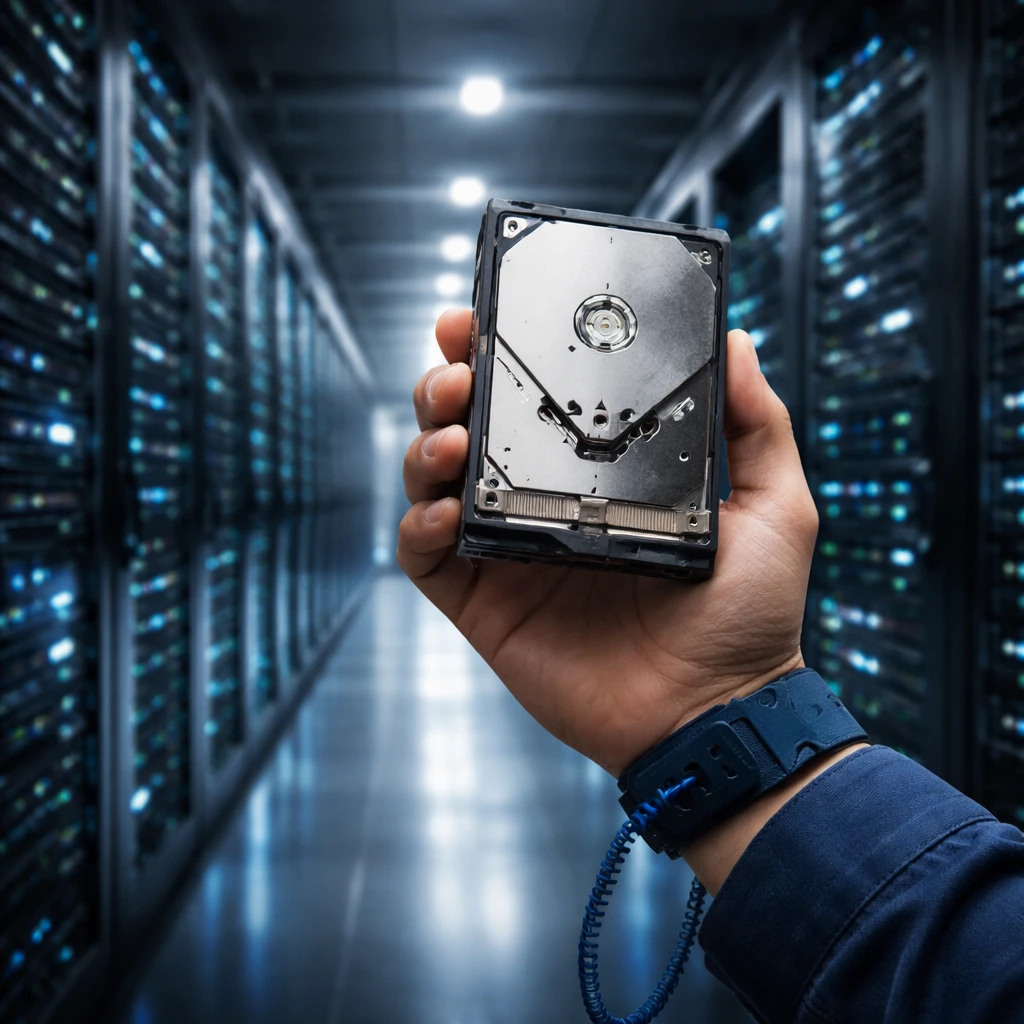
Management pointed to its heat-assisted magnetic recording, or HAMR, as a key enabler. HAMR uses tiny lasers to enable greater data density on each disk, allowing Seagate to increase storage capacity per drive without the need to construct expensive new manufacturing lines. That technical approach is central to the company's ability to supply higher-capacity drives into the AI and cloud markets.

For the first quarter, Seagate provided a revenue guide of $4.1 billion, plus or minus $100 million. That range sits above the LSEG-compiled average analyst forecast of $3.75 billion. The company also expects adjusted earnings of $7.30 per share, plus or minus $0.20, ahead of the average analyst projection of $5.80 per share.

CEO Dave Mosley framed the demand outlook succinctly: "As AI accelerates data generation and its value, we see durable long-term demand for mass capacity storage." The company said this dynamic has allowed it to raise pricing as hyperscale cloud customers expand the storage infrastructure needed to support generative AI workloads.

Seagate closed out the prior fiscal quarter with a robust performance. Fourth-quarter revenue rose 48.5% to $3.63 billion, above consensus estimates of $3.49 billion. Adjusted profit for that quarter was $5.71 per share, exceeding expectations of $5.09 per share.

The outlook and recent quarterly results highlight how an upswing in demand from large cloud operators building AI-ready storage can translate to improved top-line growth and pricing power for suppliers of high-capacity hard disk drives. Investors reacted strongly to the guidance, reflecting the market's focus on capacity supply dynamics and unit economics in the storage sector.


Note: The company provided specific revenue and earnings guidance ranges and cited product and market drivers as described above.

Risks

  • Seagate's outlook depends on continued buildout of AI and cloud storage infrastructure; if demand from those customers cools, revenue and pricing power could be affected - impacting storage suppliers and cloud infrastructure markets.
  • The company's ability to scale and realize benefits from HAMR is central to its strategy; any operational or adoption issues with the technology could constrain capacity improvements without new manufacturing investments - affecting hardware supply dynamics.
  • Market volatility is evident in the stock's sizable moves - shares more than doubled this year and rose over 8% in after-hours trading on the news - indicating investor sensitivity to guidance and sector developments which could lead to short-term price swings in technology and hardware equities.

More from Stock Markets

X Challenges Australia's Teen Account Ban, Says Proposed Enforcement Powers Clash With International Law Jul 28, 2026 Wall Street Futures Slip Ahead of Fed Decision and Big Tech Earnings as Middle East Tensions Flare Jul 28, 2026 TSMC Gradually Restarts Japan Fab After Kumamoto Quake; Inspections Underway Jul 28, 2026 Takaichi Signals Temporary Cut to Japan's Reduced Food Consumption Tax, Yomiuri Reports Jul 28, 2026 Security Council to Begin Closed-Door Straw Polls on Thursday to Narrow UN Secretary-General Field Jul 28, 2026