
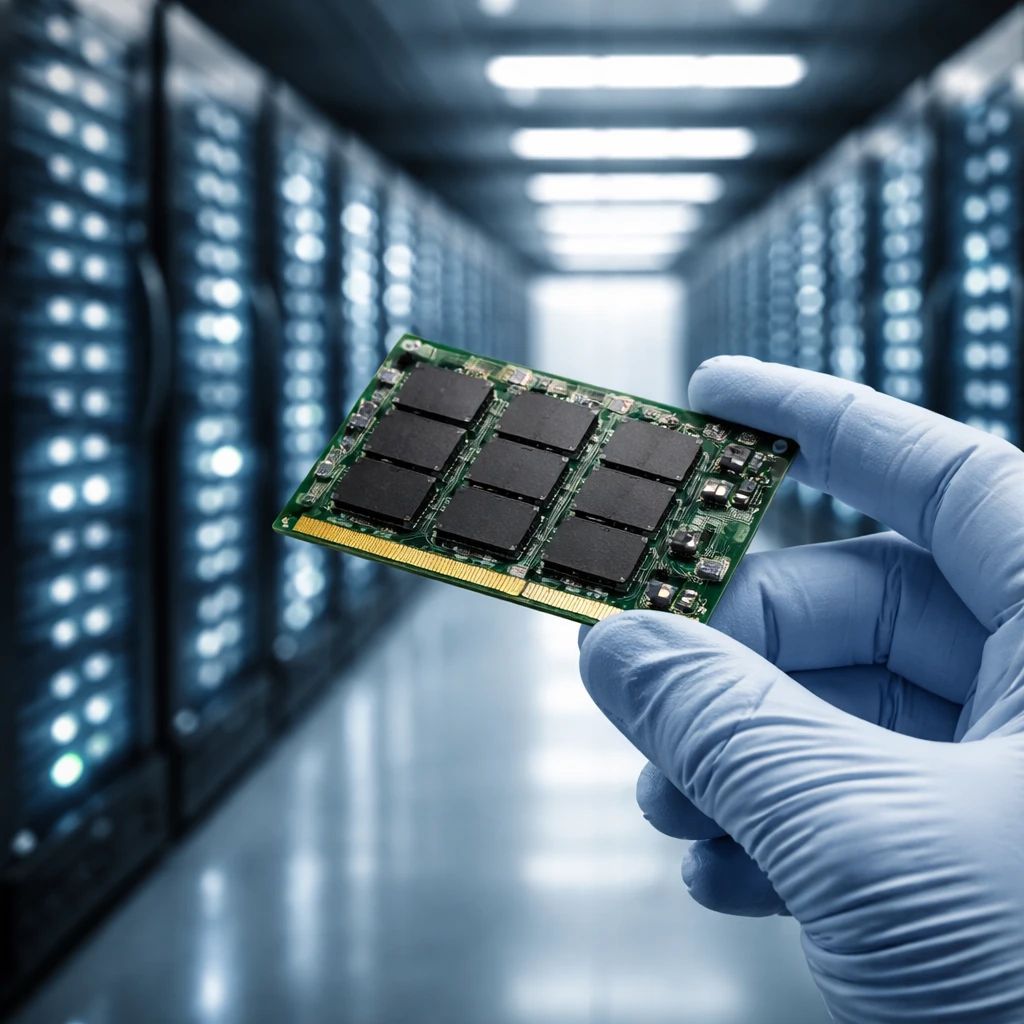
SanDisk closed out a landmark fiscal year with robust results, yet the market response was muted after near-term guidance fell short of the most optimistic expectations. The company reported FY2026 revenue of $20.25 billion, a 175% increase year over year, and posted Q4 non-GAAP earnings per share of $39.25, beating estimates by 13.5%. Despite the strong numbers, the share price fell roughly 4.0% on the day and had traded down as much as 13% in pre-market activity as Q1 FY2027 revenue guidance of $10.3 billion to $10.8 billion landed below some Street forecasts of about $12.3 billion. The episode highlights how elevated expectations can transform strong results into a relative disappointment.
Quarterly and trading snapshot
- Share price at close: $1,296.34, down 4.01% on the day.
- Q4 revenue: $8.97 billion, beating estimates by $550 million.
- Q4 non-GAAP gross margin: 84.6%.
- Q4 EPS: $39.25 versus consensus of $34.59.
The company has now reported four consecutive beats on the bottom line and revenue, a streak that included outsized upside in the prior three quarters. Those results and the price action around them were:
- FY2026 Q4 (Aug 5): EPS beat +13.5%, revenue beat +$550 million, followed by price moves ranging from -6.6% to -13% in pre-market versus intraday swings.
- FY2026 Q3 (Apr 30): EPS beat +59.7%, revenue beat +$1.22 billion, with a strong positive price reaction of +11.5%.
- FY2026 Q2 (Jan 29): EPS beat +77.7%, revenue beat +$360 million, price reaction +9.2%.
- FY2025 Q4 (Nov 6): EPS beat +37.1%, revenue beat +$160 million, price reaction +10.6%.
Questions the quarter resolved
The results addressed several of the market's pressing questions about margin durability, demand mix, and the firm's new commercial models.
- Margins above 80%? The company delivered a non-GAAP gross margin of 84.6% in Q4, up from 78.4% in Q3, and issued Q1 guidance calling for margins of 83% to 85%. That signals margins are structurally elevated rather than a single-quarter spike. Market commentary highlighted that new business models are helping keep net business margins above 80% as those agreements ramp.
- Is AI and data center demand durable? Data center revenue increased 437% year over year for full FY2026 to $5.15 billion. The data center segment has expanded to represent roughly half of the total NAND market from about 30% previously. The NAND market itself is expected to exceed $300 billion in 2026 and approach $500 billion in 2027, metrics that underpin demand-side optimism.
- Are New Business Models (NBMs) taking hold? SanDisk secured 10 NBMs that together cover $93.9 billion in long-term revenue guarantees, supported by $16.5 billion in customer financial guarantees. Management said NBMs will represent more than 50% of bits in FY2027 and about two-thirds in FY2028, indicating a meaningful shift from spot-market selling toward contracted, premium-priced supply.
- What drove recent revenue growth? Management attributed two-thirds of sequential Q4 growth to higher pricing and one-third to volume expansion, underscoring that pricing, not just unit growth, has driven recent top-line gains.
- Capital returns and cash flow strength The board authorized an additional $14 billion for share repurchases, leaving approximately $15.5 billion in remaining buyback capacity. Q4 free cash flow was $5.0 billion, representing a 56% margin on that quarter's performance.
Open questions and risks that remain
Even with many items clarified, the company faces several specific uncertainties that investors will watch closely.
- Are NAND contract prices at their peak? One of the largest market concerns is whether contract prices for memory are peaking. A July 21 note from Morgan Stanley warned that memory contract prices may top out in Q4 2026; that outlook contributed to an 8.6% drop in SanDisk shares prior to the earnings release. Management has also flagged pressure on end-market shipments, with CEO commentary projecting mid-teens declines in PC and smartphone unit shipments this calendar year, a datapoint that feeds the pricing concern.
- How transformative will High Bandwidth Flash (HBF) prove? SanDisk and SK Hynix jointly released the first HBF standard specifications this week. HBF is positioned between HBM and conventional SSDs and could scale to a multibillion-dollar market. Customer interest was described as significant, but the company did not provide a timeline for revenue contribution, leaving the commercial impact uncertain for now.
- NBM execution and concentration risk The 10 NBMs represent large commitments totaling $93.9 billion, with $16.5 billion in customer guarantees. While these deals provide visibility, they also create exposure to hyperscaler capital expenditure cycles; a pullback by large cloud customers could test execution and revenue realization assumptions.
Upcoming catalysts to monitor
- Analyst Day - next week: Investors expect detail on the HBF roadmap and capital allocation, an event analysts flagged as critical for re-rating the shares.
- Q1 FY2027 earnings - around November 2026: The company will report whether it can exceed the current Q1 guidance range of $10.3 billion to $10.8 billion.
- HBF commercial ramp - in FY2027: The first revenue from the SK Hynix consortium is anticipated sometime in FY2027.
- BiCS10 production - FY2027: Follow-on to BiCS8 majority production, expected to deliver cost and density improvements.
- NAND pricing data - monthly: Ongoing spot and contract price monitoring will provide real-time checks on the Morgan Stanley concern.
- NBM expansion - ongoing: Additional customer signings beyond the initial 10 agreements would further validate the new model.
How analysts are positioning
Wall Street views diverge on whether the current environment represents a peak in pricing or the start of a longer-term re-rating driven by AI storage demand. Key broker calls include:
- Goldman Sachs reiterated a Buy rating with a $2,200 price target, interpreting the pullback as an expectations reset rather than a fundamental failure.
- Evercore ISI kept an Outperform rating while trimming its price target to $2,800, still implying roughly 116% upside and pointing to the upcoming analyst day as the likely re-rating catalyst.
- RBC Capital maintained a Sector Perform stance and raised its price target to $1,300, noting the company beat estimates but flagging that the positive narrative must be matched by execution.
A fair value estimate around $1,440 implies about 11% upside from today's $1,296 share price, underscoring the split between near-term caution and longer-term upside scenarios.
Bottom line
SanDisk delivered a record fiscal year with elevated margins, rapid data center revenue growth, and sizable long-term contract commitments. Yet guidance that fell short of the most bullish forecasts, ongoing questions about NAND pricing, and the yet-to-be-proven commercial timeline for HBF keep investors divided. The upcoming analyst day and early FY2027 milestones will be critical for determining whether the market views the pullback as a pause in a broader re-rating or as a sign that cyclical risks are resurfacing.