
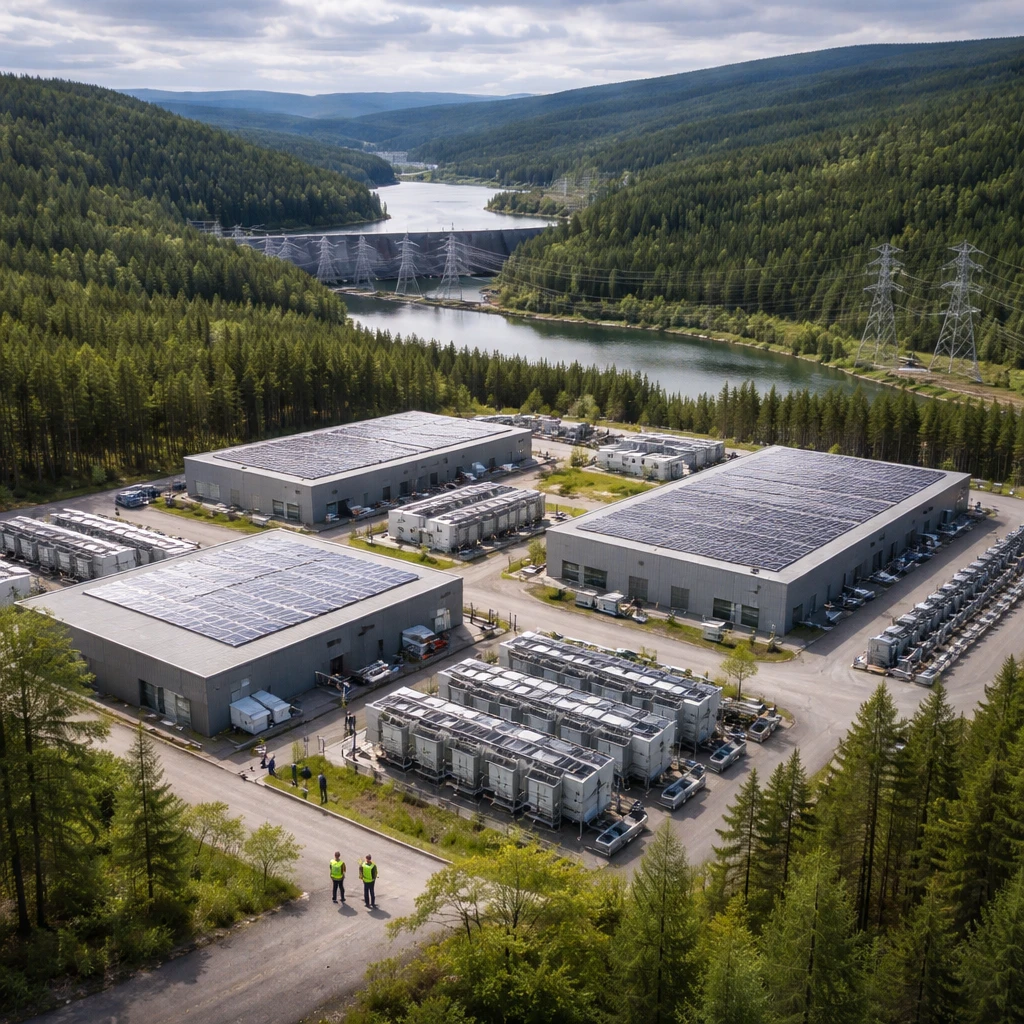
A substantial infrastructure pact is set to bring large-scale artificial intelligence compute to a newly announced data center in Tydal, Norway, through a layered arrangement covering real estate, hardware, and cloud services. The deal ties cloud infrastructure startup Volta to data center operator Bitdeer and has already affected market sentiment for the operator.
Corporate filings left the end-user unnamed, but Bloomberg has reported that Anthropic - the developer of the Claude model - is the undisclosed "leading AI lab" that secured computing capacity under the agreement. Bloomberg's reporting indicates that Anthropic has reached a $10 billion, six-year agreement with Volta Infra Holdings to obtain the compute resources necessary to meet rising demand for its offerings.
Bitdeer will manage the physical site in Tydal. In a press release, Bitdeer described a 16-year colocation lease with Volta that carries roughly $4.7 billion in initial contracted revenue. That agreement contains an eight-year extension option that could raise the total potential contract value to about $8 billion across a 24-year horizon.
The arrangement commits to operating the facility on 100% renewable hydropower. Financial backing for the obligations under the contract is expected to be supported by a $1.3 billion credit backstop that J.P. Morgan and another major global financial institution are anticipated to arrange.
Once complete, the Tydal site is planned to be among Norway's largest and most efficient facilities dedicated to AI workloads. The installation will provide 133 megawatts of gross capacity to support a 121-megawatt IT load tailored for the AI lab. Hardware supply for the infrastructure will come from Dell Technologies and will include Nvidia's Vera Rubin chips.
The construction and deployment are to be executed in two equal phases, with target handover dates of December 31, 2026, and March 31, 2027. Market response to the announcement was immediate - shares of Bitdeer rose 14% following the news.
For stakeholders across cloud services, data center operations, and chip providers, the deal represents a coordinated approach to meeting concentrated AI compute demand through long-term real estate commitments, vendor hardware agreements, and dedicated power sourcing. The project also highlights the use of sizeable credit facilities to underwrite capital-intensive infrastructure builds.