
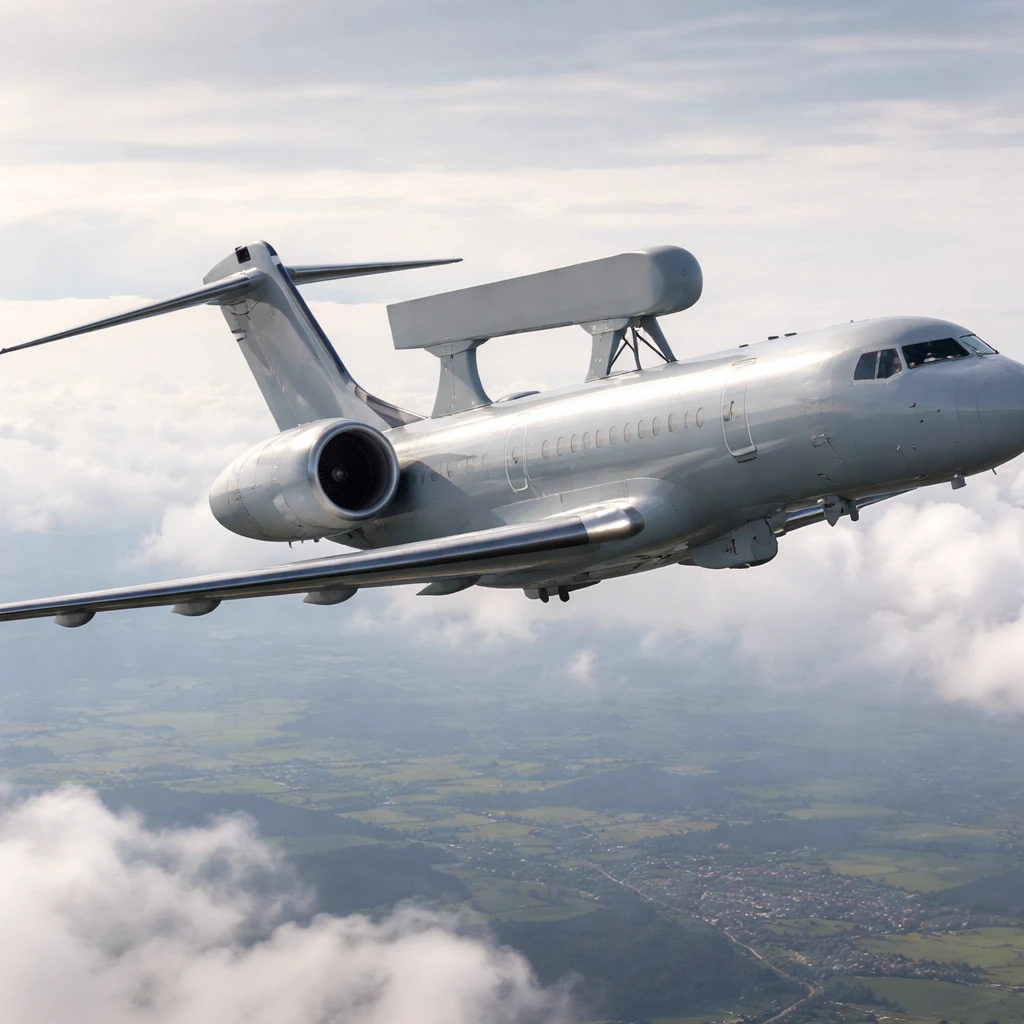
NATO has unveiled a plan to procure up to 10 Saab GlobalEye surveillance aircraft in a purchase program valued at about $4.5 billion to replace its older Airborne Warning and Control System (AWACS) fleet. The selection favors the Swedish GlobalEye over a U.S. alternative offered by Boeing.
Secretary-General Mark Rutte outlined the rationale for switching from the Cold War-era AWACS platforms, which are widely recognised for their large rotating radomes, to a newer concept built around smaller business jets. He said the GlobalEye architecture is intended to better address contemporary threats, such as massed drone attacks, and to preserve NATO’s surveillance and early warning capability well into the future.
"This will ensure we keep NATO’s... surveillance and early warning capability strong and credible for decades to come," Rutte said at a NATO summit event.
Rutte also emphasised the international nature of the GlobalEye programme, noting the aircraft are mounted on Bombardier Global 6500 business jets and that the programme involves European and Canadian industry partners along with significant contributions from U.S. suppliers. He framed the project as a transatlantic effort rather than a single-nation procurement.
The NATO announcement comes amid ongoing political pressure from U.S. leaders for allied countries to increase defence spending and to prioritise purchases of American-made equipment. That context has included repeated criticism by the U.S. president of European reliance on America for security and calls for more defence procurement from U.S. manufacturers.
The Saab GlobalEye competes directly with Boeing’s E-7 Wedgetail, an early warning and command-and-control aircraft derived from the 737 airframe and designed to perform oversight and battle-management functions.
NATO characterised the GlobalEye as a "mission-proven" system but did not provide further detail on that assessment in the announcement. With the provisional selection now public, formal negotiations between NATO and Saab have begun.
Saab's chief executive, Micael Johansson, said the programme could be valued at up to $4.5 billion and told reporters that, if a contract were signed soon, Saab could begin delivering aircraft in 2030. He said the final contract price had not yet been settled but estimated a per-aircraft range of roughly $400 million to $450 million.
The ultimate number of aircraft NATO will procure remained unclear in public statements, in part because planners were still debating whether to order a pricier variant equipped for mid-air refuelling. A person familiar with the discussions indicated the initial batch of GlobalEye aircraft would not be delivered with aerial refuelling capability, but that capability was expected to be integrated in a later upgrade.
By contrast, the current E-3 AWACS fleet in NATO service can be refuelled in flight, a feature that has been useful during missions close to Ukraine. NATO did not say whether the initial GlobalEye configuration would alter operational patterns or deployment ranges in the near term.
Program status
- NATO has announced a provisional selection of Saab’s GlobalEye to replace E-3 AWACS aircraft.
- Formal negotiations between NATO and Saab are now under way; deliveries were described as possible from 2030 if a deal is concluded soon.
- Saab CEO Micael Johansson estimated a total programme value of up to $4.5 billion and a per-aircraft price in the $400 million to $450 million range, subject to final agreement.
Context
The decision highlights a shift toward smaller business-jet based airborne surveillance platforms and reflects trade-offs between baseline cost, capability options such as aerial refuelling, and industrial participation by multiple NATO-member countries.