
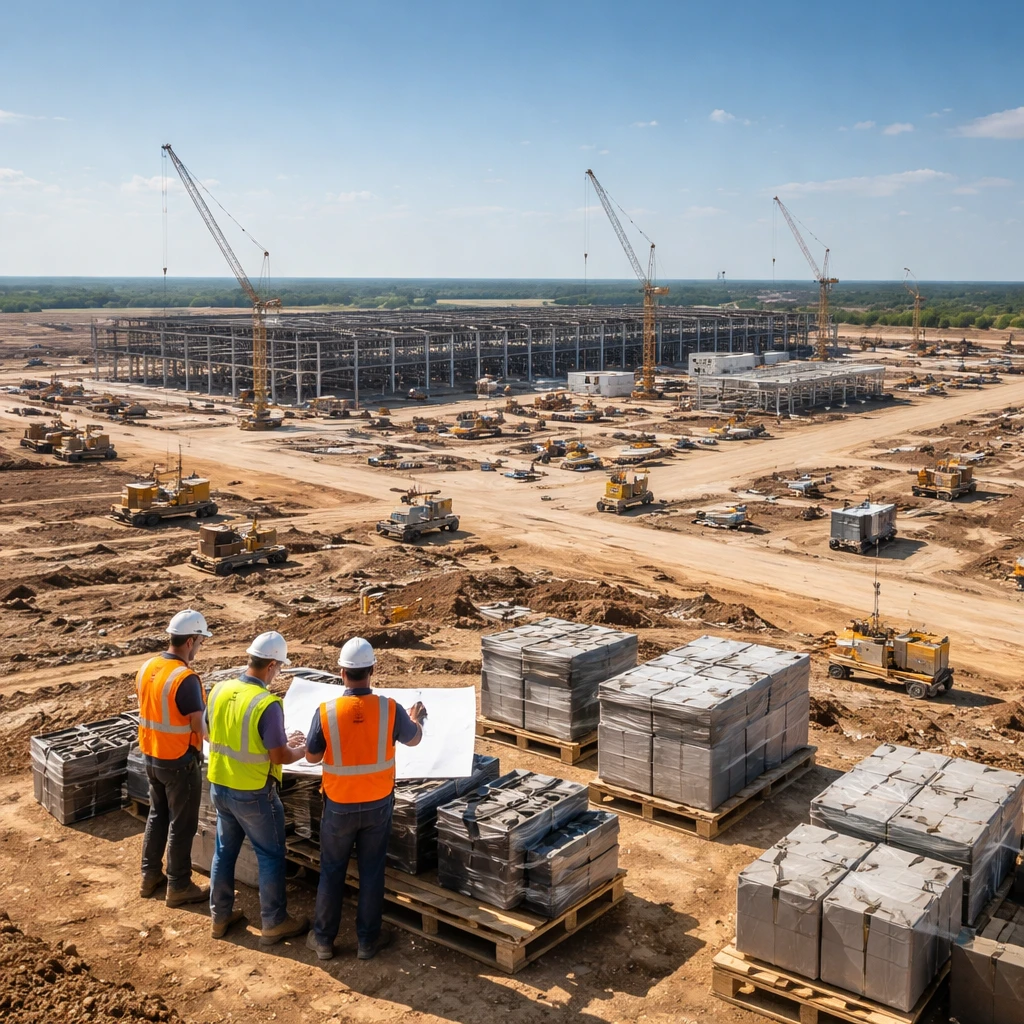
Elon Musk's proposal to assemble one of the world's largest semiconductor manufacturing operations took a concrete step forward as Texas Governor Greg Abbott joined representatives of SpaceX and Tesla to confirm the site for Terafab. The plant, described by involved parties as a vertically integrated chip manufacturing complex, will be constructed in Grimes County, Texas.
Although Musk first suggested the idea earlier in the year, the announcement formalizes both the location and the capital commitment for the project's opening phase. The initial construction is budgeted at $16.8 billion. Company statements indicate that the venture is organized as a formal joint venture between Tesla, identified as a publicly traded company (TSLA), and SpaceX, noted as newly public (SPCX).
Under the venture structure, Tesla and SpaceX are combining resources to underwrite the substantial upfront costs required to build and equip Terafab. The two firms expect the plant's output to be allocated between terrestrial robotics applications and space-based data center needs, with manufacturing support cited from Intel. The companies say they will split the facility's production to serve Tesla's and SpaceX's respective hardware demands.
State support was outlined alongside the corporate announcement. Texas has pledged a $30 million grant from the Texas Enterprise Fund and has approved tax abatements for the site. Project proponents have described the planned footprint as approximately 100 million square feet, with an expectation of roughly 3,000 new, high-paying jobs. The labor pool is anticipated to draw heavily from Grimes and neighboring Brazos counties.
Officials involved in the announcement emphasized the internal computing requirements driving the effort. Tesla and SpaceX estimate they will require in excess of 1 terawatt of computing power each year to operate systems such as Optimus robots, Cybercabs, and orbital data networks. The parties stated that current global chip supply does not meet that scale of demand, motivating a strategy to consolidate logic, memory, and packaging under a single, vertically integrated manufacturing roof in Texas.
Project proponents have suggested the first-phase capital commitment could be only the start. Analysts mentioned in the announcement estimate the total price tag across all phases could eventually exceed $119 billion. Beyond the headline figures, the announcement focused on the combination of in-house production, a large-scale campus, and state incentives as the foundation for the initiative.
Summary
Terafab will be built in Grimes County, Texas, as a joint venture between Tesla (TSLA) and newly public SpaceX (SPCX). The first construction phase carries a $16.8 billion capital cost. Texas is providing a $30 million grant and has approved tax abatements. The facility is projected to cover 100 million square feet and create approximately 3,000 high-paying jobs drawn from Grimes and Brazos counties. Tesla and SpaceX say they need more than 1 terawatt of annual computing capacity for robotics and orbital networks, a need they say current global supply cannot meet, leading them to centralize logic, memory, and packaging.
Key points
- First-phase capital expenditure is $16.8 billion, with potential total development costs possibly exceeding $119 billion - impacts the capital-intensive semiconductor manufacturing sector and large-scale industrial construction.
- Terafab is organized as a formal joint venture between Tesla (TSLA) and newly public SpaceX (SPCX), with Intel providing manufacturing support - relevant to corporate capital allocation and supply chain integration strategies.
- State incentives include a $30 million Texas Enterprise Fund grant and tax abatements; the project is expected to create about 3,000 high-paying jobs drawn from Grimes and Brazos counties - affecting local labor markets, regional economic development, and municipal planning.
Risks and uncertainties
- Scale of capital commitment - the first phase is $16.8 billion, with the project potentially growing to more than $119 billion in total costs; large, staged investments create financing and execution risk for the companies and their partners.
- Supply-demand mismatch cited by the companies - Tesla and SpaceX say current global supply cannot meet their projected need for over 1 terawatt of computing power annually, which is the rationale for vertical integration; meeting that internal demand depends on successful integration of logic, memory, and packaging under one facility.
- Local workforce reliance - the plan depends on drawing skilled labor from Grimes and Brazos counties to fill roughly 3,000 high-paying positions; labor availability and local training initiatives will be material to operational timelines.