
(Corrects length of prison sentences in paragraph 39 to between 14-16 years)
FUNDO PIDENCO, Chile, July 21 - After years of occupations, sabotage and violent encounters with security forces, militant sectors of the Mapuche movement are confronting one of the most intense periods of legal and security pressure in decades. A combination of harsh sentencing, expanded militarization and a national promise to restore order has begun to reshape both the tactics and the morale of communities long engaged in disputes over ancestral land.
Field visits to Fundo Pidenco and several other emblematic Mapuche strongholds, many of which rarely receive outsiders, reveal a movement in transition. Some groups remain committed to direct action and occupation; others - and increasing numbers of younger members - are channeling resistance through universities, the courts and campaigns to protect water, forests and medicinal plants.
Historical context and land dispossession
The Mapuche constitute Chile’s largest Indigenous group, accounting for nearly 9% of the national population - approximately 1.6 million people according to the most recent census figures. They are unique among Indigenous nations in the Americas for having negotiated an independence treaty with Spain after sustained resistance in earlier centuries. Much of their territory remained outside centralized Chilean control until the late 19th century.
Land loss accelerated dramatically during the 1973-1990 Augusto Pinochet dictatorship when large tracts were transferred to forestry firms. Reforms that had benefited Mapuche communities under socialist President Salvador Allende were largely rolled back. Between 1974 and 1994, roughly 1.7 million hectares were converted to eucalyptus and pine plantations, and a significant share of that land was taken from Mapuche areas.
Over recent decades, responses within Mapuche communities have varied. Some groups have sought to recover territory through state-backed land purchases. Others, frustrated by what they view as continued dispossession, have employed occupations and sabotage to reclaim land and disrupt industrial forestry operations.
Escalation in tactics and targets
Activists have targeted corporate forestry assets, setting fire to vehicles, excavators, logging towers, camps, warehouses and company offices. Attacks have also reached churches, cabins, crops and tourist facilities connected to large landowners. Though activists and some organizations maintain they avoid targeting people, clashes involving security forces, landholders and militants have resulted in nearly 40 deaths over the past 30 years.
The Coordinadora Arauco-Malleco, or CAM, is the most prominent militant organization cited in these confrontations. CAM has advocated for the recovery of territory "meter by meter" and for the establishment of Wallmapu, a proposed independent Mapuche state with its own government, currency and foreign policy. CAM members contend their actions are directed at company property rather than civilians, but episodes of violence have nevertheless drawn sustained law enforcement responses.
State of emergency and political responses
Large portions of Chile’s south have been under a state of emergency since 2022. The left-leaning former president at the time pledged dialogue as a pathway to resolution, but a spike in arson attacks and shootings - and an instance in which a security minister was forced to withdraw from the region after being fired upon - led to the imposition of temporary emergency measures that have been repeatedly extended.
Since taking office, the new far-right president has prioritized a tougher security approach, pledging to restore order in the south and to crack down on violence associated with the conflict. That posture has translated into intensified police operations, expanded troop deployments and the use of armored vehicles to patrol contested areas.
Temucuicui and a high-profile round of arrests
In Temucuicui, long regarded as a focal point of resistance, state security forces carried out large-scale raids in May that resulted in the detention of five activists, including Jorge Huenchullan, a community spokesperson or werken. Jorge’s brother, Jaime Huenchullan, said the growing militarization was fueling resentment within the community.
"The militarization here has been going on for a little over four years and it’s intensifying every day," Jaime said, alleging that vehicles are routinely stopped and that children are sometimes questioned while traveling to and from school. "The children convince themselves more and more at an early age that the Mapuche people have to fight, they have to defend themselves," he added.
Authorities have defended prosecutions as necessary to curb violence. But Mapuche leaders characterize tougher prosecutions and longer prison sentences as political persecution. Among those most widely cited by community leaders is CAM founder Hector Llaitul, who is serving a 23-year sentence for a range of offenses that included attacks on authorities, timber theft and violent land occupation. Fifteen years of that sentence reportedly corresponded to a conviction for incitement to violence.
In written responses provided through his lawyer, Llaitul described the prosecutions as part of a broader effort to suppress Mapuche resistance. "The criminalization becomes another tool of political persecution, taking on punitive and punishing overtones rather than re-education, in order to subdue and exterminate resistance," he said.
Government officials have argued that prosecutions represent a meaningful step toward reducing violence in Chile’s south. Questions about the crackdown and allegations of political persecution were redirected to the interior ministry, which did not reply to repeated requests for comment.
Fundo Pidenco - an occupied estate in transition
Indigenous groups estimate that Mapuche communities occupy roughly 150,000 hectares across the south, while a local business association calculated that about 12,700 hectares are effectively off limits to police and state authorities. Approximately 2,500 of those hectares are in Fundo Pidenco, a hilly property owned by forestry company Arauco that has been occupied by Mapuche activists since 2016.
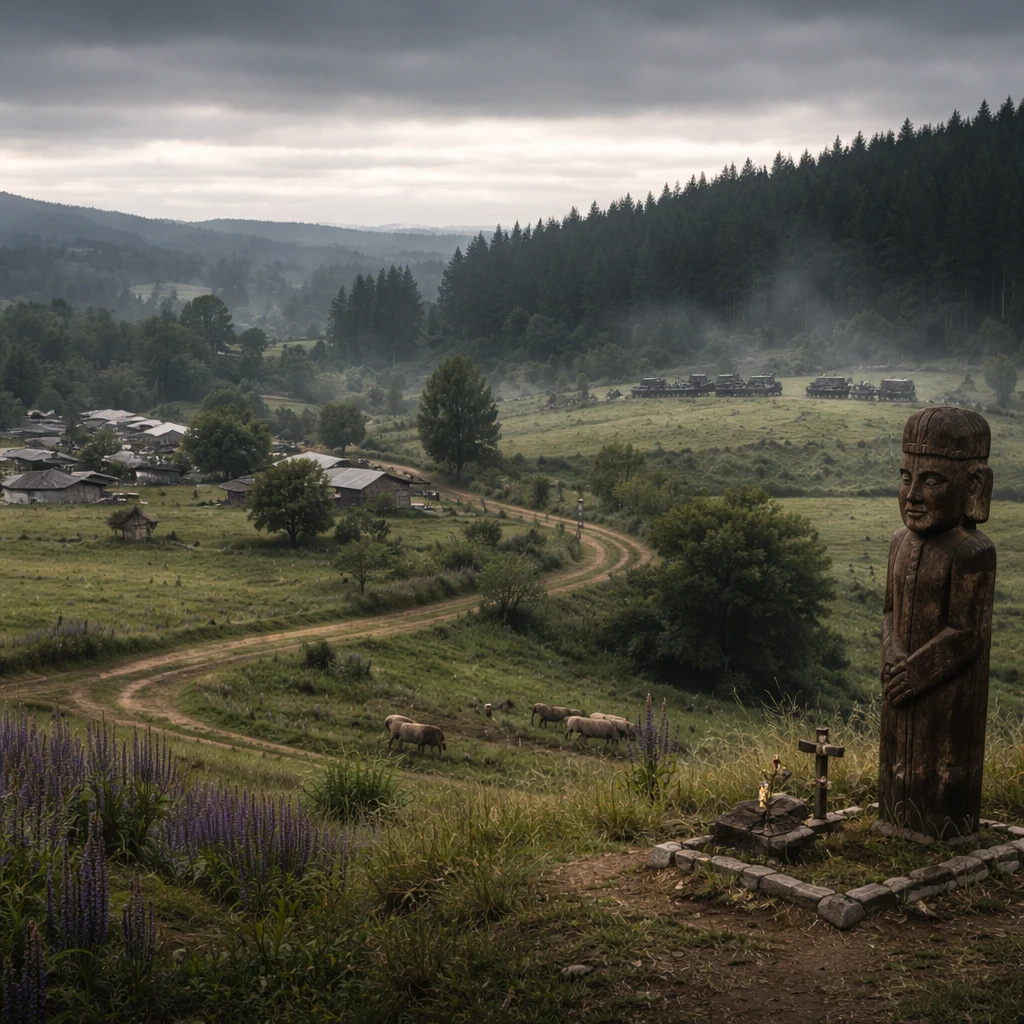
Nearly a decade after the occupation began, Fundo Pidenco presents itself as a place in transition - a patchwork of winding dirt roads cutting through hills, wooden homes, grazing livestock and fields of green lupin. For residents, the occupation has become a way of returning the land to life.
"This used to be a desert, but with everything we’ve done here we’ve been healing the earth, rebuilding and bringing it back to life," said Orfelina Alcaman, a community spokesperson. Alcaman, 44, recounted stories from her grandparents about living and working on the land before it became part of industrial forestry holdings.
She said she, other families and CAM entered Fundo Pidenco in 2016 with the intention of remaining there. "Since the first day we set foot here it was with the intention of staying, not leaving," she said. "We don’t want anything gifted to us. What we want is land to live as Mapuches, to grow as Mapuches, develop our own economy and live freely and with dignity."
Alcaman rejected labels that characterize Mapuche land occupations as terrorism. "I’ve never killed anyone, I’ve never kidnapped anyone, I’ve never injured anyone," she said. "But if by being Mapuche and occupying this land that belonged to my ancestors makes me a terrorist, then I’m a terrorist." She pointed to a carved wooden totem known as a chemamull standing on a hilltop burial site that marks the grave of Pablo Marchant, a CAM activist killed in a 2021 clash with police who has since become a symbol of resistance.
"I lie here and I’ll die here," Alcaman said, adding that she wants to be buried next to Marchant. "We’re not going to surrender. They can come with hundreds or thousands of police, soldiers, whatever. They’ll have to take us out dead."
Arauco, which owns the property, declined to comment. Corma, the association of Chilean forestry companies, also declined to comment for the reporting.
Judicial outcomes and a family’s ordeal
In late June, days after We Tripantu - the Mapuche New Year tied to the Southern Hemisphere winter solstice - dozens of activists and leaders gathered outside a courthouse in Temuco. The city is also where the current president launched his campaign.
In court, the son of imprisoned activist Hector Llaitul, Pelentaro, faced prosecution connected to an attack on a forestry plantation that left trucks and an excavator burned. He and four other young Mapuche men were ultimately sentenced to terms lasting between 14 and 16 years in prison. Family members and supporters assembled outside the courthouse, standing silently around a fire in the winter cold.
After the hearing, Hector Llaitul’s eldest son, Ernesto, addressed those gathered. "We don’t have any reason to hang our heads or be ashamed of the situation we’re in," he said. "It’s the life we chose. The life of struggle." He acknowledged the pain of seeing another family member jailed after witnessing his father receive a sentence of more than two decades.
"We knew this process was going to be difficult," Ernesto added. "Maybe they’ve won a certain battle, but they haven’t won the war." The crowd periodically responded with chants of "Marichiweu," a slogan commonly translated as "Ten times we will win."
Ernesto warned against abandoning those imprisoned. "We don’t have the luxury of giving up," he said. "The worst thing we can do for those who are imprisoned is abandon the struggle that put them there."
Generational shifts: law, education and environmental defense
Behind the courtroom scenes, younger Mapuche are increasingly pursuing different routes to defend their communities. Standing nearby during the courthouse gathering was Weftui, 20, the youngest son of Hector Llaitul. He is a law student at the University of Chile, one of the country’s principal universities.
Unlike earlier generations of weichafes, or warriors, who emphasized direct confrontation, Weftui is channeling his efforts into legal advocacy. He said he was motivated by a desire to assist Mapuche prisoners and to support his family. "I didn’t start school 100% convinced I wanted to study law, but I’ve been motivated by a dream of being able to help Mapuche prisoners. My family too, if I can," he said.
Today, he works with communities to explain Indigenous land rights and legal protections. His path mirrors broader trends within Mapuche communities as younger members balance ancestral tradition, higher education and new forms of activism.
Spiritual leaders, ecological defense and contested energy projects
Elsewhere, the nature of resistance is also shifting. In the Alto Biobio highlands, 20-year-old Millaray Suarez is a young machi - a spiritual healer who uses traditional plants gathered across southern Chile. Millaray represents a cohort less focused on reclaiming forestry holdings and more concerned with protecting rivers, forests and lahuen - medicinal plants - as international firms explore wind, hydroelectric and green hydrogen developments in the region.
Remaining in her community to embrace the role of machi has meant taking on responsibilities that previous generations have struggled to pass on. Local leaders say both machis and the medicines they use have become scarcer due to land loss.
Millaray’s father, Lonko Segundo Suarez, devoted years to fighting for territory after communities were pushed onto rocky, less productive land in the Andes. The family’s current focus is opposition to the Rucalhue hydroelectric dam project being built on the Biobio River by China’s Three Gorges company. They contend the project threatens old-growth forest areas where rare medicinal plants still grow.
"The dam will flood the area, and that lahuen will disappear," Suarez said. "As machis, we don’t just make remedies and heal. We also have a duty to protect the little that we have left. We have to protect this earth."
Local machis sought a legal injunction to stop the project, but the injunction was rejected. Despite the setback, Millaray remains steadfast. While many young Mapuche migrate to cities seeking economic opportunities, she articulated a different ethic.
"Our ancestors fought hard, many were killed, and now it is up to us, the youth," she said. "Just as they gave their lives to defend this land, we are also going to defend the little we have left."
Outlook
Across the south, the interaction of intensified law enforcement, extended sentences and a political impetus for tougher security measures is prompting tactical adaptations within Mapuche communities. Some activists maintain occupations and direct action as primary tools. Others, and particularly younger participants, are investing in legal strategies, university education and environmental campaigns as means of protecting land and community life.
For state authorities, private companies and outside developers, these shifts complicate an already entrenched conflict. The convergence of land claims, commercial forestry interests and proposed energy projects is producing a contested landscape where legal, political and ecological claims intersect with security considerations and judicial outcomes.
How these tensions evolve will depend in part on judicial processes, the persistence of occupations and the degree to which younger Mapuche pursue legal channels to secure rights and protect natural resources. For residents of Fundo Pidenco and other occupied territories, the stakes remain immediate: land use, cultural survival, community cohesion and the future of traditional practices such as the work of machis.
Key points
- Heightened prosecutions and longer prison sentences, along with increased militarization, are pressuring militant Mapuche groups and shifting tactics across communities.
- Younger Mapuche are increasingly pursuing legal education, court advocacy and environmental campaigns as alternative strategies to direct confrontation.
- Conflicts over forestry holdings and new energy projects, including a contested hydroelectric dam, place forestry and energy sectors at the center of territorial disputes.
Risks and uncertainties
- Escalating security responses and lengthy prison terms risk deepening resentment and provoking further unrest in affected regions - a development with implications for forestry operations and regional stability.
- Legal defeats or court rejections, such as the dismissed injunction against the hydroelectric project, may accelerate environmental and cultural loss, particularly for healers and communities reliant on traditional medicinal plants.
- Ongoing occupation of private land and areas viewed as off limits to state authorities create uncertainty for companies, investors and developers engaged in forestry, hydroelectric and emerging green energy projects.
Disclosure