
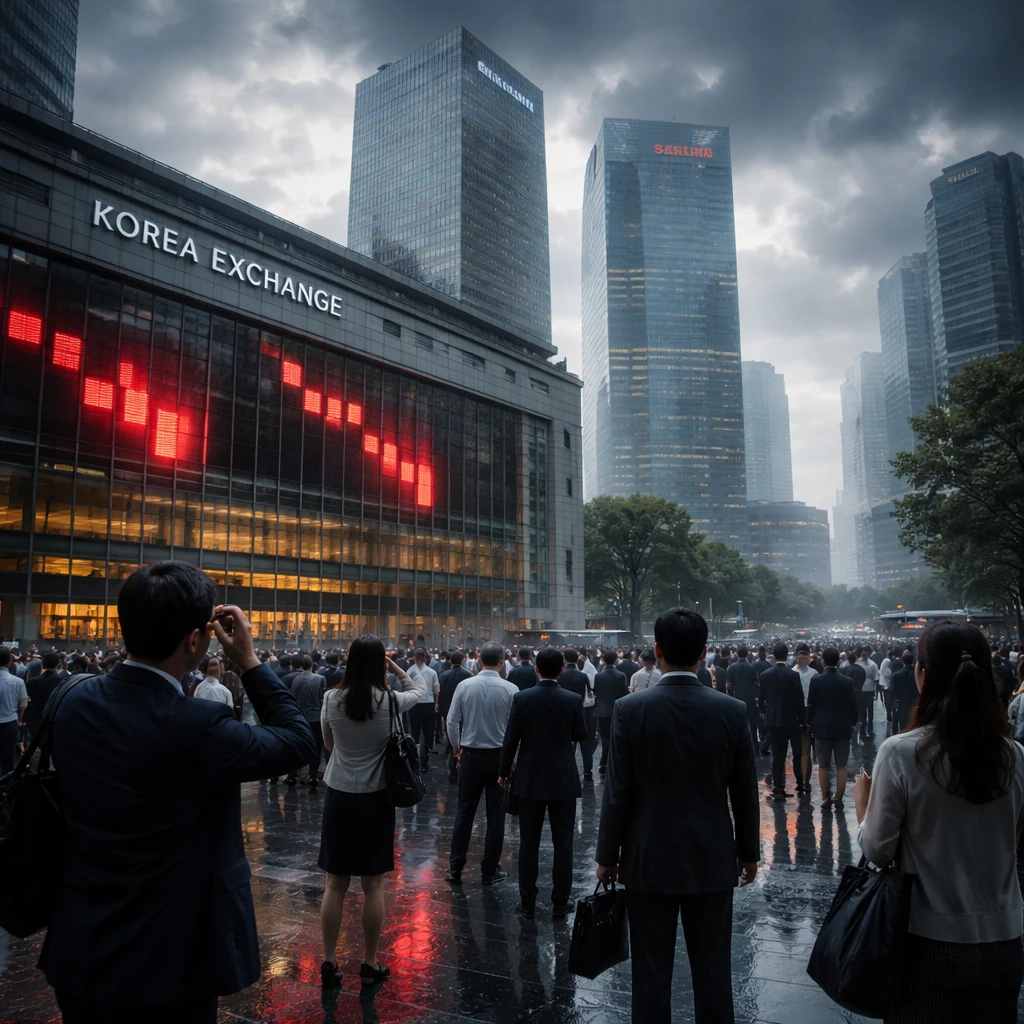
South Korea’s KOSPI tumbled on Friday amid broad selling in technology and semiconductor stocks, with declines steep enough to trigger an exchange-imposed trading halt. The drop exceeded 8%, prompting the Korea Exchange to suspend trading for 20 minutes under its circuit-breaker rules.
This pause was the fifth occasion this year that trading on the exchange has been halted, and it represented the third suspension within the same week. The KOSPI was on track to finish the week down nearly 10% after investors moved to lock in gains in high-flying chip names.
Sentiment was hit by two developments that weighed on tech-sector appetite. First, Apple Inc. shares fell roughly 6% after the company increased prices on several products, a move linked to higher memory chip costs. Second, a report indicated that OpenAI is considering delaying its anticipated initial public offering until 2027, a prospect that intensified doubts surrounding the broader artificial intelligence investment theme.
The weakest performers on the KOSPI were the country’s chipmaking giants. Samsung Electronics and SK Hynix each slid by more than 9% on Friday. Local media coverage noted that Samsung is planning to announce an investment exceeding 1,000 trillion won - the equivalent of $646 billion - aimed at chipmaking infrastructure over the next decade, a development that accompanied the companies’ share-price declines.
Both Samsung and SK Hynix were central to the KOSPI’s losses during the week. They had been the primary contributors to the index’s gains earlier in the year, and the market’s valuation has become increasingly concentrated around these two memory-chip manufacturers. Despite the recent sell-off, the KOSPI remained up about 90% year-to-date in 2026, making it the top-performing major global bourse so far this year on an outsized basis.
Market dynamics were further influenced by broader macro and domestic regulatory signals. A hawkish tone from the U.S. Federal Reserve at a recent meeting prompted markets to price in the possibility of another interest-rate increase later this year, which weighed on risk assets. At home, the head of South Korea’s markets watchdog cautioned that the government may have approved leveraged funds tied to Samsung and SK Hynix too hastily; those funds, launched last month, have increased volatility since their introduction.
Analysts and investors noted that both Samsung and SK Hynix, as manufacturers of memory chips, had benefited significantly from elevated AI-driven demand over the prior year. However, the AI-fueled rally encountered setbacks in the past week amid the confluence of corporate cost pressures, IPO uncertainty for a major AI company, and shifting interest-rate expectations.
Key statistics and market drivers:
- KOSPI dropped more than 8% on Friday, triggering a 20-minute trading halt.
- Apple shares fell about 6% after price increases linked to rising memory-chip costs.
- Samsung Electronics and SK Hynix each fell over 9% on the day.
- Reports said Samsung plans an investment of more than 1,000 trillion won ($646 billion) in chip infrastructure over the next decade.
- KOSPI was still up roughly 90% year-to-date in 2026 despite the pullback.