
Market rebound led by memory-chip recovery
Kioxia Holdings' stock rallied sharply on Thursday, extending a sector-wide recovery in Japanese semiconductor equities after the company disclosed a collaboration with Nvidia aimed at expanding effective GPU memory capacity through the use of its solid-state drives. Kioxia's shares climbed as much as 14.5% to 7,895 yen, markedly outpacing the Nikkei 225, which rose 1.3% to finish at 57,745.27.
Other technology-related stocks joined the rebound. Test-equipment maker Advantest recovered strongly, gaining about 7.8%, and SoftBank Group advanced roughly 5.3% as investors rotated back into semiconductor and tech-linked names.
Context for the move
The jump in Kioxia came amid shifting sentiment for the chip sector. Earlier in the week, Nvidia's reinstatement of Jensen Huang as chief executive triggered a relief rally on Wall Street on Monday that carried over into Japanese markets on Tuesday. That earlier rebound saw Kioxia gain nearly 10% during the Tuesday session, and the Nikkei climbed 3.91%.
However, the rally proved short-lived as investor optimism waned in the face of renewed questions about the durability of AI infrastructure spending and the possibility of fresh U.S. tariffs affecting major trading partners. On Wednesday, Kioxia slid 14.18% while the Nikkei fell 2.78%, with technology and semiconductor stocks taking much of the selling pressure.
Technical demonstration and significance
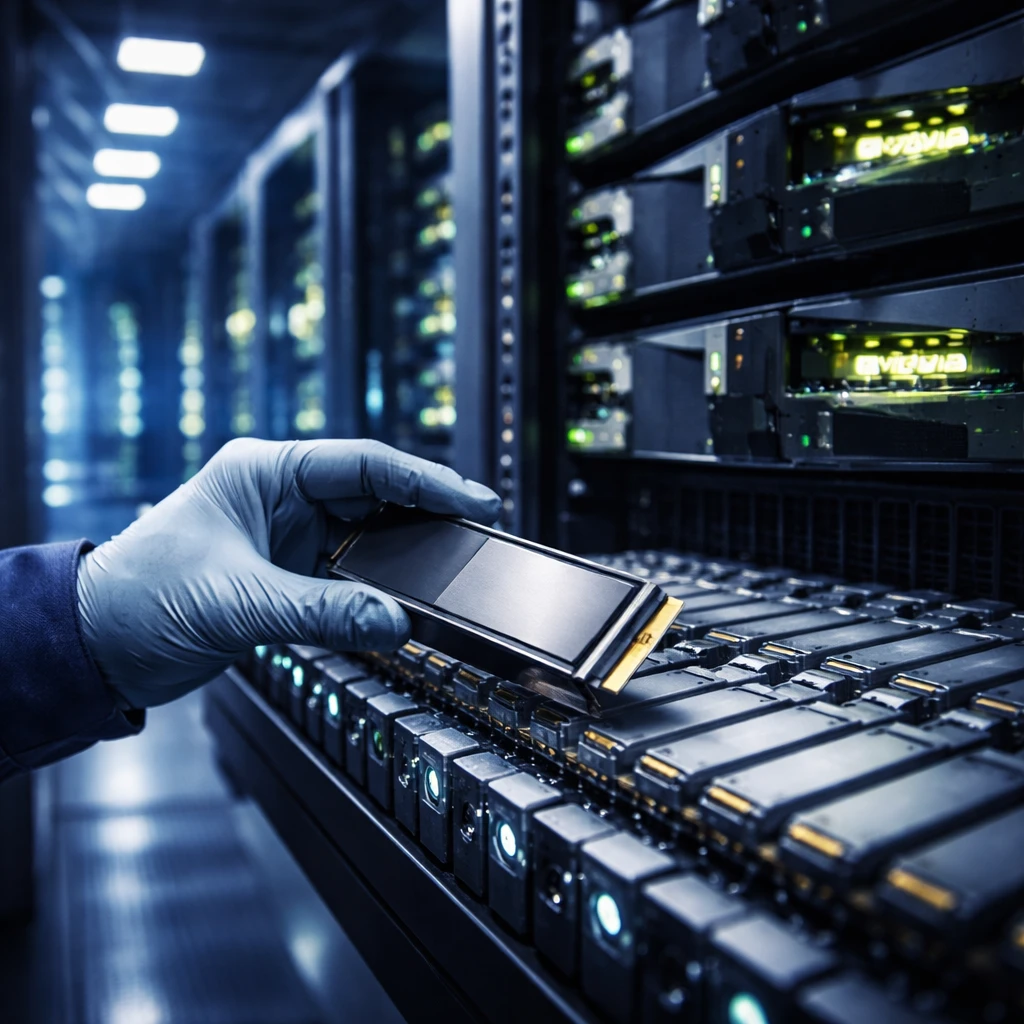
The renewed buying on Thursday reflected investor interest in the role of high-performance storage in supporting larger-scale AI workloads. Kioxia said its collaboration with Nvidia illustrated the potential to extend effective GPU memory capacity to the petabyte range by pairing Kioxia's high-performance NVMe SSDs with Nvidia's SCADA software and its Storage-Next architecture.
According to the companies' proof-of-concept, 144 Kioxia SSDs were used within an Nvidia GB200 NVL72 system to deliver about 1.1 petabytes of raw storage. The demonstration supported the potential to handle the processing of a database containing roughly 2 trillion vectors.
This approach is presented as a response to a growing constraint in AI infrastructure: ever-larger datasets are increasing pressure on the capacity of high-bandwidth memory (HBM) fitted on GPUs. Employing SSDs to extend the memory accessible to GPUs could allow AI systems to work with larger datasets without relying exclusively on costly, limited-capacity HBM.
Potential market implications and caveats
The collaboration could bolster demand for Kioxia's enterprise SSDs if AI data centers adopt architectures that rely on external high-performance storage. At the same time, the companies have emphasized that they are still assessing technical feasibility and performance characteristics of the architecture, rather than presenting it as a finished product.
Thursday's gains offered some relief after a sharp sector-wide selloff, but the article notes that continued uncertainty around the returns on AI investments and shifts in U.S. trade policy keep semiconductor stocks exposed to further volatility.
Summary of market moves
- Kioxia shares rose up to 14.5% to 7,895 yen on Thursday.
- Nikkei 225 closed up 1.3% at 57,745.27.
- Advantest and SoftBank Group were among the other notable winners during the rebound.