
Investors are increasingly demanding concrete outcomes from the major cloud-platform operators instead of backing them on hope alone, according to research firm Yardeni Research. Market participants are now dissecting each hyperscaler’s capital expenditure blueprint and revenue forecasts before committing capital.
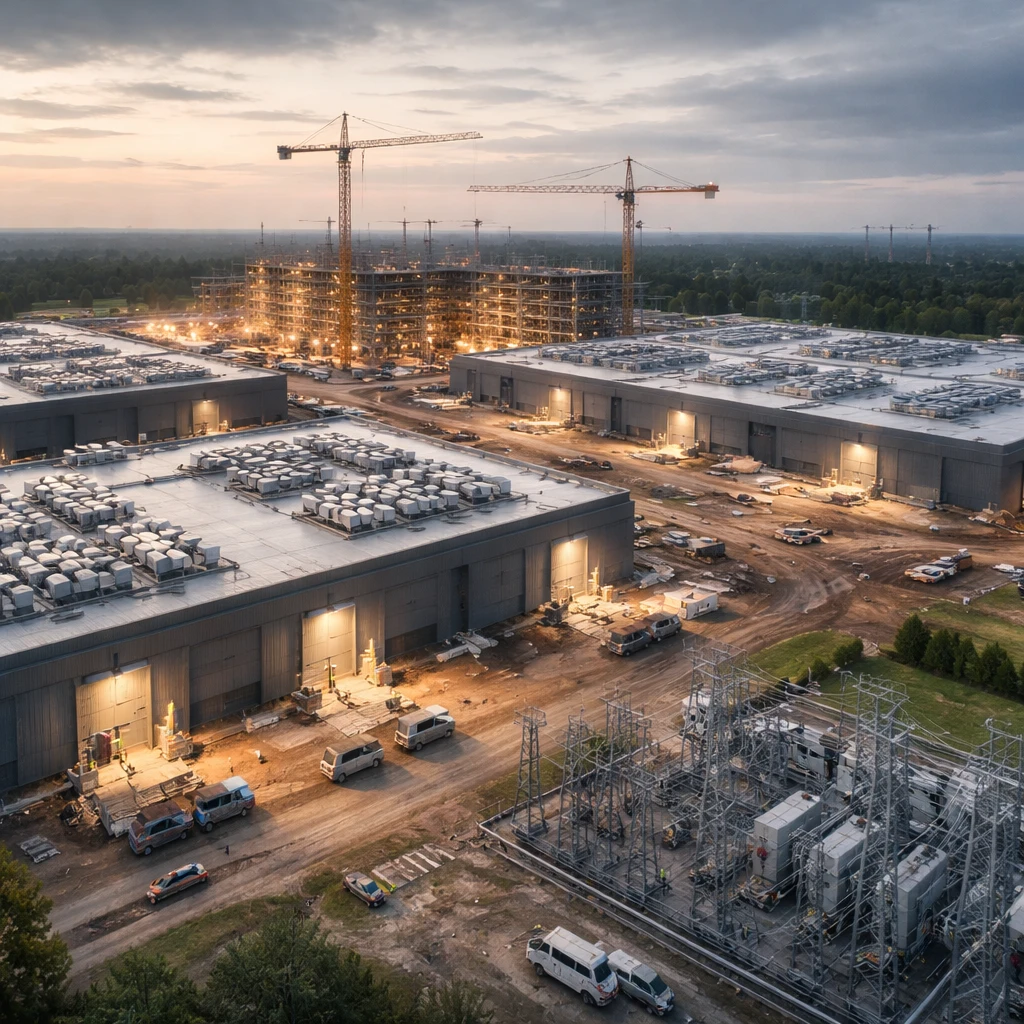
Collectively, Amazon, Alphabet, Microsoft and Oracle have outlined roughly $600 billion of capital spending for 2026, a substantial increase from $309 billion reported in fiscal 2025. Yardeni notes much of that planned capacity expansion has been deferred into 2027 and later because of bottlenecks related to power availability, equipment delivery and local permitting.
However, the firm characterizes those postponements as "one of delay, not retreat," pointing out industry trackers identify only nine cancellations among the 777 large data center projects they follow. That limited number of outright cancellations suggests companies are largely intent on completing buildouts despite timing hurdles.
Behind the capacity commitments sits an extensive roster of contracted future revenue. Remaining performance obligations - revenue that customers have contracted for but which has yet to be delivered - exceed $2.3 trillion across the four hyperscalers for fiscal 2026. Microsoft leads the group with $678 billion in RPOs, followed closely by Oracle at $638 billion.
Yardeni highlights customer concentration as a material risk, particularly whether major AI users such as OpenAI and Anthropic will fulfill the compute commitments embedded in contracts. That exposure has already affected credit assessments: S&P lowered Oracle’s credit rating to BBB- in July and cited the company’s ties to OpenAI as a key risk to its debt profile.
The mix of funding for the hyperscalers’ buildouts has shifted as well. Historically, these companies relied primarily on internal cash generation to underwrite capital spending. As investment needs have outpaced free cash flow, external capital - notably debt - has become a larger share of financing. According to estimates from Goldman Sachs cited in Yardeni’s note, external capital funded 26% of hyperscaler capital spending in 2025. That share is projected to rise to 33% in the current year and to about 35% by 2027.
Signs of the strain on free cash flow are visible in recent company results. Alphabet recorded its first quarter of negative free cash flow in the second quarter of 2026, while Amazon’s trailing-12-month free cash flow turned into a $7.6 billion outflow.
At the same time, core cloud revenue for each provider continues to grow at a brisk pace. Microsoft Cloud generated $214.3 billion in fiscal 2026 revenue, a 27% increase year-over-year. Amazon Web Services reported $134.7 billion across the four quarters through June, up 50%. Google Cloud produced $77.7 billion, up 60%, and Oracle Cloud posted $34.0 billion, a 39% gain.
Yardeni says investors are no longer treating hyperscalers as a uniform group but are parsing differences across companies — scrutinizing planned AI-related spending, the size of contracted backlogs and the cloud revenue that has actually been realized.
Equity market responses this year reflect that differentiation. Oracle shares are down 28% year-to-date amid concerns over negative free cash flow and reliance on OpenAI. Microsoft’s shares had been down 19% before recovering following strong cloud results. Alphabet is up 20% year-to-date, and Amazon is roughly 18% higher following its AWS earnings update.
"The AI trade no longer rests on blind faith, as in the initial days of AI euphoria, but on results," Yardeni said, summarizing the market’s evolving assessment criteria for these large cloud providers.
Summary
Yardeni Research reports that investors have shifted from AI-driven enthusiasm to selective investment in hyperscalers, focusing on individual capital plans, contracted revenues and delivered cloud results. The four largest hyperscalers plan about $600 billion in capital spending for 2026, with much of that spending delayed into 2027 and beyond due to power, equipment and permitting constraints. RPOs exceed $2.3 trillion for fiscal 2026, but funding is moving increasingly toward external capital. Concentration risks tied to major AI customers and signs of negative free cash flow at some providers are elevating credit and market concerns.
Key points
- 2026 capital spending across Amazon, Alphabet, Microsoft and Oracle totals roughly $600 billion, up from $309 billion in fiscal 2025 - the increase underscores heavy near-term investment in data center capacity.
- Remaining performance obligations top $2.3 trillion for fiscal 2026, led by Microsoft ($678 billion) and Oracle ($638 billion), providing a sizable contracted revenue base for future delivery.
- Funding dynamics are shifting from internal cash flow to external capital, with external financing accounting for 26% of capex in 2025 and projected to rise to about 35% by 2027 - a development with implications for corporate credit and markets.
Risks and uncertainties
- Customer concentration risk: Heavy reliance on a small number of large AI customers, notably OpenAI and Anthropic, raises uncertainty about fulfillment of committed compute volumes; this has tangible credit implications as reflected in Oracle’s July downgrade to BBB-.
- Construction and permitting delays: Power, equipment and local permitting issues are pushing planned capacity into 2027 and beyond, potentially slowing revenue recognition tied to new data center capacity.
- Funding strain and cash flow pressure: Some hyperscalers are experiencing negative or reduced free cash flow - Alphabet posted a negative FCF quarter in Q2 2026 and Amazon’s trailing-12-month FCF moved to a $7.6 billion outflow - increasing reliance on debt and other external funding.
Tags: cloud, datacenters, capex, AI, finance