
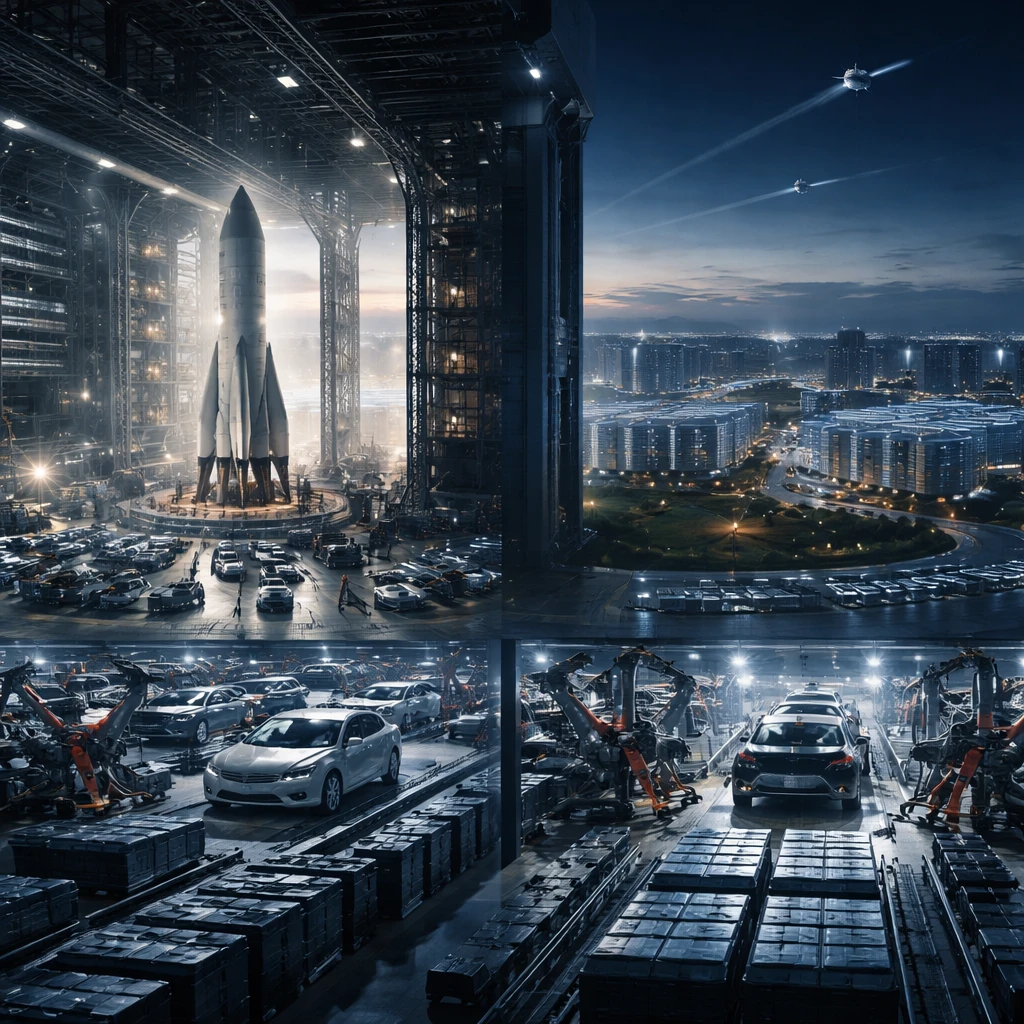
Elon Musk’s comment on July 22 that he would not dismiss a merger between Tesla and SpaceX has shifted talk of a tie-up from rumor toward a tangible possibility. Analyst Gene Munster of Deepwater Asset Management now estimates a 90% chance that the two companies will combine within a few years. Market pricing shows both names are under pressure: SpaceX is down 20% from its $135 IPO price and trades at $108.15 today, while Tesla is off 32% year-to-date and sits at $310.33 per share.
At present valuations a combined market capitalization would be about $2.65 trillion, based on Tesla’s $1.23 trillion market cap and SpaceX’s $1.42 trillion. That headline number frames the scale, but the more consequential story lies in how tightly the businesses are already connected operationally.
Operational overlap already in motion
The merger scenario is not purely theoretical because the two companies already share substantial operational linkages. These existing connections would allow a formal consolidation to bring balance sheets together and expand integrated operations rather than create entirely new interactions.
| Synergy Area | What’s Already Real | Upside Potential |
|---|---|---|
| Battery Supply | Tesla supplies battery technology to SpaceX projects | Shared R&D and cost efficiencies at scale |
| Terafab | Both companies are jointly developing an AI chip fabrication facility | Vertical AI silicon independence |
| Grok / Digital Optimus | Tesla’s Optimus robot uses SpaceX’s Grok AI model | Unified AI stack across robots and rockets |
| Manufacturing DNA | Tesla Gigafactory manufacturing methods applicable to Starship production | Faster rocket iteration cycles |
| AI Data Centers | SpaceX is building data centers in Texas while Tesla needs AI compute for FSD and Optimus | Shared compute infrastructure |
| Energy Storage | Tesla Megapacks are powering SpaceX’s 1 GW Memphis compute hub | Captive demand for Tesla Energy |
The Terafab factor
One of the most consequential potential gains cited is Terafab, the joint semiconductor fab focused on AI chips. During Tesla’s Q2 2026 earnings call, management disclosed plans to borrow up to $30 billion to support simultaneous expansions across Robotaxi, Optimus, solar and a semiconductor fab. SpaceX, for its part, already runs AI compute deals with Anthropic and Google and has raised data center revenue guidance to $430 million for 2026.
If combined, the businesses would bring together four distinct elements: the chip fabrication via Terafab, SpaceX’s compute capacity, the Grok AI models, and AI applications such as FSD, Optimus and Starlink. Together these components would amount to a vertically integrated AI stack within a single corporate umbrella.
Starlink and Tesla vehicle connectivity
SpaceX is exploring acquisition of terrestrial spectrum either through competitor purchase or government auction. Coupled with Tesla’s expanding robotaxi deployments across Austin, Dallas and Houston, a merged company could enable Tesla vehicles to communicate directly over Starlink-managed spectrum rather than relying on terrestrial cellular networks. For autonomous vehicles, the article frames low-latency satellite connectivity as infrastructure rather than an optional accessory.
Obstacles and the bear case
Despite the synergies, two structural hurdles loom large. First, regulatory friction tied to China and national security could complicate or delay any deal. Tesla maintains substantial operations in China, while SpaceX’s deep ties to U.S. defense agencies - highlighted by a recent $1.6 billion contract - make the company a potential national security flashpoint in both Beijing and Washington. Second, governance is complex: Elon Musk holds a larger voting stake in SpaceX than in Tesla, meaning any share-for-share swap would require an intricate reworking of governance arrangements and would need to secure minority shareholder support with compelling terms.
Where both stocks stand
Market action suggests investors are pricing in execution risk alongside any merger optionality. The article notes Space Exploration Technologies has shed $1.2 trillion from its $225 peak, with short interest at 31% of float. The first lock-up expiration is due on August 6, at which up to 911.5 million insider shares could become eligible for sale. Tesla is described as burning roughly $3.25 billion in free cash flow per quarter during its current capex cycle, with negative free cash flow expected to persist in the near term.
Bringing the two companies together would create a vast industrial and technology scale-up with significant optionality but material execution risk. The final outcome - whether a merger occurs, and under what terms - will depend on navigating the regulatory, governance and operational complexities set out above.
Key takeaways
- Elon Musk did not rule out a Tesla-SpaceX merger on July 22; an analyst places the probability at 90% within a few years.
- Existing operational links include batteries, joint chip fabrication plans (Terafab), an AI model (Grok) used by Tesla’s Optimus, shared manufacturing methods, data centers and energy storage partnerships.
- Regulatory risk tied to China and U.S. national security, plus governance complexity due to differing voting stakes, are primary obstacles to a deal.