
Across several West African cities, shoppers are increasingly able to order from global marketplaces even where those retailers do not operate directly. A mix of small, technology-enabled forwarding services and larger logistics platforms are creating an informal pipeline that funnels goods from warehouses in Europe, the United States and China into African markets.
One illustrative example is a Senegalese startup that gives customers delivery addresses at partner warehouses abroad, consolidates purchases and manages repackaging and dispatch to West Africa. The model addresses two of the most common barriers to cross-border online shopping on the continent: the lack of conventional street addressing systems and limited access to traditional bank cards.
Under the service, purchases made on international sites are shipped to designated warehouses in France, the U.S. or China. Operators then aggregate multiple orders for an individual customer into a single shipment for onward transport to destinations such as Senegal. When the consolidated cargo arrives, customs duties are cleared and paid locally, returning revenue to national authorities.
Crucially for many customers, payment does not require a conventional bank account. Mobile-money accounts, which can be loaded with cash at neighborhood kiosks, allow those without bank cards to pay for goods and delivery locally. Mobile money is widely used in Senegal and in other parts of Africa, often in place of conventional banking.
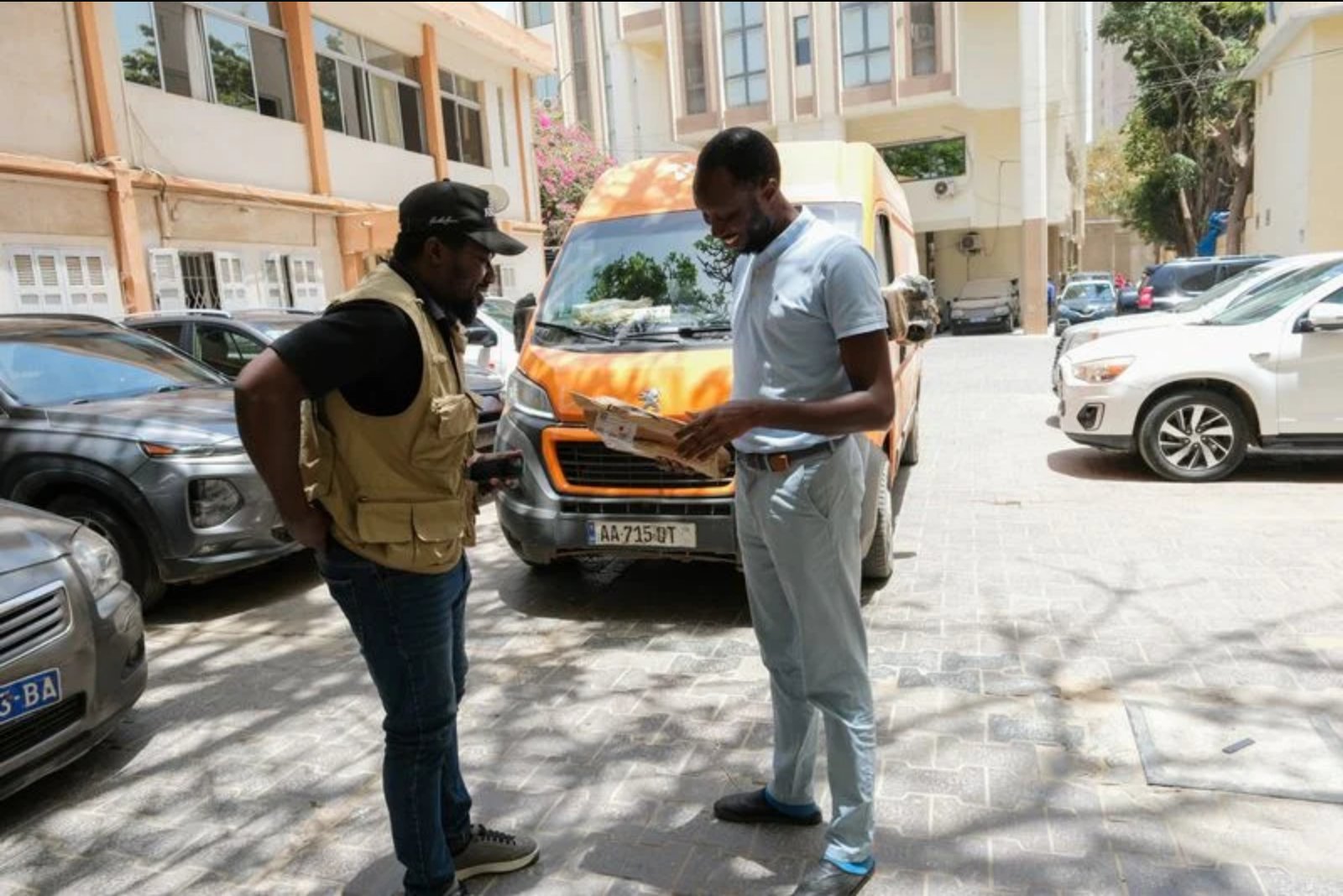
On the ground in major cities, the final leg of delivery is handled by small vehicles and motorbikes that use GPS to reach customers’ homes, working around informal addressing systems. That mix of consolidation abroad and GPS-enabled last-mile logistics is how merchandise branded by large international retailers ends up on the doorsteps of African consumers.
"You have to be very, very, very flexible. That’s the key word," said the startup’s chief executive, speaking outside a depot stacked with parcels that arrived from international sellers.
The company began in 2018 connecting informal networks of air travelers between France and Senegal and has expanded substantially since. Weekly volumes now amount to several metric tons shipped by air and multiple containers sent by sea. To contain costs, the firm leases warehouse space in France and works with local partners in the United States and China to handle trade there rather than owning facilities in every market.
These smaller forwarding operators compete with global logistics providers that have also adapted cross-border platforms to African demand. One multinational logistics group runs two overlapping services: one platform acquired from a U.S.-based company originally built to serve expatriates, and another it developed in-house that delivers to many African countries. The group says its strategy is to give African customers access to choice and brands that otherwise are unavailable in local markets.
Its reach covers a variety of destinations across the continent, including relatively large markets such as Angola and hard-to-serve environments such as Somalia. The company reports that Sub-Saharan Africa is among its fastest-growing regions and says products most commonly shipped include electronics, apparel, toys, and machinery and parts for agriculture and autos. It expects revenue from these shipments to rise substantially by 2030.
Despite rising volumes, growth faces clear constraints. For both the smaller forwarding services and larger logistics operators, demand is concentrated in and around major urban hubs where incomes and internet access are higher. E-commerce activity remains highly uneven across the continent. Internet penetration has reached roughly 43% of Africa’s population of about 1.5 billion people, yet only a small segment of that group has sufficient income to shop online regularly.
Where internet access exists, uptake of online shopping varies widely. In some leading economies, about one in three internet users shop online. In contrast, more economically challenged regions see markedly lower participation, with only about one in 20 people shopping online in parts of Central Africa, according to a regional consultancy’s data cited by industry participants.
South Africa stands apart from many Sub-Saharan markets. As the region’s largest and wealthiest economy, it accounts for a disproportionate share of online retail volumes. Online retail there has expanded at an annualized pace approaching 35% over the past five years, reaching roughly 140 billion rand in 2025, a figure reported by payments-data providers. That growth has drawn international players to establish first operations in the region: one global online marketplace launched an online marketplace in South Africa in 2024, and the first stores bearing a major U.S. retail brand opened in Johannesburg last year.
When asked about further expansion across Sub-Saharan Africa, neither of those multinational retailers offered comment. They also did not provide data on sales routed through intermediaries.
Even where global retailers are not operating broadly across Africa, competition among intermediaries is sharpening. A regional e-commerce company active in eight Sub-Saharan countries sells a broad array of consumer goods and has been defending market share against low-cost Chinese entrants by adapting services to local needs. That tailoring includes opening local help centers and creating pick-up points in less urbanized areas.
The regional player reports it has not yet posted a profit but expects to reach break-even this year. Executives at both the multinational logistics operator and the regional e-commerce company identify Nigeria as one of the continent’s most promising markets. Although the Nigerian government does not publish routine e-commerce statistics, it has pointed to an international estimate that places the country’s total e-commerce market at roughly $75 billion in 2025.
To serve that potential, logistics firms are expanding physical capacity: one major operator opened a warehouse in Nigeria in April of this year. Meanwhile, some e-commerce players report rapid recent growth in Nigeria, with one saying its business there rose by about 50% in the fourth quarter of 2025. Company leadership described the market as still substantially underpenetrated, framing current activity as early in a broader transformation.
The rise of forwarding services and adapted logistics platforms demonstrates a practical route for global brands to reach African consumers without establishing full local operations. The model relies on a combination of foreign consolidation, local payment workarounds and GPS-based last-mile delivery to translate demand in urban centers into sales. Yet the model also highlights structural limits: concentrated urban demand, uneven internet penetration and income constraints mean large swathes of the continent remain outside the addressable market for cross-border retail for now.
For retailers and logistics providers, the growth trajectory in the region will likely depend on how well they can convert urban growth into sustainable volumes while addressing the payment and distribution frictions that still constrain broader adoption.