
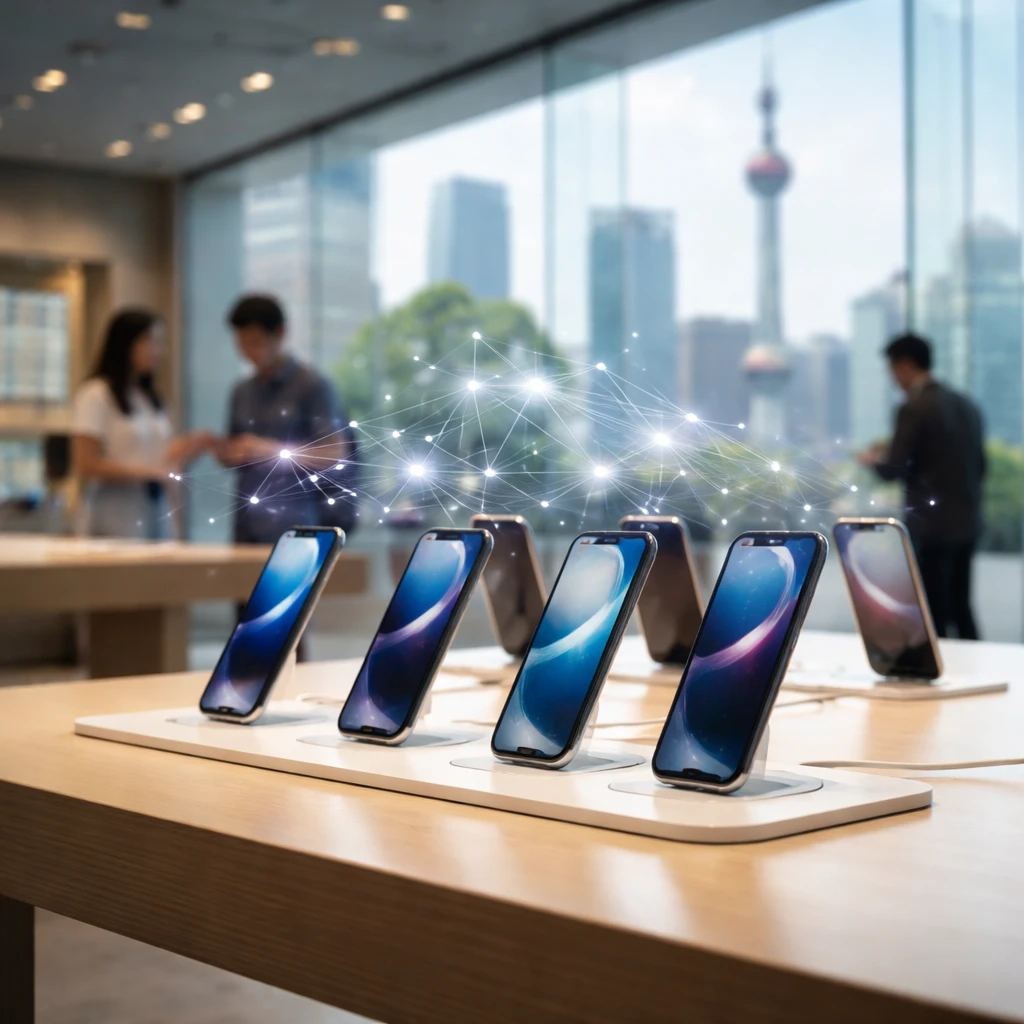
Apple's product and distribution environment appears to be shifting in ways that could generate a sustained upgrade tailwind for iPhone replacement cycles. Three discrete but simultaneous developments - the regulatory registration of Apple Intelligence in China, the roll-out of a new two-year leasing plan, and the introduction of an agentic Siri with on-device capabilities - are being cited by several analysts as the basis for materially higher unit forecasts over the next two years.
Market expectations are already moving. HSBC projects iPhone sales to increase by roughly 21% in fiscal 2026 and a further 11.6% in fiscal 2027, while consensus global shipment estimates are being revised from about 240 million units in 2025 toward near 260 million by 2027. Those figures form the backbone of an upgrade narrative that traders and some banks argue Wall Street has not fully priced.
The upgrade thesis explained
One common bearish critique has been that software enhancements, including artificial intelligence features, are not sufficient alone to trigger broad hardware replacement. That argument carried weight when advanced AI features were restricted geographically and when voice assistance remained limited in functionality. The recent combination of developments challenges that narrow framing by expanding availability, reducing the effective cost of ownership, and introducing qualitatively different on-device features that can make older phones feel obsolete.
China - a critical market opens
Arguably the most consequential near-term development is the registration of Apple Intelligence for use in China. The service had not been available to Chinese users previously; the recent registration by the country’s cyberspace regulator included integration with local large language models from Baidu and Alibaba - specifically their Qwen model integrations for local users.
Already, iPhone shipments in China rose 24.4% year-over-year in the second quarter - a gain that occurred prior to the full staged roll-out of AI features. Analysts treating China as a source of incremental replacements view the registration not as a temporary boost but as a structural change that opens the addressable base of more than one billion consumers to Apple’s new software capabilities.
The leasing program - shortening replacement intervals
On July 28 (ET), Apple launched a leasing program called Apple Upgrade. The program is backed by Klarna and offers 24-month terms. Research by KB Securities suggests this program has the potential to reduce the average replacement interval from the current three to four years down to approximately two years. If replacement cycles compress materially, that mechanically increases annual unit demand; KB Securities estimates the change could add roughly 10 million incremental units a year and supports a 260 million unit shipment projection by 2027.
Agentic Siri - a different class of feature
HSBC’s decision to upgrade its rating to Buy (from Hold) with a $366 target was predicated on a particular upgrade: an agentic Siri that pairs visual intelligence and cross-app access with distilled Gemini models running on-device. HSBC characterizes this capability as a step beyond earlier text-summarization tools that failed to convince some users. The bank has increased its fiscal 2027-28 revenue forecasts by 7% to 9% and raised its iPhone unit estimates by 11% to 13% to reflect the potential impact.
Earnings scorecard and near-term catalyst calendar
Apple has exceeded consensus estimates in four consecutive quarters, producing an average EPS surprise of +6.5% during that streak. The pattern has led some observers to conclude management has been conservative with forward guidance as iPhone momentum accumulates.
| Quarter | EPS Surprise | Revenue vs Est | Price Reaction |
|---|---|---|---|
| FY26 Q2 | +4.15% | +$2.28B | +3.69% |
| FY26 Q1 | +6.37% | +$6.33B | +1.19% |
| FY25 Q4 | +5.11% | +$0.81B | +0.25% |
| FY25 Q3 | +10.56% | +$5.04B | -3.19% |
The upcoming fiscal report on July 30 (after markets) carries a 3.5% implied move per options markets. Historically the stock has moved outside that implied range in five of the last eight quarterly reports, making the call and accompanying commentary a key near-term data point for investors focused on unit guidance and any early metrics tied to Apple Upgrade enrollment.
Bull and bear perspectives
Proponents of a sustained upgrade cycle - including analysts at HSBC, Evercore and Morgan Stanley - point to the convergence of China’s registration of Apple Intelligence, the new leasing program, agentic Siri, an anticipated iPhone 18 Pro cycle and a planned 20th-anniversary special edition in 2027 as drivers that could produce a multi-year supercycle. Consensus fiscal 2027 EPS of $9.69 is cited as implying meaningful earnings power if these factors materialize.
Bearish views, represented by firms such as Barclays (Underweight, $230) and Jefferies, emphasize several countervailing risks included in current market discussion. Those concerns highlight that prior AI feature rollouts failed to prompt broad upgrades, that recent price increases across Mac and iPad product lines may reflect margin pressure from memory costs, and that shortening replacement cycles through leasing might cannibalize full-price upgrades. Additional regulatory uncertainty - noted in market commentary around U.S. Department of Justice antitrust settlement discussions - is also cited as an overhang.
Conclusion - a real but uneven cycle
The combined developments present a credible argument for a revived upgrade cycle, though execution and feature quality will determine its size and duration. China’s registration of Apple Intelligence represents a concrete regulatory approval rather than a promise, and the leasing program begins compressing cycles immediately. Agentic Siri remains a pivotal variable: if it delivers on the described visual intelligence and cross-app, on-device capabilities, it would substantiate a premium hardware thesis; if it disappoints, the bear narrative could regain momentum quickly.
Investors should focus on the July 30 earnings report for iPhone unit guidance and any commentary around early enrollment trends for the Apple Upgrade program as the next meaningful indicators of whether the projected upgrade tailwind is materializing.