
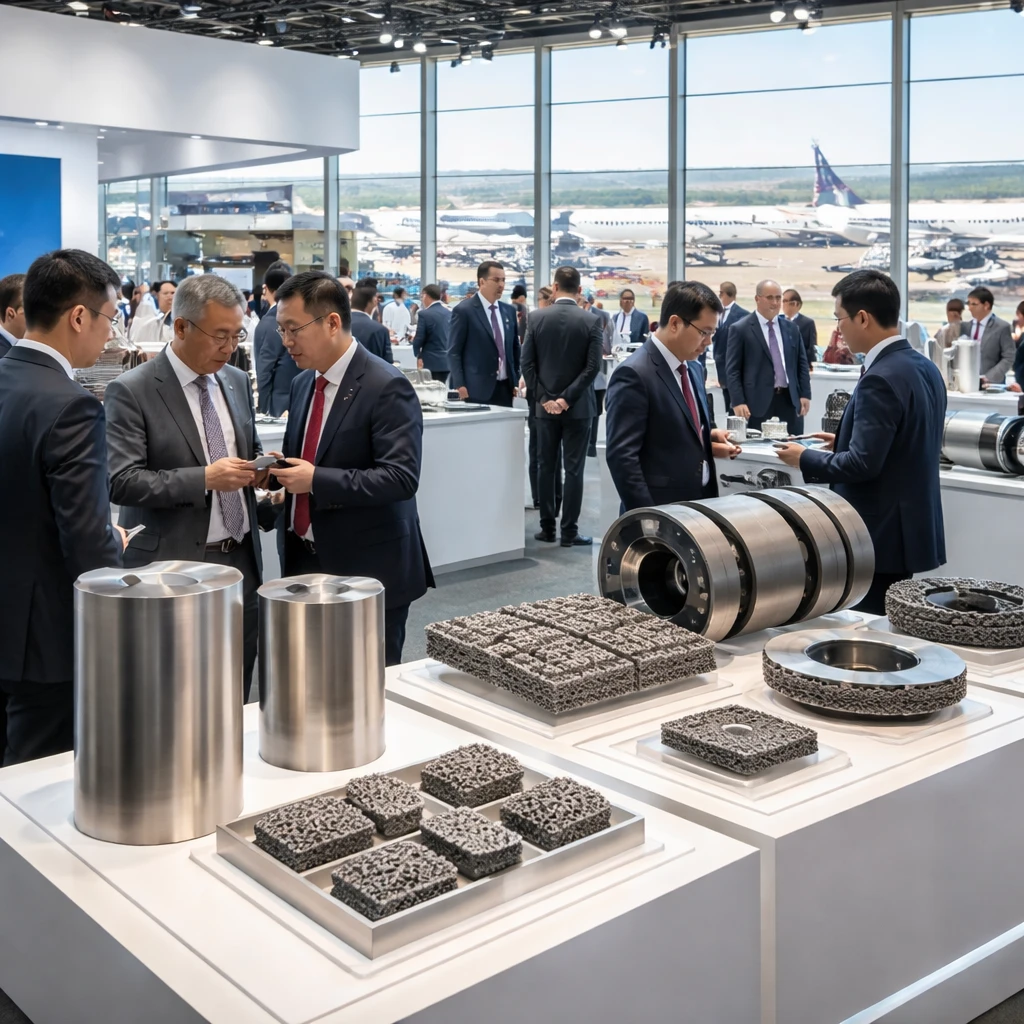
The Farnborough Airshow this week became a focal point for Chinese suppliers of titanium who are actively pursuing aerospace customers outside their domestic market. Close to two dozen firms, including HST Titanium, Jinda Titanium and Baoji YongshengTai, displayed a range of products - from titanium sponge and ingots to ceramic brake plates - as they seek new demand amid strained global supplies of the critical metal.
Titanium is valued in aircraft construction for its strength-to-weight ratio and corrosion resistance, characteristics that make it a core component for jet engines, landing gear and airframes. Industry participants at Farnborough described a market still coping with supply shocks from multiple recent disruptions. These included the COVID-19 pandemic, Western sanctions on a major producer following its 2022 full-scale invasion of Ukraine, and U.S. tariffs on Chinese imports.
“There’s strong internal competition in China and they want to find a larger overseas market,” said Karolina Jackiewicz, a special metals trader at CCMA, a raw materials distributor that advises Chinese suppliers. Her observation reflects what many exhibitors at Farnborough portrayed: an urgent push to diversify sales beyond a domestic market that is increasingly dominated by the emerging planemaker COMAC, which had a record showing at the event.
While U.S. tariffs on Chinese titanium initially weighed on suppliers, executives who spoke at Farnborough said there remain commercial openings in the United States, where supplies have been constrained and domestic production has effectively ceased. Interest from European buyers was also reported as strong.
At least three Chinese suppliers, speaking on condition of anonymity, said their titanium is being used on Airbus aircraft. Airbus did not respond to a request for comment on those claims.
A broad Chinese presence across the air show underscored a coordinated effort to cultivate relationships in Western markets. That presence included aerospace and defence firms and was led in part by COMAC, which is positioning itself as a challenger to established manufacturers but continues to rely on foreign suppliers for certain technologies, notably jet engines.
Aviation analyst John Strickland commented on the significance of the activity at Farnborough: “They’re making contacts. They’re networking. They’re explaining their product. They’re showcasing their product,” he said, describing the outreach as more than a display and as part of a concerted business development effort.
Strickland added that he expects COMAC and Chinese aerospace suppliers to gradually play a larger role in global markets, but he cautioned that such a shift hinges on expansion of the support infrastructure that underpins major manufacturers. He noted the need to establish maintenance and repair networks, spare-parts distribution, engineering support and aircraft leasing services. “If they deliver their planes … in terms of reliability, performance, and in particular a market that shows that they can develop infrastructure support globally, because that’s what airlines want,” Strickland said.
The activity at Farnborough illustrates how supply pressures and shifting commercial strategies are prompting Chinese metals suppliers to press Western customers directly. Their efforts aim to translate a prominent presence at one of the world’s largest aerospace gatherings into enduring commercial relationships, even as trade frictions and market-entry hurdles remain.