
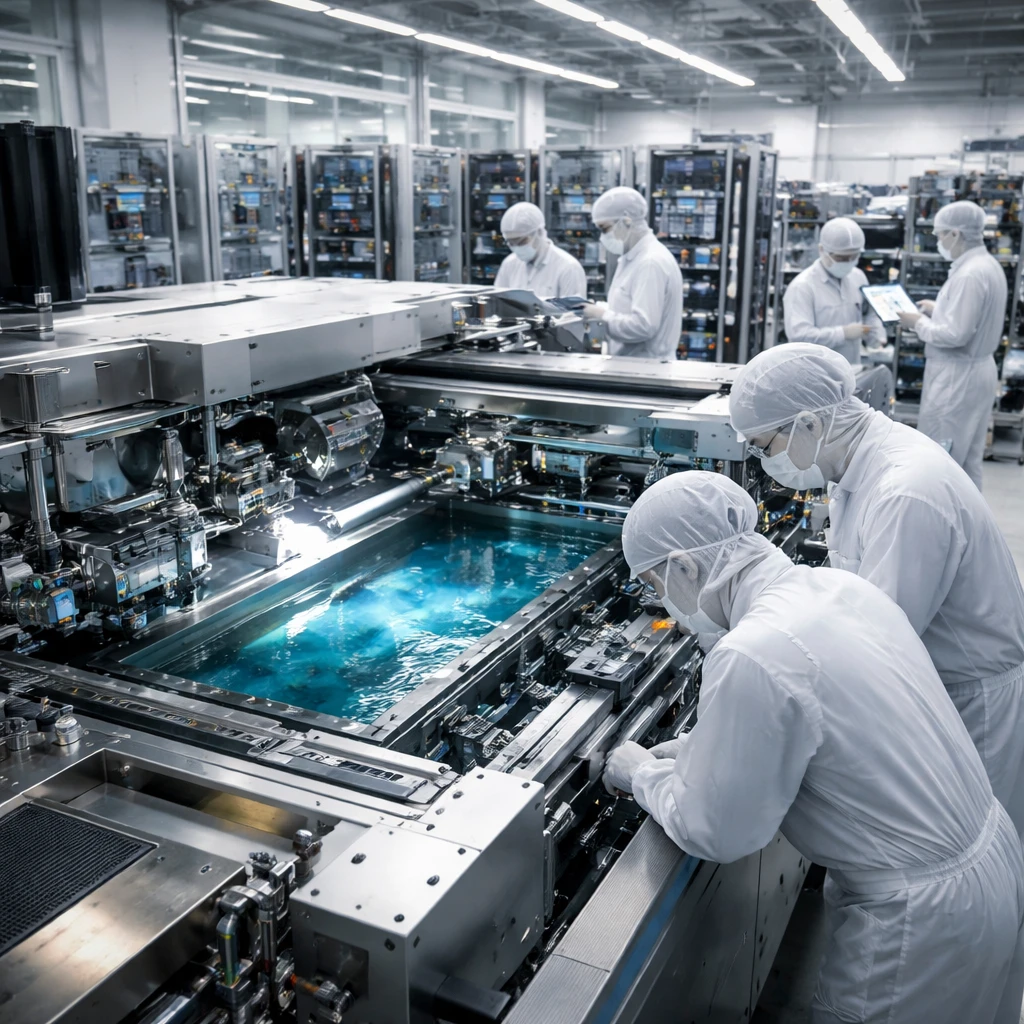
China has started mass production of locally developed immersion deep-ultraviolet (DUV) lithography equipment, according to a person familiar with the matter, marking a notable development in the country's campaign to reduce dependence on foreign chipmaking technologies. Production is being steered by Shanghai Aishengna Electronic Technology Group, a little-known state-owned enterprise that has absorbed engineering teams from prominent domestic lithography startups.
The domestically produced immersion DUV machines represent a milestone for Beijing's semiconductor self-reliance drive, which is identified by Chinese leadership as a strategic priority. While the move broadens the pool of equipment available to Chinese fab operators, the machines are understood to need additional testing and are not yet equivalent to competing models supplied by established foreign manufacturers.
According to information shared with industry observers, the Chinese-built immersion DUV systems are expected to be delivered this year to several leading domestic chipmakers, including Semiconductor Manufacturing International Corp (SMIC), Hua Hong Semiconductor and memory-chip maker ChangXin Memory Technologies (CXMT). Sources familiar with the situation indicated early production volumes are modest, with plans to manufacture around five machines this year and to scale to roughly 20 units in 2027.
ASML, the Dutch supplier long dominant in DUV and the provider of the most advanced extreme-ultraviolet (EUV) systems, was unaffected directly by these initial steps, though market reaction was visible in a single-day share-price decline for the Dutch supplier. Industry contacts and the source noted that the newly built Chinese systems are likely to trail ASML models in performance and maturity for the near term.
Implementation of domestic immersion DUV capability would provide Chinese chipmakers with an alternative source of lithography tools should Western export or servicing restrictions tighten. U.S. export controls have already barred Chinese firms from acquiring ASML's most advanced EUV systems, and Dutch export measures have limited access to certain advanced DUV machines. Immersion DUV technology, which uses a layer of water between the projection lens and the silicon wafer, enables the printing of smaller circuit patterns than conventional dry DUV systems and can be extended toward more advanced semiconductors via multiple patterning - a process that requires repeated exposures of the same layer.
Corporate registration records show Shanghai Aishengna Electronic Technology Group was founded in August 2023 with registered capital of 7 billion yuan (equivalent to $1.0 billion at an exchange rate of $1 = 6.7677 yuan). The company is backed by two state-owned shareholders: Shanghai Electric Holding and a subsidiary of Shanghai International Trust. Little public information is available about Aishengna; the firm lacks an official website and has not publicly disclosed operational details.
Sources indicate Aishengna has integrated teams from lithography startups that have been active in domestic equipment development efforts, including Yuliangsheng and Shanghai Micro Electronics Equipment (SMEE). Yuliangsheng, which began testing a DUV prototype last year, is affiliated with a Huawei-backed equipment maker. Corporate and recruitment records show Aishengna and Yuliangsheng list the same address in Shanghai.
Company representatives and the named affiliates did not provide responses to requests for comment on the production program, according to industry inquiries. Similarly, the chipmakers expected to receive the machines - SMIC, Hua Hong and CXMT - did not respond to outreach seeking confirmation.
Observers caution that while progress on domestic lithography tools is meaningful politically and strategically, commercial and technical parity with entrenched global suppliers remains distant. Separate reporting in December indicated China had succeeded in assembling a prototype EUV system, a different and more advanced category of lithography tool, but that effort was assessed as still years away from production readiness.
Summary
China has begun mass production of domestically developed immersion DUV lithography machines led by state-backed Shanghai Aishengna Electronic Technology Group, which incorporated teams from domestic lithography startups. Initial output is small and the machines require further testing, but deliveries to leading Chinese chipmakers are expected this year. The move supports China's semiconductor self-sufficiency goals but does not immediately match the capabilities of established international suppliers.
Key points
- Shanghai Aishengna, a state-backed firm established in August 2023 with 7 billion yuan in registered capital, is leading mass production of immersion DUV tools.
- Initial production volumes are limited - roughly five machines this year with plans to scale to about 20 in 2027 - and the equipment will need further testing before matching established foreign models.
- Deliveries are expected to target major domestic chipmakers including SMIC, Hua Hong Semiconductor and CXMT, expanding China’s in-country equipment options amid export controls on advanced lithography.
Risks and uncertainties
- Technical performance: The domestically produced immersion DUV machines are reported to be far from matching established competitors, creating uncertainty about their immediate utility for advanced semiconductor production - affecting the semiconductor manufacturing sector.
- Regulatory and market reaction: Further restrictions by Western governments on exports or servicing of foreign lithography tools could alter demand dynamics for domestic equipment, introducing strategic risk for suppliers and purchasers in the chip-equipment and fab sectors.
- Operational transparency: Limited public disclosure by Aishengna and affiliated startups, alongside non-responses from involved companies, creates information gaps about timelines, production capacity and commercial readiness - impacting investor and industry assessments across the technology and capital markets.