
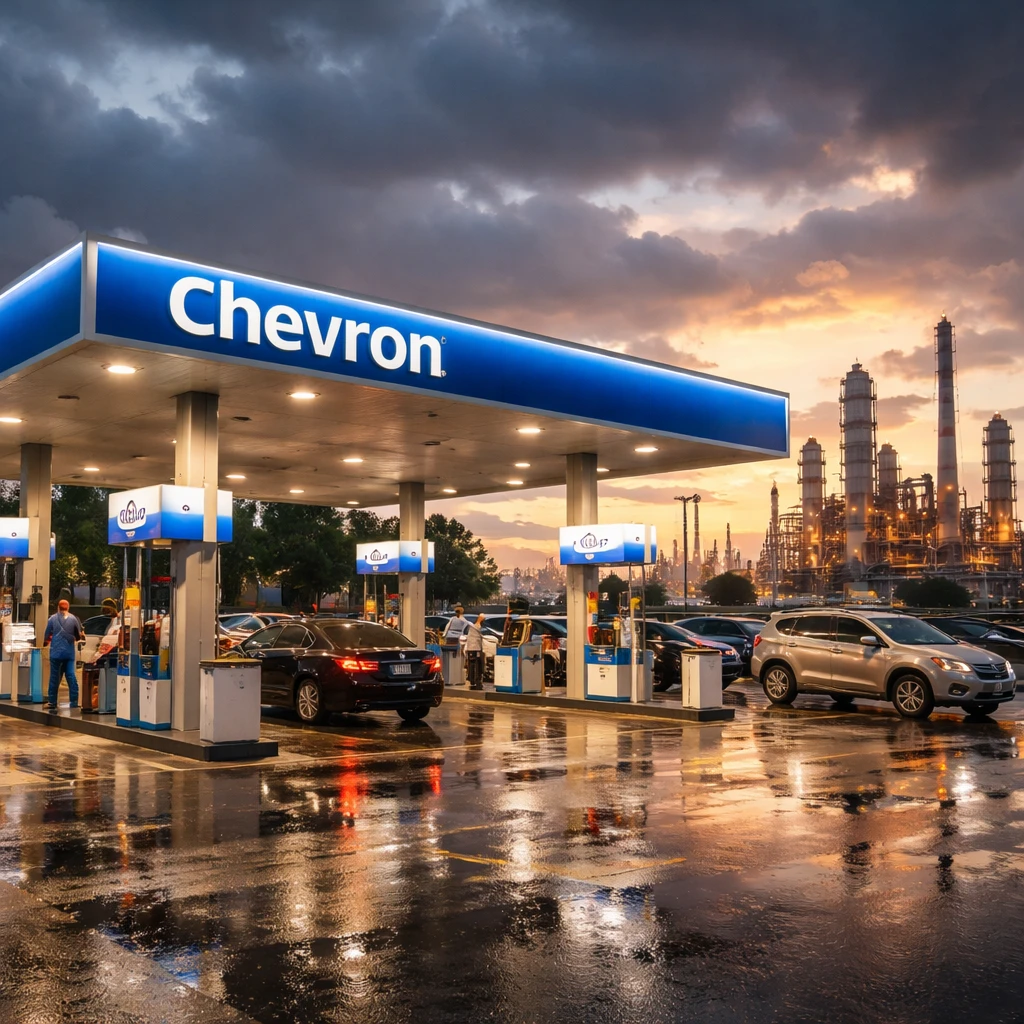
Chevron posted Q2 FY2026 earnings per share of $6.06, materially above the $5.11 consensus estimate and marking its best quarterly profit in six years. The jump in earnings is attributable to the sharp rise in oil prices associated with the Iran war; Brent crude averaged $126.41 per barrel in April compared with $69.82 in January. Within days of the earnings release and an employee bonus announcement, President Trump publicly pressed CEO Mike Wirth to lower retail gasoline prices, creating a political spotlight on Chevron's wartime profits. The stock slid following the episode, falling -1.85% on August 3.
The profit that drew public scrutiny
Chevron's outsized quarter reflects a dramatic earnings run-rate driven by higher upstream prices. Management reported Q2 EPS of $6.06 against a $5.11 estimate, a beat of approximately 18.59 percent. Rather than pass unnoticed, the earnings print coincided with increased political attention. The proximity of a White House demand to reduce pump prices to the earnings announcement has amplified investor concern about potential downstream margin pressure and policy responses.
Five channels that could shave EPS
There are at least five distinct mechanisms through which Chevron's EPS could be reduced if political and market dynamics evolve:
- Margin compression via voluntary retail cuts - Pressure to lower pump prices could prompt branded stations to accept smaller retail margins, directly reducing downstream contribution to EPS.
- Windfall profit tax risk - Political pressure could translate into legislative proposals that seek to reclaim a portion of war-era gains, which would reduce net earnings.
- OPEC+ supply responses - If pressured allies increase supply, a fall in crude prices would lower upstream revenue for producers like Chevron.
- Regulatory price controls - In an extreme scenario, government intervention on pricing could impose structural ceilings on revenue generation.
- Reputational and execution friction - Heightened political scrutiny can slow permits, approvals or create operational headwinds for growth projects in the Permian and Gulf of Mexico, adding execution risk.
How exposed are the numbers?
Market expectations already imply a sharp earnings deceleration after the Q2 peak. The forward EPS profile reflects a drop from $6.06 in Q2 to a consensus of $4.24 in Q3 and $3.63 in Q4. That pattern assumes a return of oil prices toward more normal levels. If political pressure accelerates price normalization, or prompts retail margin rollbacks on top of lower crude, the FY2026 consensus of $15.20 is at risk.
For context, FY2025 EPS was $7.29 when oil traded in a relatively range-bound environment. The current war premium has roughly doubled Chevron's earnings run-rate versus that baseline. Any forced retail price rollback would eat directly into that incremental profit.
Where Chevron has control - and where it does not
Upstream crude prices are set by global markets and therefore outside Chevron's unilateral control. The retail gasoline price point is where Chevron has some discretion; branded service stations can set pump prices within local competitive dynamics. However, Chevron's exposure on the downstream side is relatively limited because it is primarily an upstream producer and does not operate as extensive a refining and retail footprint as some integrated peers. Significant voluntary retail price cuts would likely require Chevron to absorb margin reductions, producing a direct drag on EPS.
Bull and bear scenarios
The bull case emphasizes that presidential rhetoric does not always convert into enforceable price controls. Proponents of this view note Chevron's balance sheet strength and its long dividend record as cushions against transitory pressure. The bear case highlights the potential for an escalated political response - such as a windfall profit tax - that could trigger an immediate re-pricing of FY2026 earnings. Over the past year EPS estimates for Chevron were revised up by 81.42 percent, a trend that could reverse sharply if policy risk materializes.
Market signal and recent momentum
Consensus estimate revisions have been rising recently, with EPS estimates up 17.31 percent over 90 days and up 12.05 percent in the previous seven days. That upward momentum in expectations has increased Chevron's earnings bar just as political attention intensified.
Bottom line
Chevron's Q2 EPS of $6.06 captures the impact of wartime oil prices, but the subsequent public pressure to lower pump prices introduces multiple legitimate pathways for earnings to be trimmed. Analysts and investors will be watching whether political rhetoric leads to voluntary retail price concessions, legislative measures, or market responses that lower upstream prices. Each of those outcomes would have a credible negative effect on the FY2026 earnings consensus of $15.20.