
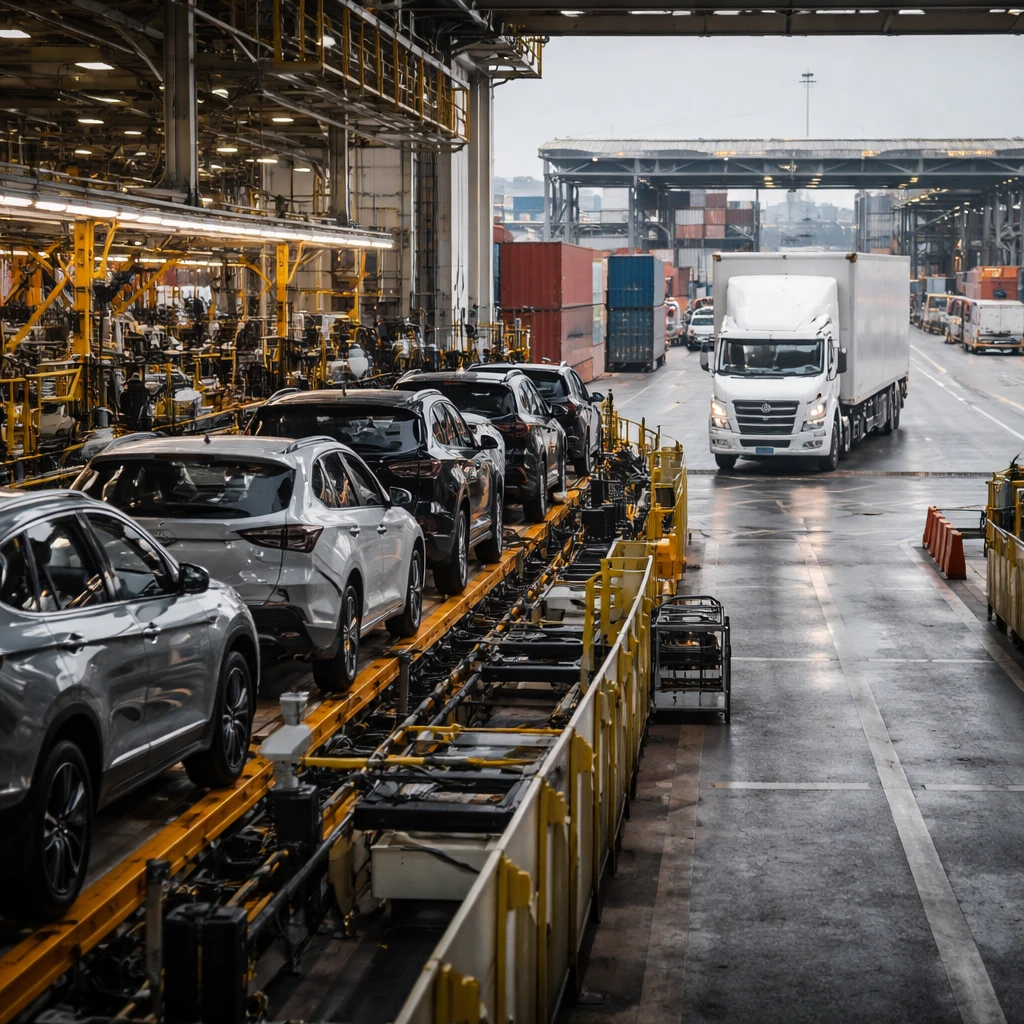
Canada's plan to impose dollar-for-dollar retaliatory tariffs in response to U.S. policy is set to hit North American vehicle manufacturers where they are most exposed - embedded cross-border supply chains. The measure, due to take effect on September 8, will particularly pressure Detroit's Big Three: General Motors, Ford and Stellantis.
Summary of the immediate market context
The S&P 500 Automobiles index has declined roughly 19% year-to-date, and the onset of Canadian counter-tariffs is expected to deepen the strain. Canada announced its actions after trade negotiations collapsed on August 22, targeting categories that include steel, dairy, appliances, agricultural equipment and electronics. Within that list, the auto supply chain is uniquely vulnerable because vehicles and parts commonly cross the U.S.-Canada border multiple times during production - a pattern that allows duties to compound at each stage.
The tariff asymmetry and competitive implications
A structural imbalance in North American trade policy is central to the pressure on U.S. automakers. According to the details in the market commentary, U.S.-based manufacturers effectively face roughly 25% duties on imports from Canada and Mexico. By contrast, Japanese, Korean and European exporters into the U.S. encounter a flat 15% tariff. That 10-percentage-point differential amounts to a built-in cost disadvantage for General Motors, Ford and Stellantis relative to many foreign competitors exporting to the U.S.
Ford - the most exposed
Ford Motor is the company judged most sensitive to the Canadian response. At the cited trading level of $13.80 and a market capitalization near $55.1 billion, Ford's reported net margin is -4.4% while its debt-to-equity ratio stands at 461%. The company's Ontario footprint - including the Oakville Assembly plant - means Canadian counter-tariffs will directly raise production costs for vehicles and parts tied to that network. Ford has already estimated a net tariff impact of about $1 billion for 2026 and is adjusting production plans, including shifting Lincoln models from China to U.S. factories. Given its negative margins and significant leverage, analysts note Ford has the thinnest buffer to absorb an acute tariff shock. The company was also presented with a fair value downside of -23.3% in the data referenced.
General Motors - resilient performance, meaningful exposure
General Motors, trading at $85.48 with a market capitalization around $75.1 billion, posted year-to-date performance of +5.0% in the figures provided. Yet GM carries substantial tariff risk: gross tariff exposure is estimated at $2.5 billion to $3.5 billion for the year, with roughly $900 million of costs expected for the remainder of the year. That magnitude of tariff expense could consume more than 20% of reported operating profit. GM has raised full-year 2026 guidance following a strong first half and has reached tentative labor agreements with Unifor covering 4,600 Canadian workers - a development that stabilizes labor relations but also locks in Canadian labor costs as cross-border trade becomes more expensive.
Stellantis - steep sell-off and operational headwinds
Stellantis stands out for its severe stock price weakness. At the cited trading level of $5.22 and a market capitalization of $15.1 billion, the company was down 53.8% year-to-date and trading near the lower bound of its 52-week range ($5.05 to $12.22). Stellantis reports a net margin of -14.6% in the dataset provided. Multiple analyst downgrades - including Bernstein to Underperform and Piper Sandler to Underweight - were attributed to high dealer inventory and a stalled recovery in U.S. sales. While Stellantis has less direct Canadian manufacturing exposure compared with Ford and GM, the broader tariff environment amplifies its existing operational challenges.
The potential scale of adjustments to North American content rules
Automakers have conveyed to the U.S. administration that revised North American trade proposals - specifically a proposal cited that would require 50% U.S.-made content to qualify for lower tariffs - could cost each Detroit automaker at least $2 billion annually. With no new talks scheduled between the U.S. and Canada, and with U.S. Trade Representative Jamieson Greer stating the U.S. is "moving forward" in response to Canadian retaliation, the pathway to a negotiated resolution appears limited in the near term.
Market and competitive consequences
The policy paradox is clear in the figures and statements presented: tariffs intended to shield American manufacturing are, in the current configuration, increasing costs for the U.S.-based producers they purport to protect. Meanwhile, foreign competitors exporting to the U.S. retain a 10-percentage-point tariff advantage under the tariff structure described.
Investors and industry participants will be watching near-term earnings impacts, production shifts and dealer inventory dynamics as Canadian tariffs take effect on September 8.