
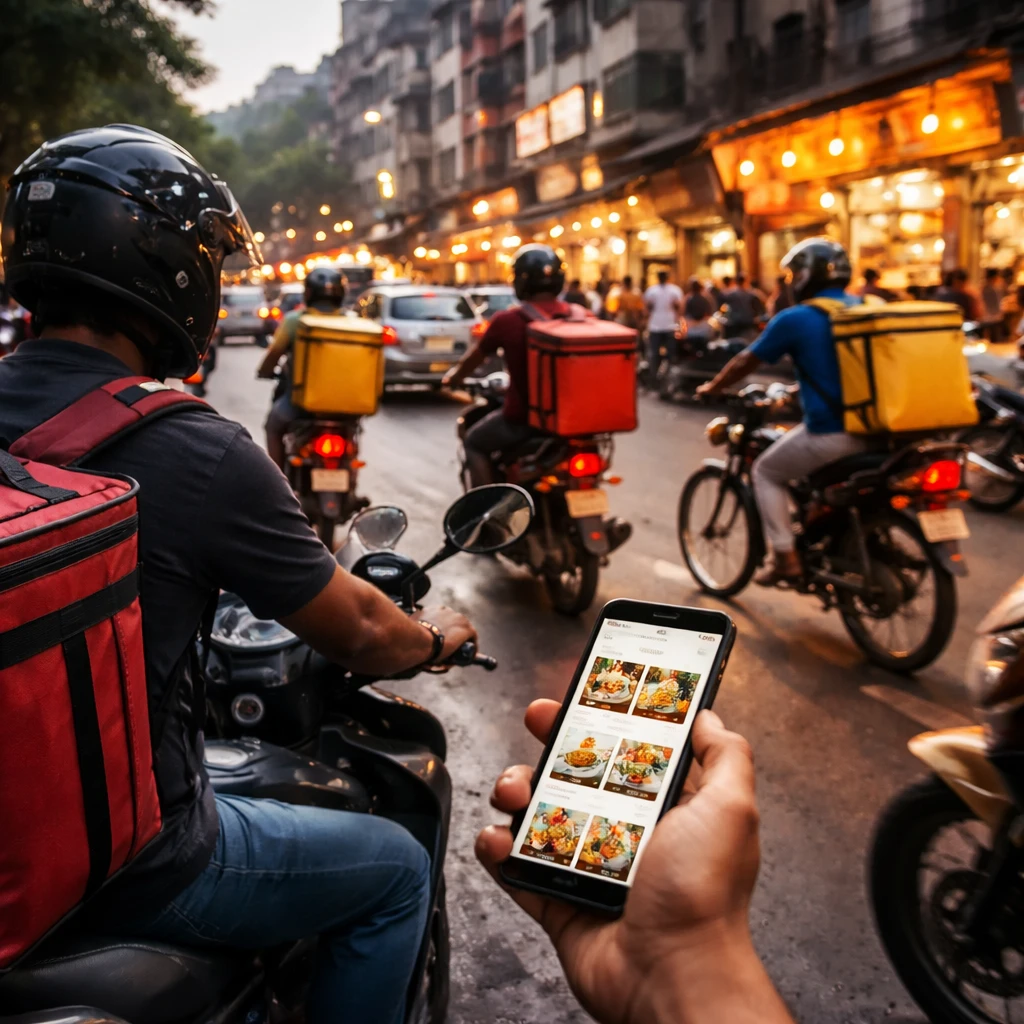
Bernstein reviewed recent moves by Rapido and Flipkart into India’s food delivery market and posed a central strategic question - will new entrants broaden the market footprint or will increased competition erode profits for the existing duopoly?
Food delivery in India has been dominated by Zomato and Swiggy for several years. The segment is growing rapidly, with year-over-year expansion of roughly 18-20% and adjusted EBITDA margins of about 5% - the highest among comparable markets. Before listing, each of the two incumbents attracted substantial capital, with reported pre-IPO investments in the range of $4-5 billion. Today, their combined food delivery operations are valued at approximately $20 billion, implying a Tobin's Q multiple near 4-5 times, a valuation metric that could draw new competitors.
Despite that appeal, the sector still reaches a minority of the population. Bernstein cites annual transacting customers across both platforms in the range of 85-95 million. Monthly active users are concentrated at 27.2 million for Zomato and 19.2 million for Swiggy. On a wider scale, food delivery accounts for about 15% of India’s total food services market.
There are meaningful differences in order economics between delivery and the broader food market. Average order values for delivery hover around 400 rupees, in contrast to about 150 rupees for the broader food services market. Emerging competitors are testing alternative pricing structures aimed at lower price segments: Rapido is reported to be experimenting with a no-commission or low-commission approach, while Flipkart is said to plan a commission model of roughly 10-11%.
Geographic concentration is another feature: the top 20 cities represent about 30-40% of India’s organized food services market, and many quick-service restaurant chains focus their expansion within the top 50 cities. That concentration shapes scale opportunities and unit-cost dynamics for any operator seeking growth.
Bernstein emphasized that the decisive issue for entrants will be whether they can materially alter the cost base that underlies incumbent unit economics. Delivery expense is a significant component - Bernstein estimates last-mile delivery and rider recruitment cost about 60-65 rupees per order. The ability of new players to reduce those costs, or to offset them with different revenue structures, will determine whether they can achieve sustainable unit economics without simply triggering margin compression across the sector.
Summary - Bernstein examined whether Rapido and Flipkart’s market entry will expand adoption or pressure margins for Zomato and Swiggy, noting strong growth, modest profitability, concentrated customer penetration, and delivery costs that are central to unit economics.