
Stock Markets August 4, 2026 09:57 AM

BYD rolls out Brazil-made plug-in hybrid flex car as local production scales up

Song Pro Super-Hibrido Flex Fuel arrives from Camacari after targeted investments and rising Brazilian sales

By Leila Farooq
Share
Twitter Reddit Facebook LinkedIn

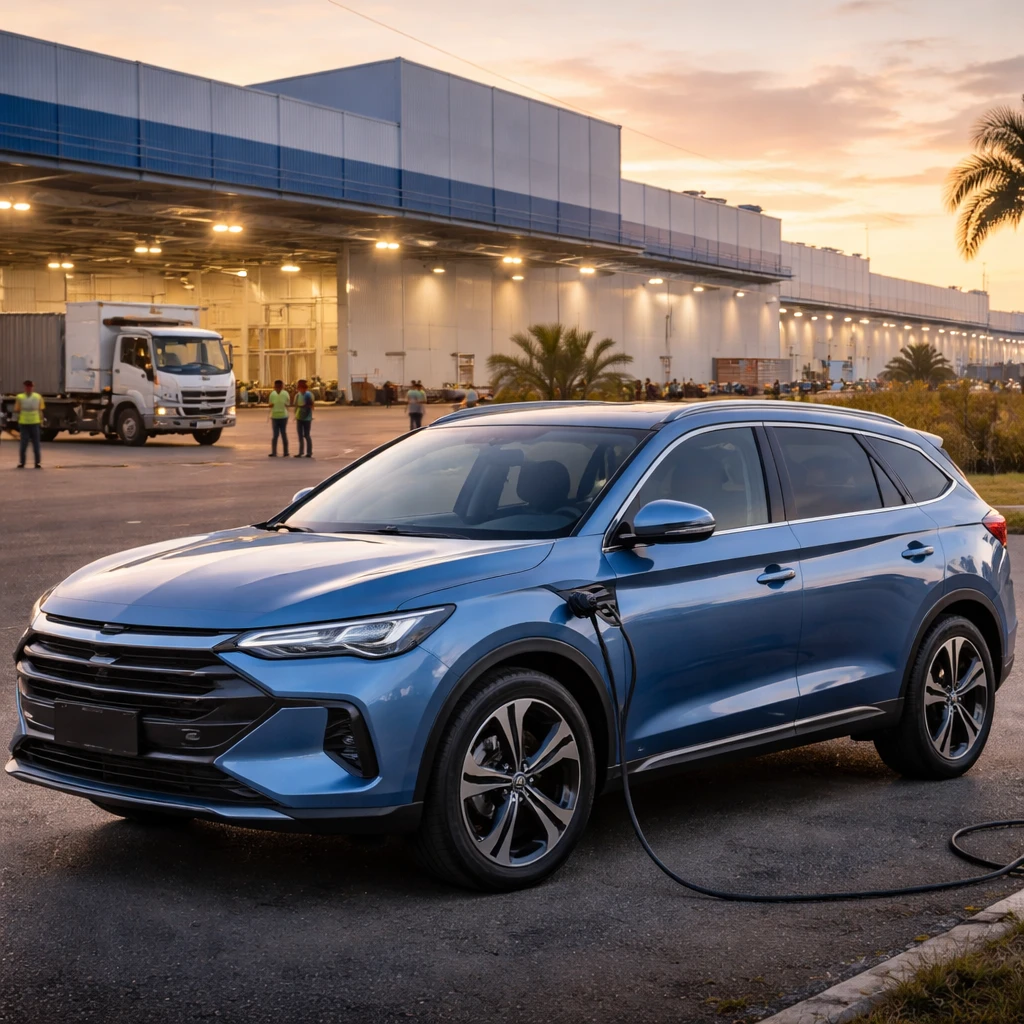
Chinese automaker BYD has introduced the Song Pro Super-Hibrido Flex Fuel, the company's first plug-in hybrid flex-fuel vehicle built in Brazil after a two-year, 100 million reais investment. The model, produced at the Camacari plant in Bahia, can operate on electricity, gasoline or ethanol and is part of a broader shift toward local manufacturing as BYD ramps production and sales in the Brazilian market.

BYD rolls out Brazil-made plug-in hybrid flex car as local production scales up
Summarize with
ChatGPT Perplexity Claude Grok Gemini

Key Points

  • BYD launched the Song Pro Super-Hibrido Flex Fuel, the company's first Brazilian-made plug-in hybrid flex-fuel vehicle, after a two-year, 100 million reais investment - impacts automotive manufacturing and energy sectors.
  • The Camacari plant in Bahia will produce the model and is part of a larger 5.5 billion reais investment expected to yield about 180,000 cars this year - affects automotive supply chain and local industrial activity.
  • July sales surged with BYD selling 23,465 vehicles and capturing a 9.1% market share, while the Dolphin GS led retail sales with 5,861 units - signals competitive shifts in Brazil's auto market and consumer adoption trends.

Chinese carmaker BYD this week began selling its first Brazilian-produced plug-in hybrid that accepts flex fuels, following a two-year development program backed by an investment of 100 million reais. The vehicle, named the Song Pro Super-Hibrido Flex Fuel, goes on sale across dealerships in Brazil on Wednesday, company Senior Vice President Alexandre Baldy said in an interview.

Built at BYD’s Camacari factory in the northeastern state of Bahia, the model is designed to run on three power sources - electricity, gasoline and ethanol. Baldy said the electric-only driving range differs by trim: the GL model delivers 60 km (37 miles) while the higher-end GS version provides 120 km of electric range.

BYD highlighted that the new model supports the company’s local content objective. Baldy said the automaker expects all vehicles manufactured in Brazil to incorporate more than 50% local parts by January 2027. The Camacari plant is already sourcing items such as tires domestically and will produce batteries on site, according to Baldy. The factory first opened in October 2025.

Development of the Song Pro Super-Hibrido Flex Fuel was a joint effort between research and development teams in Brazil and China, Baldy added, characterizing the effort as a project tailored specifically for the Brazilian market. He described the car as highly symbolic for BYD, marking a first collaboration of that nature between the two R&D groups.

The company’s presence in Brazil is shifting from initial assembly of semi-knocked-down units toward expanded local manufacturing. Baldy said this strategy responds both to Brazilian regulatory requirements and BYD’s ambition to make Brazil a regional export hub. While the vehicle is aimed at Brazilian consumers, Baldy noted the Song Pro Flex could eventually be marketed in other countries, including India, if ethanol fuel adoption grows.

BYD is directing significant capital to its Camacari facility. The company is investing 5.5 billion reais in the plant and anticipates production of about 180,000 cars this year. Baldy estimated the factory will likely supply roughly 150,000 of the approximately 200,000 vehicles BYD aims to sell in Brazil in 2026.

Sales momentum in Brazil has accelerated recently. July marked the company’s strongest month in the country, with the Dolphin GS leading retail sales at 5,861 units, BYD said. Total sales for the month reached 23,465 vehicles, more than double the 9,680 sold in July of the prior year, positioning BYD fourth in the Brazilian market with a 9.1% share.


Methodology note - This article reports comments and figures provided by BYD executives and the company’s disclosed sales and production targets.

Risks

  • Execution risk in meeting local content and production targets - setbacks at the Camacari plant could affect supply and BYD’s goal to source more than 50% local parts by January 2027 - impacts manufacturing and supply chain sectors.
  • Market acceptance and fuel adoption uncertainty - broader export plans, including potential sales to markets such as India, depend on the spread of ethanol fuel adoption which is not guaranteed - impacts automotive demand and fuel markets.
  • Delivery of forecasted production volumes - BYD expects the Camacari factory to produce about 180,000 cars this year and to supply roughly 150,000 of the 200,000 vehicles targeted for Brazil in 2026; failure to hit these figures would affect sales and inventory dynamics.

More from Stock Markets

Polymarket in Talks for Roughly $1 Billion Round at Valuation Above $20 Billion Aug 4, 2026 Prologis Shares Retreat After Announcement of $18.8 Billion SEGRO Deal and Concurrent Equity Raise Aug 4, 2026 Southern Company Shares Edge Lower After $2.375 Billion Convertible Note Sale Aug 4, 2026 Marvell Rallyes After FMS 2026 Debut of AI-Focused Memory and Storage Products Aug 4, 2026 MDA Space Shares Jump After $474M Follow-On Order from Telesat Boosts Lightspeed Production Aug 4, 2026