
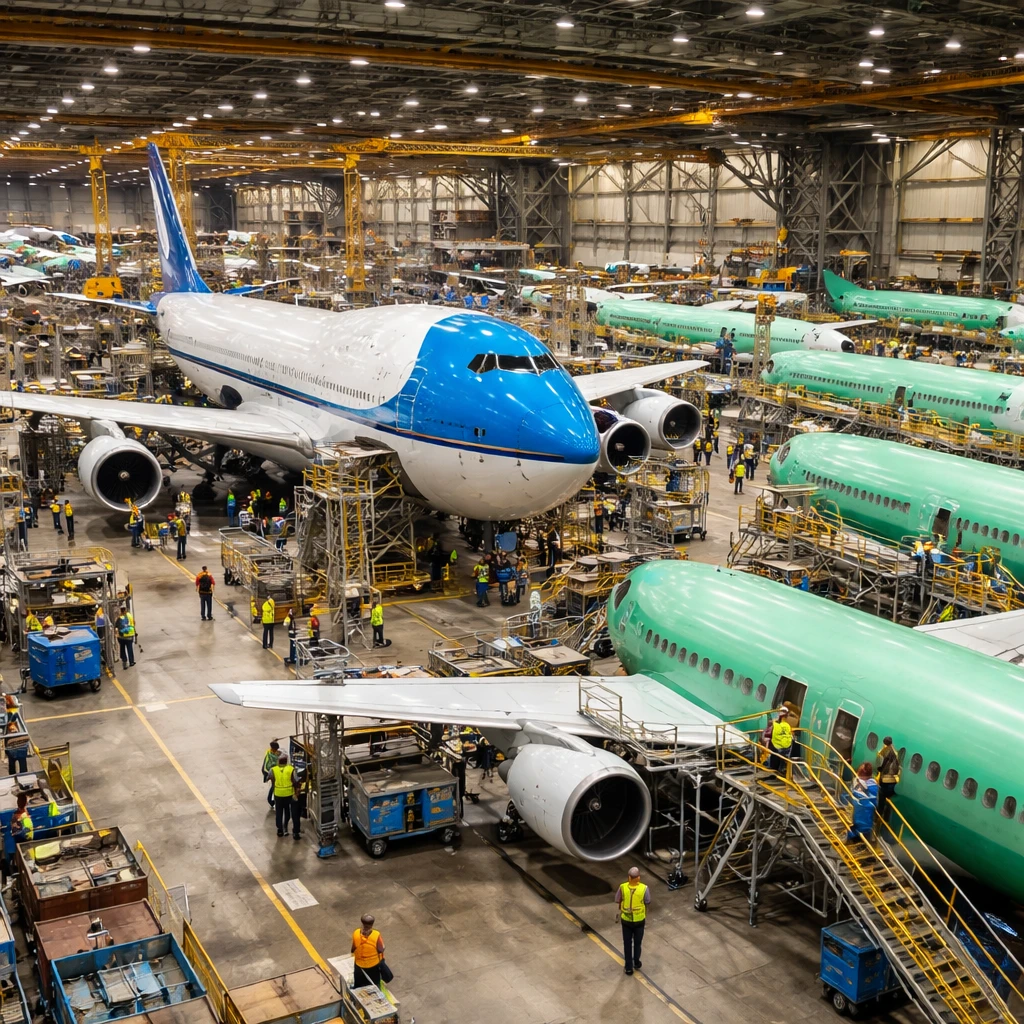
Boeing reported a larger-than-expected quarterly loss after taking a $280 million charge related to its troubled Air Force One replacement program, but the company also produced positive free cash flow as it continued executing on production improvements.
The charge, which Boeing said was driven by higher engineering costs to ensure delivery of two delayed U.S. presidential aircraft in 2028, contributed to a $428 million net loss for the second quarter. Despite the larger-than-anticipated loss, Boeing shares rose 4% in midday trading, as investors appeared to focus on signs of steady progress in production and the company’s improved cash generation in the quarter.
Quarterly results and cash flow
Boeing reported a core loss per share of $0.76 for the quarter, wider than the average analyst expectation of a $0.30 loss per share, based on LSEG data. The company’s core loss, however, was narrower than the $1.24 per share core loss reported in the same period last year.
Crucially, Boeing recorded $631 million of free cash flow in the quarter, compared with a negative $200 million in the second quarter of 2025. The company attributed the improvement in part to higher customer payments than anticipated. Boeing said it remains on track with its guidance of $1 billion to $3 billion in free cash flow for the year - which, if achieved, would mark its first positive annual free cash flow result since 2023.
Boeing also increased capital investments in the quarter versus a year earlier, citing spending tied largely to expanding capabilities for 787 production in South Carolina and to military jet production in the St. Louis, Missouri, area.
Air Force One program and contract dynamics
The company is working to deliver two 747-8 aircraft to serve as Air Force One under a $3.9 billion fixed-price contract signed in 2018. That program is now four years behind schedule and more than $1 billion over budget. The $280 million charge taken in the quarter reflects additional engineering work required to meet the revised delivery timeline in 2028.
Separately, the U.S. president accepted a Qatari-donated 747-8 that is serving as an interim Air Force One plane. The president said this month that the donated jet would soon be sent away for upgrades following questions about some of its security features.
Production ramp and supplier caveats
Boeing is increasing output of its best-selling 737 MAX, moving from 42 to 47 jets per month and targeting 52 per month by early next year, with a further goal of 57 per month thereafter. Management stressed that reaching 57 per month will depend on stronger supplier performance and smooth scaling of production on key parts such as wings assembly for the 737 family.
On the 787 program, Boeing said that engine deliveries from GE Aerospace remain the critical factor for lifting output toward a target of 10 aircraft per month. The company is working closely with GE on a recovery plan after engine shipments lagged in the first half of the year.
Boeing continues to contend with nearly $26 billion in net debt, reflecting the financial strains from the company’s recent crises even as it moves to restore margins and cash generation.
Key takeaways
- Boeing posted a $428 million net loss in Q2 after a $280 million charge tied to Air Force One engineering costs, but produced $631 million in free cash flow.
- The company is increasing 737 MAX production from 42 to 47 jets per month, aiming for 52 and then 57 per month in subsequent phases, while 787 output is constrained by engine deliveries from GE Aerospace.
- Capital spending rose to support expanded 787 production in South Carolina and military jet work in the St. Louis area; the firm maintains a $1 billion to $3 billion free cash flow guidance for the year.
Risks and uncertainties
- Supplier performance - Reaching the planned 737 MAX production rates, particularly the 57 per month target, depends on suppliers delivering key components reliably, including wings assemblies.
- Engine supply for 787s - Engine deliveries from GE Aerospace are the gating factor for increasing 787 output toward 10 aircraft per month; lagging shipments could constrain recovery efforts.
- Program overruns - The Air Force One replacement program is already four years behind schedule and more than $1 billion over budget; further engineering cost increases or delays could further impact financial results.
Overall, Boeing’s quarter reflects a combination of program-specific charges and encouraging cash-flow trends tied to improved production and customer payments. The firm’s ability to hit ambitious production ramps will hinge on supplier execution and the resolution of engine delivery shortfalls.