
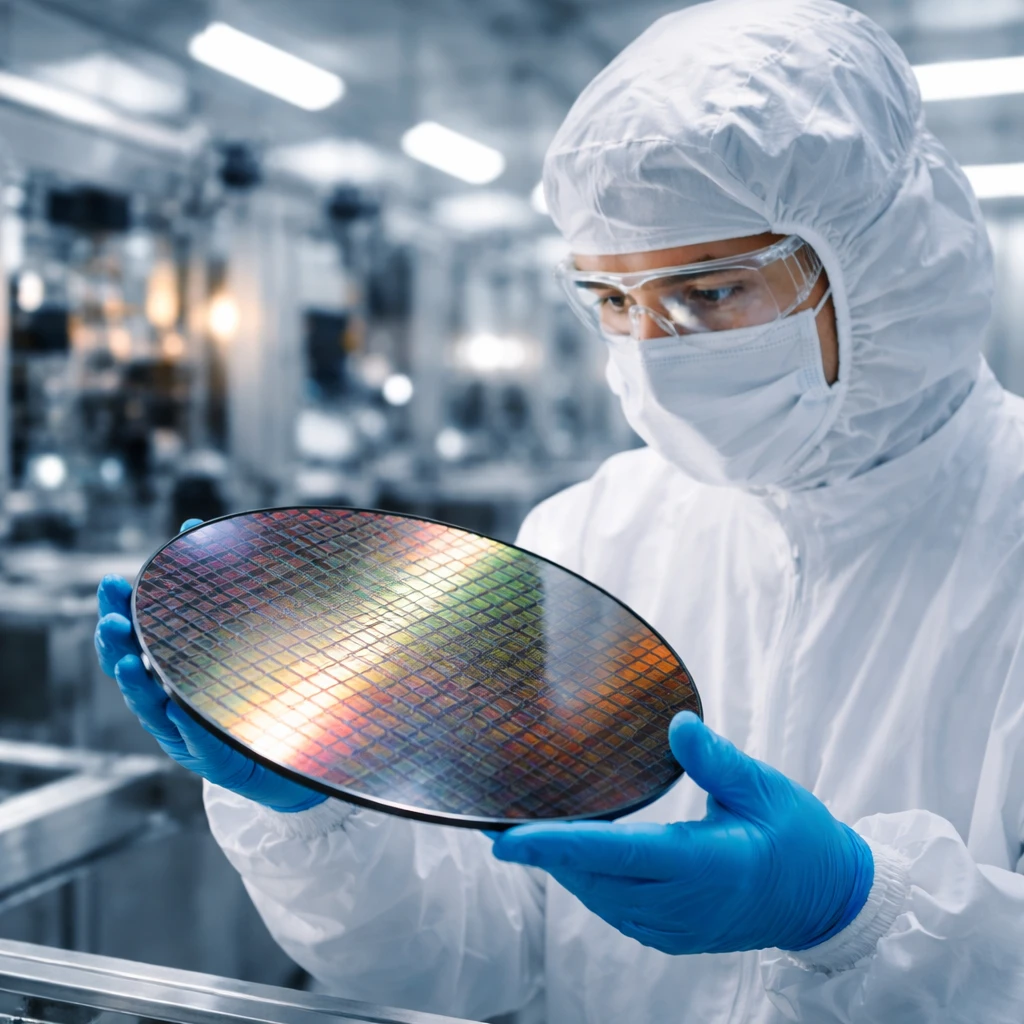
Bank of America analysts argue that semiconductor capital equipment stocks are presenting a compelling investment case as spending on wafer fabrication equipment (WFE) picks up on a multi-year basis. The firm points to a recent collective increase in calendar year 2026 WFE guidance to $150-$160 billion - a level that represents about 30% year-over-year growth and is higher than earlier estimates near $140-$145 billion.
According to the analysts, the acceleration in WFE outlays is expected to extend into 2027, driven by memory upgrades, advanced logic nodes and stronger packaging demand. Despite meaningful stock drawdowns of roughly 20% to 40% across the semiconductor capital equipment complex, the sector now trades at more attractive forward valuations, with three-year price-to-earnings-growth ratios near 0.7x.
Bank of America presents a bottom-up consensus path for WFE that implies spending reaching $156 billion in 2026, $213 billion in 2027 and $262 billion in 2028. The firm views these figures alongside company fundamentals to identify securities it regards as well-positioned to capture earnings leverage as the market expands.
Lam Research (LRCX)
Bank of America highlights Lam Research for its rising value capture as manufacturing complexity intensifies. The bank notes Lam is a disproportionately large beneficiary in NAND, capturing over two-thirds of conversion opportunities, and that the NAND serviceable addressable market per wafer could approach roughly two-times growth as architectures scale from 128-layer to 500-layer-plus designs.
On DRAM, Lam’s Akara conductor etch tool is reported to be gaining adoption beyond gate-all-around foundry use into advanced DRAM applications. Lam’s customer service business posted a year-over-year increase of 43%, with spare parts performing ahead of expectations. The analysts say gross margin expansion toward the mid-50% range is supported by manufacturing optimization and product mix improvements rather than relying primarily on pricing.
Lam also reported record revenue of $6.72 billion and diluted earnings per share of $1.82 for its fiscal fourth quarter of 2026, results that exceeded Wall Street forecasts.
Applied Materials (AMAT)
Applied Materials is identified as having the largest exposure to DRAM, the fastest-growing segment of WFE spending in the 2026-2027 period. Bank of America emphasizes that Applied holds best-in-class share in DRAM and is positioned to benefit as memory spending accelerates.
The bank’s $720 price objective for Applied Materials is derived from a 36x calendar year 2028 price-to-earnings estimate, a multiple near the high end of the company’s historical trading range and justified by potential WFE outgrowth and a balanced growth profile. The report also notes recent price target increases from other industry analysts who cited the company’s product portfolio and the wafer fabrication equipment outlook.
MKS Instruments (MKSI)
MKS Instruments is presented as a beneficiary of multiple WFE and printed circuit board complexity drivers, with notable earnings-per-share leverage. Bank of America’s $500 price objective for MKS is based on a 22x calendar year 2028 enterprise value to EBITDA multiple, which the analysts say sits near the peer median of 23x. That multiple reflects higher margins balanced against the company’s higher leverage and non-semiconductor exposure.
MKS has announced a $25 million investment to expand its equipment manufacturing facility in Guangzhou, China. The expansion is expected to roughly double the site’s production capacity upon completion.
Teradyne (TER)
Teradyne is highlighted for evidence of secularly rising test intensity across semiconductor devices. Bank of America’s $450 price objective applies a 31x price-to-earnings multiple to calendar year 2028 non-GAAP earnings per share, a valuation the bank characterizes as toward the middle of Teradyne’s historical trading range and supported by elevated growth, potential share gains and long-term robotics optionality.
Teradyne announced second-quarter 2026 revenue of $1.33 billion and non-GAAP earnings of $2.47 per share, metrics that were above analyst estimates.
Overall, Bank of America’s analysis frames the semiconductor capital equipment sector as entering a multi-year earnings leverage phase as wafer fabrication equipment spending ramps. The bank’s preferred names reflect different ways of participating in that cycle - from NAND and DRAM exposure to test intensity, manufacturing services and production capacity investments.