
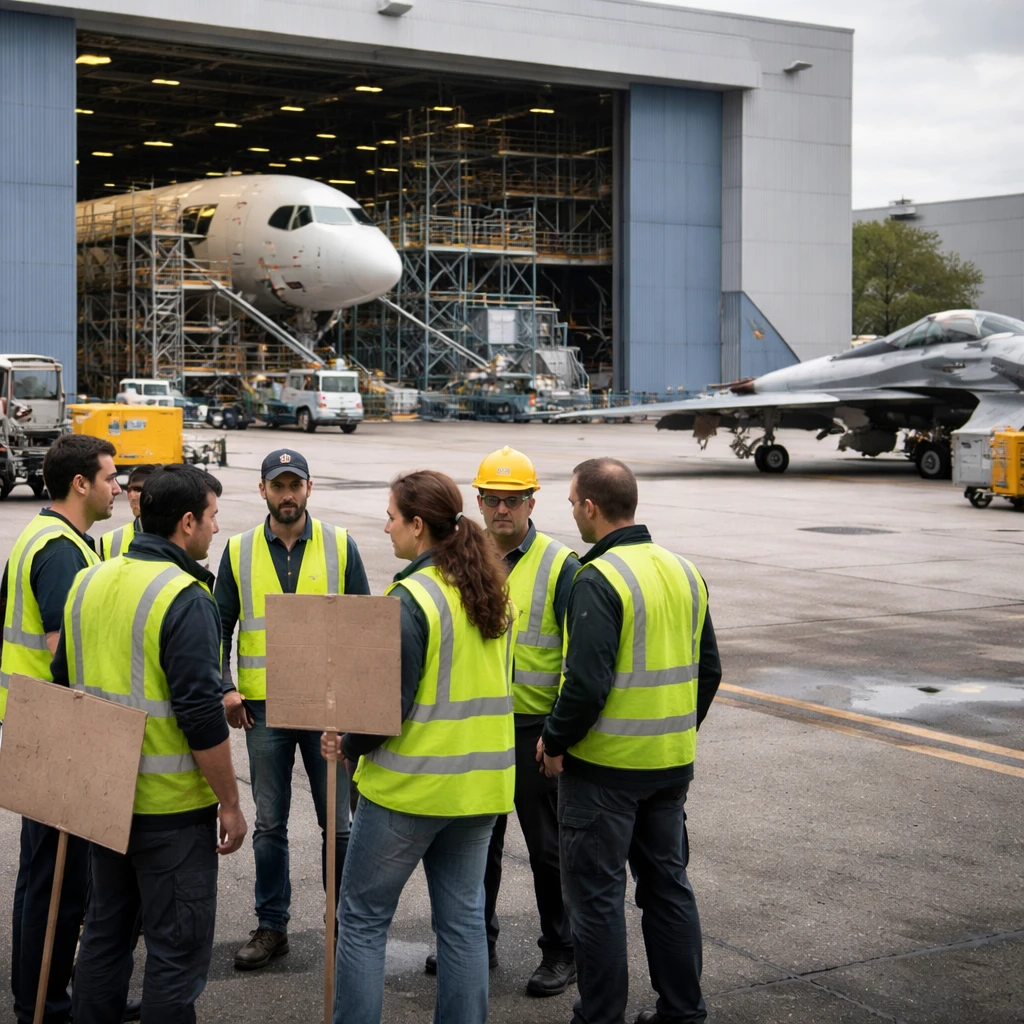
Airbus production and labour relations in Spain saw another flare-up on Tuesday as workers represented by the CGT, UGT and UTIL unions resumed strike activity after deeming the company's latest offer on wage increases and remote-working arrangements "insufficient." The action marks a continuation of on-and-off industrial disruption that has affected Spanish operations since July, with August 25 representing the first resumption of activity after the holiday period.
The company said it was assessing what additional consequences this new round of strikes would have across its production obligations, customer contracts, institutional commitments and corporate reputation. Airbus also reported that it had held a meeting with union representatives on the preceding Friday, at which it committed to ensuring wage rises in line with inflation and to reinstating prior remote-working agreements. Airbus said it remained committed to further talks aimed at converting those proposals into a mutually agreed contract.
According to Airbus' first-half 2026 workforce disclosures, the company employed roughly 14,000 people in Spain: about 4,000 in Airbus Commercial, roughly 9,000 in Defence & Space and around 500 in Helicopters. Reports indicate that approximately 40% of the Spanish workforce is affected by the strike action. The industrial stoppages have so far had limited impact on production, a condition attributed in reports to the high proportion of white-collar employees among those taking part. Facilities named as affected include Getafe, San Pablo and Tablada, Illescas, Albacete and Cadiz.
On the defence procurement front, the U.S. Department of State has approved a foreign military sale of BAE Systems' Advanced Precision Kill Weapon System II (APKWS II) laser-guided rocket to Italy, according to a Janes article cited in reports. The package, intended for integration onto Italy's Typhoon aircraft in a counter-unmanned aircraft systems role, covers 5,031 systems and is valued at up to $364 million. The scope of the sale includes launchers, warheads, rocket motors and technical support.
In related security and technology cooperation, the British government announced on Monday that it has signed a partnership with Ukraine to jointly develop artificial intelligence tools for defence use. Reported by Reuters, the agreement allows UK researchers access to a Ukrainian battlefield data platform that is used to train military AI systems. The collaboration encompasses pilot projects applying AI-enabled sensors, as well as research into low-power AI chips aimed at drones and other autonomous systems.
The UK announcement follows separate news that MBDA received authorization to release classified information on British-made components used in the SCALP cruise missile to Ukraine, a development noted alongside the AI partnership.
Market assessments noted in reports show Jefferies has a "hold" rating on Airbus, with shares quoted at C202.70, and a "hold" on BAE Systems, with shares at 2,097.00 pence. The ratings and quoted share levels were provided in the coverage referenced in the original reporting.
The three developments - resumed industrial action at Airbus in Spain, the approved U.S. sale of guided rockets to Italy, and the UK-Ukraine AI collaboration - touch on different but interlinked parts of the aerospace and defence sector, with labour relations, procurement approvals and technology partnerships each presenting separate operational and market considerations.