
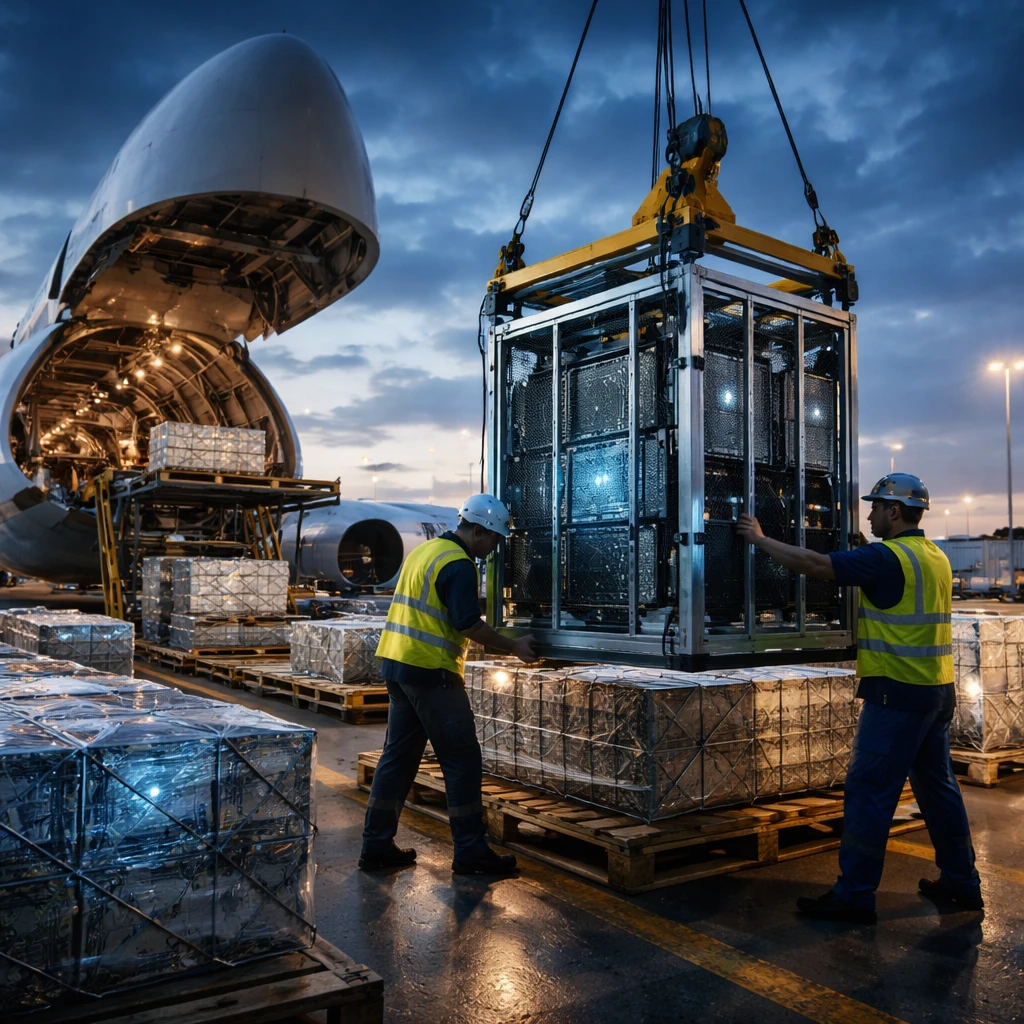
The international race to deploy artificial intelligence is altering Asia's air cargo landscape, with carriers and freight operators shifting emphasis from pandemic-era parcel trade to higher-value semiconductor and data centre shipments.
Unlike the short-term parcel boom after COVID-19, current demand tied to AI infrastructure reflects long-term, contract-driven shipments. Airlines and logistics companies say orders for advanced memory chips, processors and server components are being placed on a multi-year basis and are backed by plans for hundreds of billions of dollars of investment in data centres.
At the same time, tighter rules on low-value imports in the United States and the European Union are reducing the cross-border e-commerce traffic that powered much of recent airfreight growth. Those regulatory shifts, industry analysts say, have erased a previously dominant growth pillar for parcel shipments.
Visibility and multi-year horizons
Industry analytics firm Xeneta has highlighted the change. Niall van de Wouw, Xeneta's chief airfreight officer, noted in the firm’s mid-year outlook that "e-commerce was air freight’s single biggest growth pillar, but that is no longer the case." The firm also reported that global semiconductor sales more than doubled year-on-year in April, the strongest recorded growth since records began in 1986.
For carriers, that new mix means demand is unusually visible and often extends several years into the future. Jaedong Eum, executive vice president and head of cargo at Korean Air, said advanced high-tech cargo has quickly become a core growth driver and that orders for high-bandwidth memory chips and processors already stretch two to three years ahead while demand still outstrips supply. Korean Air reported cargo revenue jumping 46% in the second quarter to 1.54 trillion won ($1.07 billion), driven by shipments tied to AI chips, server racks and data centre equipment that the airline said have overtaken China-origin e-commerce shipments as its primary growth engine.
Regulatory headwinds for e-commerce
Policy changes are undercutting the low-value parcel flows that used to underpin much of air cargo growth. The United States ended duty-free de minimis treatment for low-value imports from China last year, and the European Union abolished its own duty-free threshold this month. The effect is visible in trade statistics: China’s low-value and e-commerce exports fell 7% in May, marking a sixth consecutive monthly decline.
Retailers and carriers are already flagging impact. Fast-fashion platform Shein said those regulatory changes had hurt its U.S. business and would likely create further headwinds in Europe. Japan’s ANA Holdings described the EU change as a downside risk for the wider cargo market even while noting that semiconductor-related shipments remain robust.
Geography of the new flows
The altered cargo mix is reconfiguring trade routes across Asia. Japan remains an exporter of semiconductor manufacturing equipment, South Korea produces advanced memory chips, and Taiwan is the centre of cutting-edge chip production. Meanwhile, countries such as Vietnam, Malaysia, Thailand and Singapore are becoming increasingly important as manufacturing and assembly locations for AI servers bound for North America and Europe.
Singapore’s Changi Airport recorded freight throughput growth of 8.7% year-on-year in the first half of the year, which Lim Ching Kiat, the airport group’s executive vice president for air hub and cargo development, attributed to strong global semiconductor demand.
Airlines are responding by rearranging schedules and capacity around these flows. Japan Airlines said technology products accounted for roughly 80% of the increase in air exports from Asia excluding China over the past year and has expanded freighter services linking semiconductor hubs such as Taipei, Bangkok and Hanoi with Tokyo's Narita airport.
ANA is integrating Nippon Cargo Airlines in order to reallocate large freighters to trans-Pacific and European routes while using its Asian network to collect semiconductor cargo from across regional manufacturing centres. In Taiwan, China Airlines has added freighter flights to Southeast Asia as production diversifies, and cited AI-related demand as a factor in lifting cargo volumes 8.1% in the first half of the year. EVA Airways said shipments tied to AI now represent as much as half of its cargo revenue.
Handling, value and infrastructure pressure
Airlines and industry bodies note that AI hardware differs from typical e-commerce goods. Shipments often consist of delicate, high-value items such as semiconductor manufacturing equipment, graphics processors and complete server racks that require specialized handling and rapid transit to meet data centre project schedules.
The International Air Transport Association (IATA) estimates that AI-related goods accounted for 53.5% of the value of goods moved by air in 2025, even though they made up only 7% of cargo volume. That combination - high value and relatively compact size - makes air transport worth the premium for many of these shipments.
Carriers are adopting new systems and operations to manage the change. Cathay Pacific said it had implemented software to automatically determine how semiconductor equipment and AI hardware should be loaded and secured inside aircraft. At the same time, the surge in high-value shipments is stretching physical infrastructure: Dimerco Express Group reported that Taipei’s air cargo hub reached capacity in July, tightening freight space on routes to the United States and within Asia.
Looking ahead, Korean Air’s Eum said the carrier expects strong cargo demand to continue through the second half of 2026 as major technology companies roll out next-generation AI processors and continue long-term infrastructure investments.
Key points
- AI-linked demand for semiconductors, processors and data centre equipment is prompting airlines to reconfigure routes and capacity around semiconductor manufacturing hubs in Asia.
- New import rules in the U.S. and EU are weakening low-value cross-border e-commerce, reducing a once-dominant source of air cargo growth.
- Airlines, airports and logistics providers are adapting operations and software to handle higher-value, time-sensitive AI hardware, while some hubs are reaching capacity constraints.
Risks and uncertainties
- Regulatory changes on low-value imports in the U.S. and EU could continue to depress e-commerce volumes and affect carriers and parcel-focused logistics firms.
- Capacity constraints at key cargo hubs, such as Taipei, may tighten freight space and raise costs or cause routing disruptions for AI-related shipments.
- Any slowdown or delay in planned data centre investment or multi-year chip orders would reduce the visibility that currently underpins airline cargo planning.