
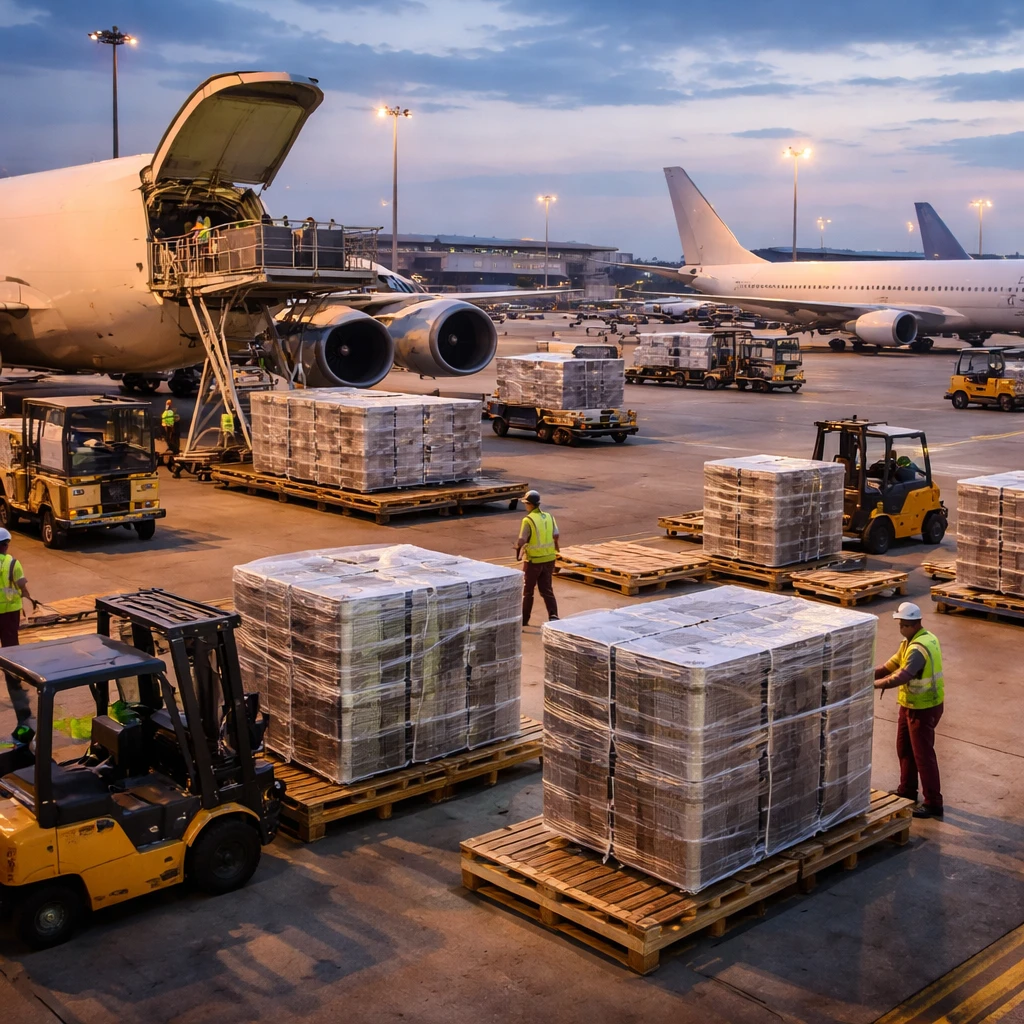
SATS’ chief executive, Kerry Mok, told Reuters that air cargo demand linked to AI data-centre projects remains strong and shows no sign of waning, even as investors question the durability of AI-related capital spending. Mok, who runs the Singapore-based SATS, said capital equipment shipments - notably server racks and semiconductors - have been the principal contributors to the company’s air cargo growth over the past year.
"Some data-centre builds are multi-year projects, which means there is a constant demand for that... It’s good for us," Mok said in an interview on Wednesday. He added that SATS is in the midst of the air cargo market’s annual peak season and is not observing any decline in AI-driven demand. "The numbers are pretty robust," he said.
SATS’ cargo customers cited in the company’s most recent financial results presentation include Singapore Airlines, Turkish Airlines and Atlas Air. Mok said the Americas have emerged as SATS’ fastest-growing market this year after a difficult prior period when tariffs and the removal of the "de minimis" exemption to duties on low-value packages weighed on flows into the United States. "This year, our Americas are growing double digit, and it’s coming back very nicely," he said.
He noted that SATS has been handling "a lot of data-centre products being shipped into the US" and has observed a rise in charter flights arriving into and departing from the country. Mok highlighted that charter operations have become "far more important" as Middle East carriers cut passenger services, which in turn reduced belly-hold capacity for cargo. The resulting shift elevated the role of charter lift in maintaining cargo throughput.
For the quarter ended September 30, SATS reported revenue of S$1.71 billion, equivalent to $1.33 billion, a 9% increase compared with the prior period. Management attributed the rise to higher cargo volumes alongside increased meal volumes from its catering business. The company’s cargo volume expansion outpaced International Air Transport Association (IATA) benchmarks for the 12th consecutive quarter: SATS’ volumes rose 8% in the July-September period versus 5.3% global growth reported by IATA.
Mok said the conflict in the Middle East contributed to a surge in cargo handling activity in Singapore, where volumes increased by more than 8% in SATS’ first half ended September 30. He described that pace as "unheard of" for a city-state whose cargo growth typically tracks GDP. The disruption to passenger services by some Middle East carriers, and the consequent reduction in belly-hold cargo space, helped drive demand for dedicated freighter and charter capacity.
Mok estimated that about 20% of the cargo SATS processes globally requires specialised handling. Much of this volume is capital equipment that cannot be subject to vibration, tilting or double stacking. He said the proportion of technology-related cargo is even greater within Singapore.
Last week, the United States announced restrictions on shipments of advanced chips to Southeast Asian countries including Malaysia, Singapore and Thailand, noting those routes have been used by some Chinese companies to access computing power for training AI models. When asked about the potential impact of such restrictions, Mok downplayed the risk to overall air cargo volumes, saying demand currently exceeds supply and that disruptions to flows into one country could shift demand elsewhere.
"If it’s a shortage of chip in one country, if suddenly I’m stopping the flow to that country, there’ll be new demand elsewhere," he said.
Key operational takeaways for markets and industry participants include the continued strength of capital-equipment shipments tied to AI deployments, the accelerating recovery of the Americas region for SATS, and the increasing reliance on charter flights to bridge capacity gaps created by reduced belly-hold space.
Currency conversion used in company reporting: $1 = 1.2896 Singapore dollars.