
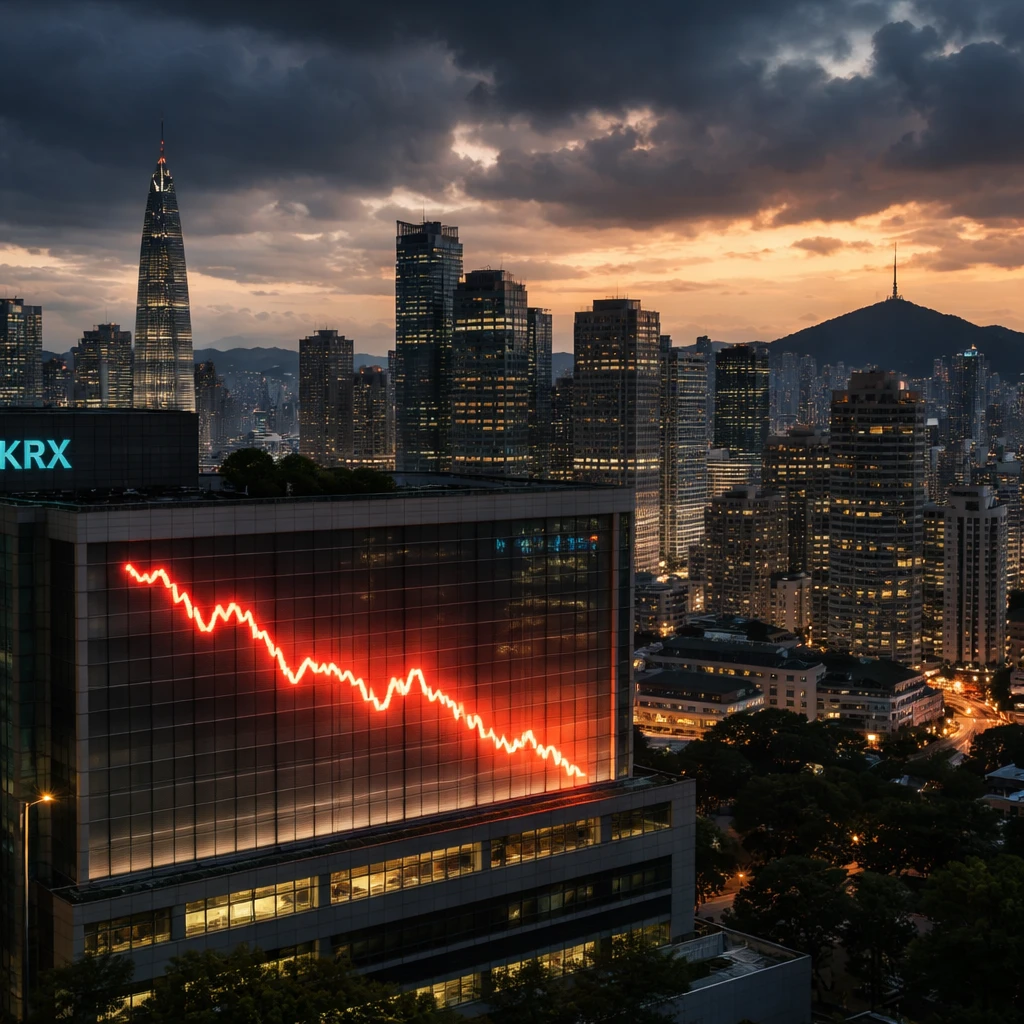
South Korea's equity market is flashing a stark contradiction: record corporate profits alongside a record exodus of foreign capital. The KOSPI, home to the world's dominant makers of AI memory chips, hit an all-time high in June but has since shed 44%, wiping out roughly 3.3 quadrillion won ($2.4 trillion) in market value. The decline comes even as Samsung Electronics and SK Hynix, which together account for nearly half of the index's value, have seen earnings surge ninefold and sevenfold, respectively, to unprecedented levels.
That divergence has left analysts pointing to a market driven less by corporate fundamentals than by a simple absence of buyers. Foreign investors are on track to sell Korean stocks for a seventh consecutive month in November, with cumulative net outflows reaching $115.2 billion - the largest retreat in LSEG data going back to the start of 2008.
“We’re essentially experiencing a full-fledged ‘Sell Korea’ trend,” said Han Jiyoung, an analyst at Kiwoom Securities in Seoul. “The challenge for the market now is to find a catalyst that could bring foreign investors back.”
Fundamentals vs. Flows
The disconnect is particularly striking given the shareholder-return plans unveiled by the two chipmaking giants. Samsung and SK Hynix have announced combined return programs for 2026 worth as much as 210 trillion won, including buybacks, dividends, and share cancellations. But with the end of those programs approaching, markets are on edge.
Responding to questions on Thursday, Samsung Electronics reiterated plans to return up to 110 trillion won to shareholders for 2026, saying its board would finalize the scale and execution of the remaining returns in late January. SK Hynix also reaffirmed plans to return about 100 trillion won through share buybacks and cancellations, adding that it would continue quarterly share repurchases and pay special dividends on significant investment gains.
Corporate buybacks had soaked up much of the foreign selling in recent months, but they are now easing off. Retail investors, still nursing losses from the selloff that began in June, may struggle to fill the gap.
The rout has been accelerated by the unwinding of leveraged single-stock ETFs, particularly those tied to SK Hynix in Hong Kong, which had fueled outsized gains on the way up but amplified the speed and depth of the decline.
Sentiment Sours on AI Trade
Sentiment around the AI trade has worsened markedly in recent weeks. The emphatic victory by Democrats in this month's US midterms fueled worries about a slowdown in data-center construction. Washington's restrictions on advanced chip supply to several US trading partners in Asia and Latin America have exacerbated those concerns.
“There’s a capitulation, where positions are shifting away from anything linked to AI into anything defensive, high quality and stable,” said Isaac Thong, a portfolio manager at the Aberdeen Asian Income Fund in Singapore. “Why it doesn’t feel like previous down cycles is because fundamentally things are still really strong in the AI world,” he said. “There’s a lot of confidence at a corporate level, at least in the shorter term.”
Last month, Samsung said chip supplies were expected to remain tight through 2028, while SK Hynix painted a similarly bullish picture of demand, pointing to an even longer supply crunch.
Goldman Sachs lowered its target on the KOSPI this week for the second time since the end of October, to 7,500 from 12,000, “to account for the market’s continued reluctance to fully price in fundamentals.” Still, the bank’s strategists wrote, “We still see Korea offering the greatest potential upside among regional markets.”
The KOSPI closed at 5,062.92 on Wednesday, still up 20% this year in local currency terms. Korean stocks trade at a substantial discount to global peers, with MSCI’s country gauge trading at a multiple of 3.27 times forward earnings, compared to 15.35 times for the MSCI All-Country World index, according to LSEG Datastream.
Political and Regulatory Overhang
Tighter regulation and other guardrails after the US midterms could eventually raise costs and slow the AI buildout, according to Seoul-based Sanjeev Rana, head of North Asia semiconductor research at CLSA. But given how important AI infrastructure is to the US economy and jobs, Rana expects most of the capacity needed to support AI’s growth to be built, even if the pace slows or other countries take up the slack.
In the medium term, “the elections and the changing political landscape doesn’t change the outlook in any meaningful way,” he said. “Earnings for 2027 are still pretty much in the bag.”
For now, the market’s path hinges on whether foreign investors return and whether buybacks can stabilize the floor. Without a clear catalyst, the ‘Sell Korea’ trade may persist, leaving one of the world’s cheapest major equity markets searching for conviction.