
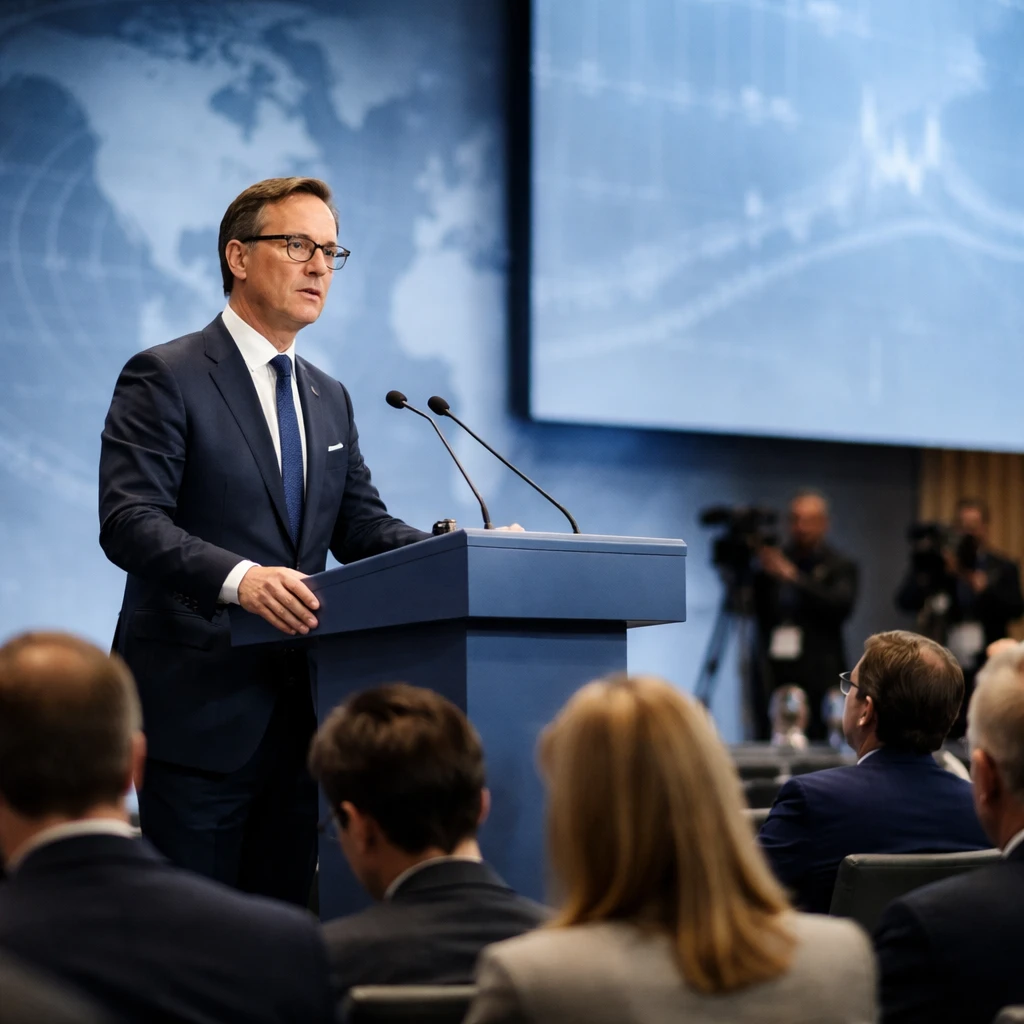
Bank of Canada Governor Tiff Macklem said in Paris that widening global imbalances are elevating financial stability risks as capital moves at greater speed and with reduced transparency through non-bank financial intermediaries.
Speaking at the Paris Europlace forum, Macklem said the pattern of global imbalances has shifted back toward wider gaps after narrowing in the years following the 2008-09 financial crisis. He warned that when trade and financial imbalances grow too large and persist over time they can transmit shocks that influence employment, inflation and financial security through channels such as trade flows, investment flows, exchange rates and asset prices.
"Canada is not a contributor to excessive global imbalances, but we are being knocked by increased trade tensions, and we could be sideswiped if financial stability risks crystallize," Macklem said, underscoring that adverse developments abroad can carry spillovers for the Canadian economy.
Macklem singled out China’s sizable and expanding trade surplus as a focal point of concern. He described China’s growth model as heavily dependent on investment and exports, with overinvestment in manufacturing generating excess capacity and exerting deflationary pressure. According to Macklem, attempts to export that excess capacity have triggered allegations of unfair practices and have prompted calls for trade restrictions and tariffs.
The governor emphasized the link between trade imbalances and capital flows: the U.S. trade deficit requires offsetting capital inflows from other economies. At the same time, he said the financial system has evolved in speed, scale and complexity, with non-bank financial intermediaries now accounting for a larger share of financial intermediation.
Macklem noted that regulatory strengthening of banks after the global financial crisis has coincided with a migration of riskier activities into non-bank intermediaries that operate outside the regulated banking sector. He highlighted that these non-bank entities generally do not face the same reporting requirements or supervisory scrutiny as banks.
The governor identified two material risks arising from current global capital flow dynamics. First, large capital inflows into the United States could be misallocated, stretching valuations in equities and credit. Second, such inflows could reverse abruptly. He warned that either outcome has the potential to transmit stress beyond U.S. borders.
On policy remedies, Macklem argued that rebalancing requires adjustments across major economies: China should raise consumption, the United States should increase saving, and Europe should boost investment. He pointed to China’s new five-year plan, which emphasizes strengthening consumption, and to European plans to raise infrastructure and defence investment as moves aligned with those objectives.
To reduce vulnerabilities, Macklem outlined three priorities for policymakers and market participants: preserve openness in trade and investment; improve investability by creating more safe assets and better conditions for firms to scale; and increase transparency through enhanced data on non-bank financial intermediaries, foreign exchange markets and cross-border capital flows.
Context and implications
Macklem’s remarks link structural trade patterns to financial market functioning and to cross-border capital dynamics. They stress coordination across policy areas - trade, macroeconomic policy and financial regulation - and call for better information on the growing non-bank sectors that are now central to global capital movements.