
Fitch Ratings has reduced its projection for world economic growth and raised its outlook for oil prices, citing the economic fallout from the ongoing U.S.-Iran conflict. The agency now forecasts global growth of 2.4% for the year, a 0.2 percentage point downgrade from its prior estimate.
In a report accompanying the revisions, Fitch economists said: "Forecast cuts have been widespread as higher inflation squeezes real wages, dampens consumption and raises companies’ input costs." The firm tied the weaker growth outlook directly to the energy shock sparked by disruptions to oil flows.
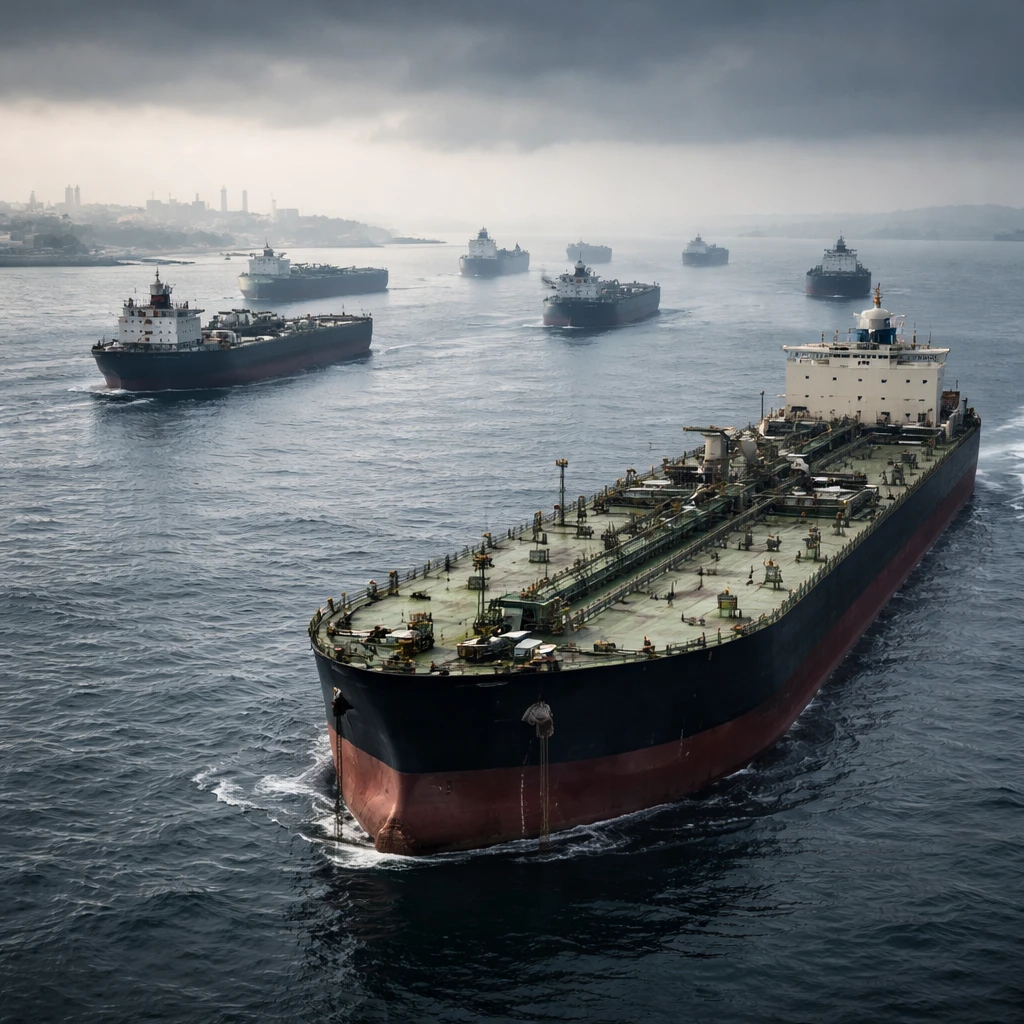
Fitch lifted its average Brent crude forecast for 2026 to $87 a barrel, up from a previous projection of $70. The revision reflects the extended closure of the Strait of Hormuz, the key maritime chokepoint for global oil shipments. Fitch noted that the waterway has been closed for 14 weeks and that reopening is unlikely before July, given the difficulty of negotiations between Washington and Tehran.
The ratings agency was careful to temper the severity of its baseline scenario, saying it remains well short of the scale of the 1970s oil crises when real oil prices approached $170 a barrel. It also pointed to the much smaller share of global economic output accounted for by oil today compared with 1980.
Fitch set out a more adverse scenario to illustrate potential downside risks: if oil averaged $100 a barrel, equity markets fell 10% and credit conditions tightened, the firm estimates U.S. growth over the following 12 months could decline to 0.8%, eurozone growth could fall to 0.3%, and China’s growth could slow to 3.4%.
Under Fitch’s baseline, U.S. growth is expected at 1.9% and eurozone growth at 0.9% - both reduced from earlier forecasts. By contrast, the agency raised its forecast for China to 4.6%, reflecting a stronger-than-expected first quarter and continued resilience in exports.
On monetary policy, Fitch anticipates the Federal Reserve and the Bank of England will hold policy rates steady this year and only begin cutting in 2027. It expects the European Central Bank to raise rates in June and then reverse course next year. The firm noted: "Policy rates are much higher than in 2021, labor market conditions and wage pressures are softer, and fiscal policy far less expansionary."
Fitch also highlighted one partial offset to the broader slowdown: a pronounced surge in global IT spending tied to AI activity. As Brian Coulton, Fitch’s chief economist, put it, "A very pronounced boom in global spending on IT is cushioning the impact on activity in the near term, particularly in Asia."
Key points
- Fitch cuts its global growth forecast to 2.4% for the year, trimming the previous estimate by 0.2 percentage points.
- Brent crude forecast for 2026 raised to $87 a barrel from $70, driven by the prolonged closure of the Strait of Hormuz.
- Under an adverse shock scenario - $100 oil, a 10% equity selloff and tighter credit - U.S., eurozone and China growth could slow sharply to 0.8%, 0.3% and 3.4% respectively.
Sectors impacted
- Energy and commodity markets, through higher oil prices and disrupted flows.
- Household consumption and real wages, via inflationary pressures.
- Corporate sector margins, through elevated input costs.
Risks and uncertainties
- Geopolitical risk - Continued closure of the Strait of Hormuz and uncertainty over U.S.-Iran negotiations could prolong supply disruptions, keeping oil prices elevated and pressuring global growth.
- Financial market stress - A scenario combining $100 oil, a 10% fall in equities and tighter credit conditions could significantly weaken growth in the U.S., eurozone and China.
- Inflation-wage dynamics - Higher inflation that compresses real wages and curbs consumption may further dampen demand and squeeze corporate profit margins.
Fitch’s revisions sit alongside similar warnings from other international organisations as the conflict moves into its fourth month and continues to unsettle energy and commodity markets. The ratings firm’s outlook underscores the transmission channels from geopolitical shocks to inflation, spending and monetary policy paths.