
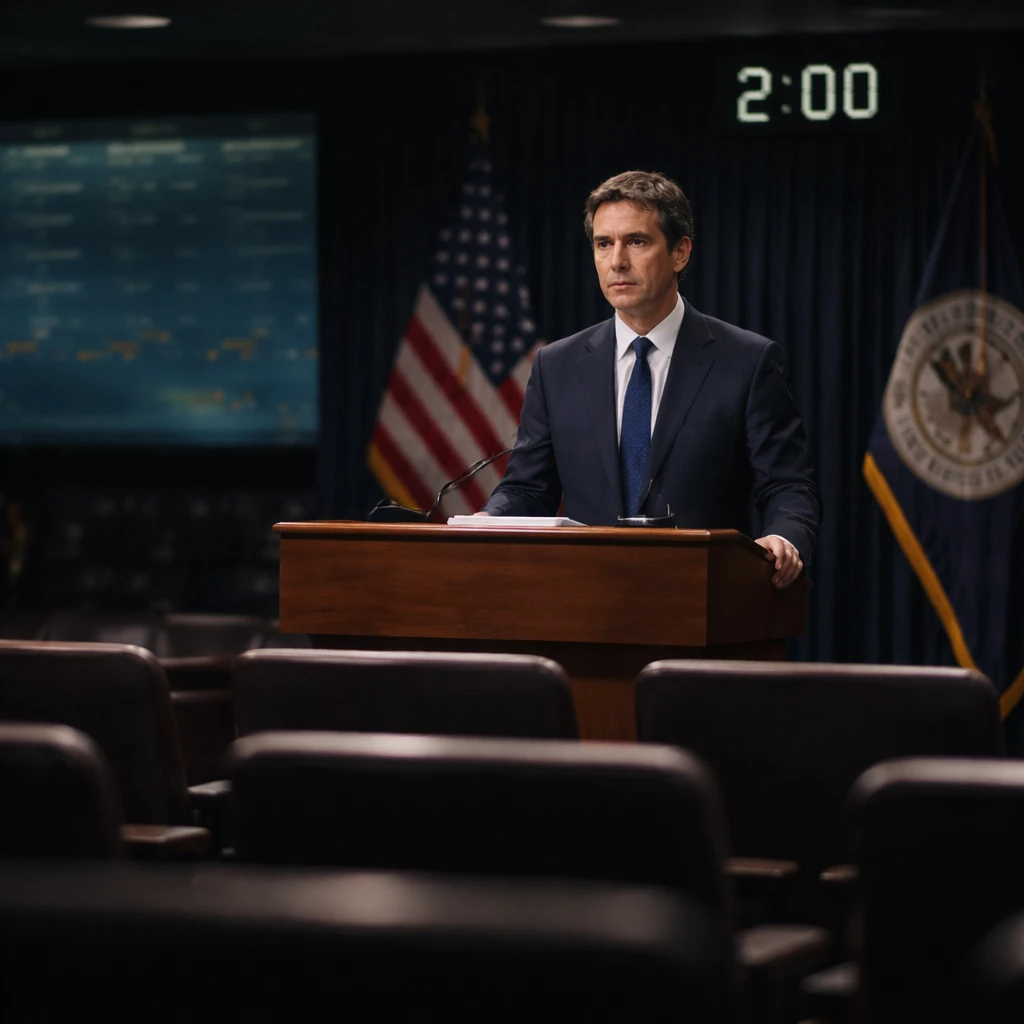
The Federal Reserve appears more likely to leave interest rates unchanged when it announces its decision at 2 p.m. EDT (1800 GMT) on Wednesday, yet the result is clouded by an uncommon level of uncertainty because Chair Kevin Warsh has chosen to provide minimal explanation and no forward guidance around policy moves.
Warsh, who assumed the chairmanship in May, takes the podium for a press conference about half an hour after the decision. His approach - signaling little about the central bank's future policy path - has injected unpredictability into the market's assessment of rate risk. At the previous meeting, Warsh won unanimous support from colleagues to maintain the Fed's benchmark interest rate in the 3.50% - 3.75% range, but officials were otherwise evenly divided among the 18 voting members on whether additional tightening will be required this year. That even split means the chair's vote and messaging could be decisive for the committee's direction.
Warsh has stated he has "no tolerance" for inflation that has been running above the Fed's 2% target for more than five years. Until last month, inflation pressures had been strengthening, driven in part by the U.S.-led conflict with Iran lifting global fuel and food prices, and by demand related to investment in data centers and other spending tied to artificial intelligence. Those factors, alongside other dynamics, helped accelerate inflation before June.
Since that meeting, however, key price pressures have shown signs of easing. Consumer price inflation slowed to 3.5% year-over-year in June from 4.2% in May, and oil prices fell sharply this week amid renewed hopes for another ceasefire between the U.S. and Iran. Those developments have tempered the immediate case for a rate increase.
Still, the chair's deliberate choice to offer little guidance complicates forecasts. "We think the Fed will probably not hike. It would be odd to do so right after the better June inflation print, given an uncomplicated path to hike in September if needed," said Krishna Guha, vice chairman of Evercore ISI. "But we cannot take the probability too low given Warsh's refusal to set out his strategy. ... We do not see broad pressure on the committee to hike now. But the votes are there if Warsh wants to go."
In the run-up to the two-day meeting, some regional Fed presidents signaled a willingness to tighten policy further. Dallas Fed President Lorie Logan and Cleveland Fed President Beth Hammack both indicated support for higher rates aimed at returning inflation to the 2% objective. Economists expect at least one of them to dissent should the majority of policymakers opt to leave rates unchanged.
Market pricing places roughly a one-in-three chance on a quarter-percentage-point rate hike. A few forecasters argue that Warsh could choose to surprise markets this week; Neil Dutta, head of economics at Renaissance Macro Research, suggested in a note that "It's better to do a little now instead of a lot later."
The Fed's policy posture has shifted over the past year. Under Warsh's predecessor, Jerome Powell, the central bank cut rates three times in 2025 to counter a perceived weakening in the labor market that subsequently stabilized. Inflation, which had appeared to be cooling last year, regained momentum in 2026 even though June's data showed improvement.
"If last year was about taking out some insurance, this year is about giving some of it back," Dutta wrote, capturing the tighter stance some policymakers now favor.
A rate increase would likely be unwelcome in the White House. President Donald Trump has publicly criticized the Powell-led Fed for not delivering the deep rate cuts he sought to stimulate growth, and he selected Warsh to lead the central bank with the expectation that the move could open the door to easier policy. Trump has blamed other members of the Fed's Board of Governors for constraining Warsh's ability to shift rates. "We should have the lowest interest rate in the world," he told reporters aboard Air Force One on Monday. "Kevin is fantastic, but he's got a board, and the board members are very political."
Despite political pressure, a rate cut has attracted almost no support among Fed officials. The committee's latest projections, released after last month's meeting, showed only one policymaker expecting that rates would be lower by the end of this year.
On the opposite end of the spectrum, some analysts have even considered the possibility of an unusually large move. One forecaster outlined a scenario in which the Fed could deliver a half-percentage-point hike. Derek Tang of forecasting firm LH Meyer wrote that "In our view, hiking at all (especially 50 basis points) would be driven more by posturing and credibility motives," and argued such a sizable increase would eliminate doubts that Warsh had yielded to presidential pressure and would signify the "regime change" the new chair promised.
At his June 17 post-meeting press conference, Warsh said he regards financial markets as a crucial source of information for policymakers. He has explained that one reason for avoiding explicit guidance is to compel market participants to respond to incoming economic data rather than to policymakers' forward-looking signals. Barclays economists warned that "With little guidance on the reaction function under the new chairman, markets are filling the void with speculation that Warsh may be eyeing a surprise hike to reinforce anti-inflation credibility," and cautioned that "The risk is that the speculation itself begins to shape policy."
What to watch today
- The policy announcement at 2 p.m. EDT and Warsh's press conference roughly 30 minutes later.
- Any change in the Fed's language about inflation risks or the expected path for rates, and whether Warsh offers more forward guidance than he has in recent weeks.
- Potential dissents by regional presidents who have signaled support for additional tightening.
The decision and subsequent briefing will be closely scrutinized for signs of how the Fed intends to reconcile easing inflation readings with lingering upside risks and political pressure from the executive branch. With voting members split previously and the chair keeping his cards close, markets and participants will be watching both the vote and the tone of any comments for clues to future action.