
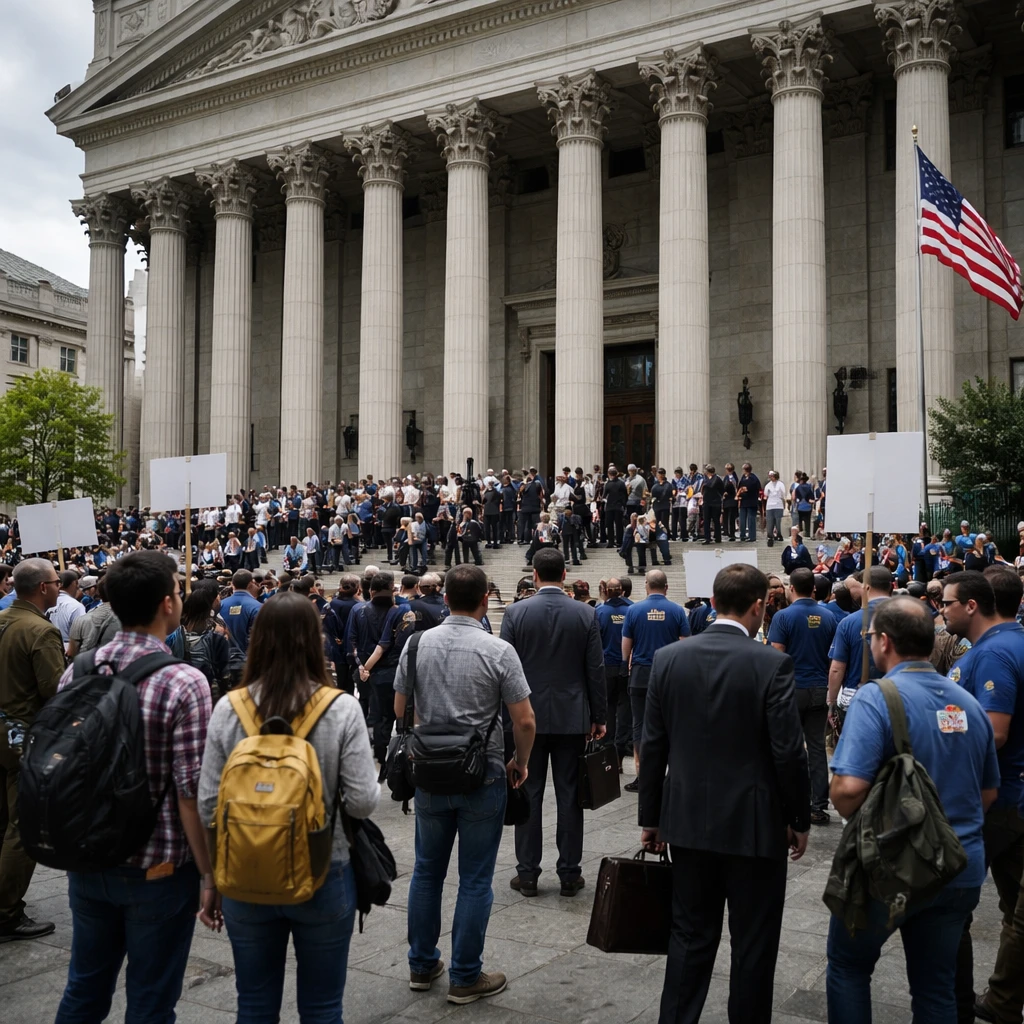
President Donald Trump entered his second term proclaiming a mission to "restore freedom of speech and end federal censorship," but the judiciary has delivered repeated findings that his administration has in practice constrained constitutionally protected expression. Courts across the country have issued 75 lower-court rulings concluding actions by the federal government violated First-Amendment protections for speech, religion or the press.
The rulings, identified through a review of federal filings and legal databases, include determinations that the administration chilled or suppressed speech by individuals and groups opposing its policies. Judges have found the government detained, deported and revoked visas of foreign students and faculty because of their pro-Palestinian advocacy; rescinded grants to universities and researchers that declined to adopt the administration's preferred viewpoints; retaliated against law firms for their legal work; and used excessive force at public demonstrations.
U.S. District Judge William Young, a Boston-based jurist appointed by President Ronald Reagan, summarized the constitutional stakes in one such case. He wrote that "The President’s palpable misunderstanding that the government simply cannot seek retribution for speech he disdains poses a great threat to Americans’ freedom of speech." In a September ruling, Judge Young found unlawful the detention, deportation and visa revocations directed at foreign students and faculty because of their political advocacy.
Examples from the bench
Court opinions have addressed a range of government conduct. Federal judges have:
- Blocked terminations of grants to universities - including at Harvard - that the administration viewed as insufficiently aligned with its ideological aims.
- Found retaliatory treatment of law firms, where administration actions targeted firms because of their prior legal representation of political opponents.
- Ruled that federal agencies used excessive force at protests or otherwise interfered with demonstrators' expressive rights.
These findings often identified viewpoint discrimination or retaliation as the motivating factor behind agency decisions.
Scale of the litigation and counting method
The 75 cases that resulted in rulings against the administration were part of a broader set of 93 matters during the president’s second term in which judges addressed First-Amendment claims. The tally treated consolidated lawsuits or multiple rulings in a single suit as one case and excluded filings by self-represented litigants. Some decisions catalogued in the review were preliminary - issued to address urgent, time-sensitive requests before a full merits hearing.
By comparison, in the prior presidential term under Democratic President Joe Biden, federal judges considered 27 First-Amendment challenges and ruled against that administration in 13 cases. Most of those rulings related to vaccine mandates and religious-freedom claims.
Who sued and who won
Many of the lawsuits were brought by critics of the administration or by media organizations challenging restrictions on their reporting capabilities. Notably, the New York Times and the Associated Press sought court orders to block limits on their access to the White House and Pentagon; both news organizations won at the lower-court level, although some of those decisions remain stayed pending appeal.
The administration appealed roughly two-thirds of the adverse rulings and chose not to contest others. For instance, it refrained from appealing orders preventing interference with classroom discussion by academics and decisions that blocked cuts to longstanding grants awarded to legal and medical organizations that opposed administration policies.
Appeals and mixed results
When the government did appeal, results were mixed. In 15 of the 75 cases that went against the administration, appellate courts either stayed the district court's First-Amendment ruling or reversed it entirely. Two appellate panels this year overturned lower-court decisions that had led to the release of pro-Palestinian campus activists associated with Columbia University - Mahmoud Khalil and Mohsen Mahdawi - on jurisdictional grounds rather than on the merits. Attorneys for Khalil have said he intends to seek review by the U.S. Supreme Court.
In another notable appellate outcome, the San Francisco-based 9th U.S. Circuit Court of Appeals in February overturned a district court order that had prevented the administration from removing collective bargaining rights for hundreds of thousands of federal employees. The unions had argued the change was a retaliatory measure in response to their advocacy, in violation of the First Amendment. A three-judge panel concluded the administration would have taken the same action even without any intent to punish, and thus reversed the lower-court decision on the merits.
Other appeals courts have affirmed district court rulings against the administration. In May, the 9th Circuit agreed with a lower-court judge that rescinding federal grants awarded to University of California researchers as part of the administration’s anti-DEI initiative amounted to viewpoint discrimination.
President’s rhetoric and executive actions
Trump campaigned on opposition to what he called an "online censorship regime" he attributed to the prior administration, arguing it pressured technology platforms to suppress alleged misinformation during the COVID-19 pandemic and after the 2020 election. He continued themes from his first campaign about resisting "cancel culture," framing social and professional censure as a disincentive to conservative expression.
Within hours of his 2025 inauguration, the president signed an executive order titled "Restoring Freedom of Speech and Ending Federal Censorship," which directed that no federal agency or employee should unconstitutionally abridge Americans' speech rights. Yet critics contend that subsequent executive directives and administrative policies undercut that pledge, instituting measures aimed at limiting funding for initiatives the administration labeled as promoting "gender ideology" or diversity, equity and inclusion - issues central to many of the First-Amendment suits.
Legal scholarship and historical comparison
Timothy Zick, a William & Mary Law School professor who authored a book titled "Trump 2.0: Executive Power and the First Amendment," said the scope of executive action to limit expression is historically notable. Zick observed that no president in modern times had taken similarly broad measures to suppress dissent since earlier 20th-century episodes, and he emphasized that current First-Amendment precedents make the constitutional boundaries far clearer than in past eras.
A federal appeals court in Washington heard arguments in May and appears inclined to uphold lower-court decisions that found the administration’s campaign against law firms and lawyers violated free-speech protections. One focal case was decided in May by U.S. District Judge Beryl Howell, an Obama appointee, who sharply criticized the administration’s targeting of Perkins Coie. Judge Howell’s order condemned an executive order that suspended security clearances for Perkins Coie lawyers and barred them from federal buildings because of the firm’s prior representation of political opponents, writing that "Settling personal vendettas by targeting a disliked business or individual for punitive government action is not a legitimate use of the powers of the U.S. government or an American President."
Practical consequences and administration posture
The judicial findings have produced a patchwork of outcomes - some sustained through appeals, others reversed or stayed. Administration officials have frequently labeled judges who ruled against them as "activists" encroaching on executive authority. White House spokeswoman Abigail Jackson criticized the First-Amendment rulings, asserting that "the federal judiciary has repeatedly endangered and obstructed the election choices of the American people with its unlawful rulings."
Legal battles are ongoing in multiple courts, and some decisions catalogued here are not final. The administration’s combination of litigation, selective appeals and some decisions not to challenge rulings has produced a dynamic legal landscape in which First-Amendment claims remain a persistent flashpoint between the executive branch and the federal judiciary.
What remains unresolved
A number of the cases identified are still moving through the appellate system, and several rulings cited were interim. Plaintiffs range from university researchers and student activists to media organizations, unions, law firms and providers of federal services. The courts’ continuing engagement with these disputes will determine, case by case, whether district-court findings of unconstitutional government action withstand further review or are overturned on appeal.
For now, the federal bench has registered substantial and repeated concerns about administration actions that, judges have found, curtailed protected speech in multiple contexts.