
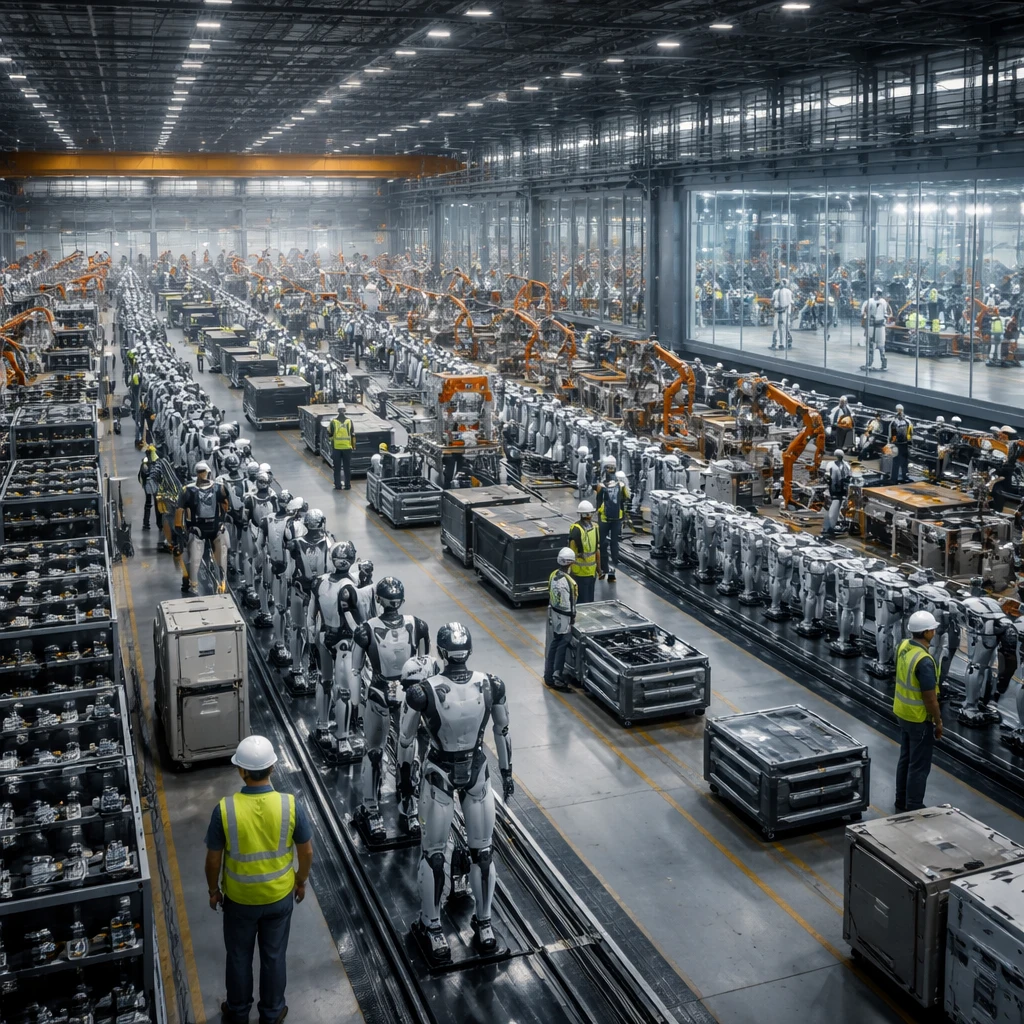
The global contest for leadership in artificial intelligence and robotics is taking on a distinctly industrial character, according to an Alpine Macro report published on May 12, 2026. The analysis emphasizes that raw compute and frontier research, while important, are no longer the sole determinants of advantage - large-scale manufacturing, dense deployment and on-device data generation are becoming central.
The report describes a bifurcated hardware landscape. The United States preserves a clear lead in the so-called "brain layer" through advanced semiconductors and autonomy software. China, by contrast, has consolidated strength in the "body layer" - the physical units, actuation systems, and the manufacturing ecosystems that produce them at scale.
Beijing has incorporated embodied intelligence into formal industrial strategy. Under the 15th Five-Year Plan, the Chinese government has identified this area as a national priority and committed billions of dollars in targeted economic development funds to support it. Alpine Macro highlights that this state-directed approach to industrial policy is central to China’s strategy. As Dan Alamariu, Alpine Macro Chief Geopolitical Strategist, put it: "State capitalism is needed to 'win' at AI. AI success depends on forms of heavy state interventionism, a departure from techno-libertarian dreams."
The report points to a widening gap in physical deployment between China and the United States. Data from the International Federation of Robotics show China installing more than 295,000 industrial robots annually, compared with 34,200 units in the United States. Alpine Macro ties these installation figures directly to the pace of embodied learning - operational hours in real-world settings that generate training signals not replicable in purely digital datasets.
China has industrialized the process of collecting embodied data through state-backed initiatives such as "robot training farms." An example cited is the Wuhan Hubei Humanoid Robot Innovation Center, which the report says produces about 100 hours of usable embodied data per day. That continuous, real-world operation is presented as a lever that accelerates improvements in robotic performance and reliability.
The industrial concentration in China also enables cost compression among leading producers. Alpine Macro cites Unitree as a case study - a company that expanded humanoid robot shipments from 5 units in 2023 to 3,551 units in the first nine months of 2025, while its average unit price declined from roughly RMB 593,000 to RMB 168,000. The report frames such pricing dynamics as a product of high manufacturing density and integrated supply chains.
U.S. robotics efforts are characterized in the report as more dependent on frontier-grade silicon and high-fidelity simulation. The American model embeds advanced compute stacks directly in physical platforms and uses synthetic data generation techniques - including simulations like NVIDIA’s Cosmos world models - to supplement embodied experience. Nevertheless, Alpine Macro notes structural dependencies that temper this approach: the United States remains reliant on Asian manufacturing channels for many hardware components.
The report quantifies several aspects of China’s control over component markets. It estimates China supplies 80% to 90% of key hardware components worldwide, holds 93% of the permanent magnet market used in robot actuators, and controls nearly 99% of heavy rare earth element processing needed for high-strength robotic motors. Those concentrations are presented as material enablers of China’s manufacturing and deployment advantage.
Key points
- China leads in physical deployment and manufacturing scale - More than 295,000 industrial robot installations annually versus 34,200 in the U.S. - impacts manufacturing and industrial automation sectors.
- State-directed funding and policy focus - The 15th Five-Year Plan and billions in specialized funds prioritize embodied intelligence - influences capital allocation across industrial robotics and supply-chain investments.
- Supply-chain concentration - China’s dominant share of key components and processing for magnets and heavy rare earths reinforces cost and production advantages - relevant for hardware suppliers and semiconductor-dependent device manufacturers.
Risks and uncertainties
- Dependence on state-led intervention - Alpine Macro frames success in AI as linked to heavy state involvement, which introduces political and policy risk for firms and investors in the robotics ecosystem.
- Concentrated supply chains - High shares of components and processing in China create vulnerability for global manufacturers who rely on those inputs, affecting industrial hardware and manufacturing sectors.
- Structural U.S. reliance on Asian manufacturing - The United States’ focus on compute and simulation remains constrained by hardware sourcing dependencies, which could limit deployment speed in physical robotics markets.
Bottom line
Alpine Macro’s assessment suggests that control of manufacturing capacity, component markets and real-world deployment will be decisive in capturing the bulk of economic value from robotics. While the United States retains technological strengths in semiconductors and simulation-driven autonomy, China’s concentrated production clusters, state support and data-generating deployment infrastructure give it a pronounced edge in scaling embodied intelligence.