
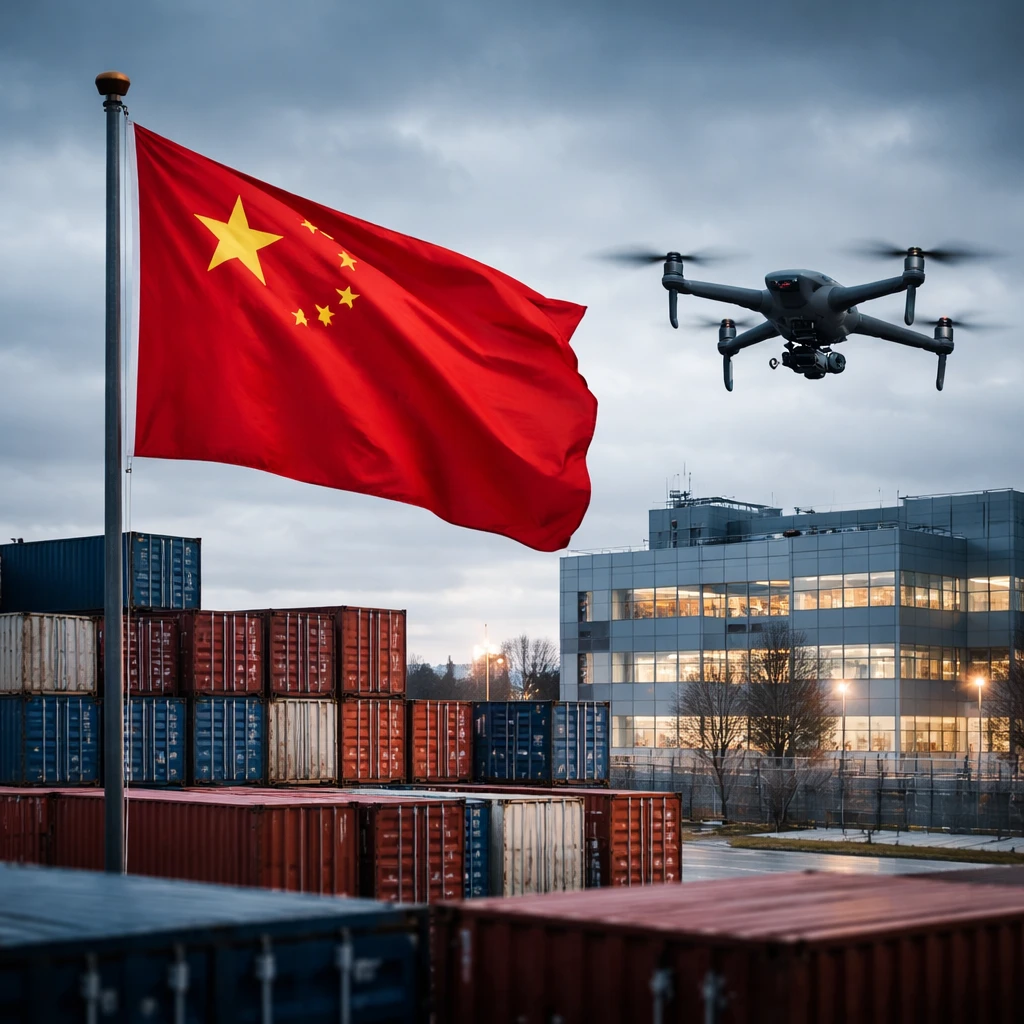
China has rolled out new countermeasures aimed at U.S. organisations and at shipments of drone-related technologies to the United States, framing the moves as responses to recent U.S. policies targeting Chinese telecom operators, testing laboratories, drones and other technology sectors. Beijing also referenced Washington’s recent step of adding more than 40 Chinese entities to the U.S. Uyghur Forced Labor Prevention Act entity list as part of the rationale for its actions.
The measures announced by China's Commerce Ministry include placing seven U.S. entities on a countermeasures list that bars transactions and cooperation with organisations and individuals in China, tightening export review processes for drone sales to U.S. buyers and stopping the use of U.S.-based agencies for some factory inspections required under China’s product-certification system.
Among the organisations named is Compliance Testing, a laboratory and certification-services firm based in Mesa, Arizona. China’s order prevents Chinese organisations and individuals from conducting transactions or cooperating with the company. Chinese authorities said the firm had assisted and supported actions taken by the U.S. Federal Communications Commission that damaged China’s interests. Compliance Testing conducts testing and certification work for products such as wireless devices, electronics and telecommunications equipment to establish whether they meet applicable technical, safety and regulatory standards prior to sale.
Beijing imposed the same restriction on six other U.S. entities: Applied DNA Sciences, Stratum Reservoir, Altana Technologies, the Responsible Business Alliance, Verité Group and Human Rights in China. Chinese authorities accused those six organisations of supporting U.S. sanctions linked to China’s far-west region of Xinjiang, an area where Washington and advocacy groups allege there have been widespread human and labour rights abuses. Several of the named organisations are involved in supply-chain tracing or labour-risk assessments.
The published Chinese orders do not set out asset freezes, travel bans or further penalties against the seven named entities. The language of the orders specifies only that organisations and individuals within China are prohibited from engaging in transactions or cooperation with the listed companies and groups.
Separately, China announced it would conduct stricter, case-by-case reviews of exports to the United States of controlled drones, key drone components and related technology. The Commerce Ministry said these shipments will no longer be eligible for the standard licensing conveniences that simplify approval processes, making licences harder to obtain for items already governed by China’s dual-use export-control rules.
The measure does not amount to an outright ban on drone exports to the United States, but it raises the administrative hurdles for U.S.-bound shipments. That increased scrutiny could have repercussions for U.S. drone manufacturers and other U.S. purchasers that rely on Chinese-made drone components, equipment or related technology.
China’s actions represent the latest escalation in an ongoing cycle of trade and technology tensions between Beijing and Washington. In recent years, U.S. policymakers have tightened restrictions on Chinese access to U.S. technologies and to the U.S. market on national-security and human-rights grounds. Beijing, in turn, has imposed export controls on materials such as rare earths and restricted other goods it considers critical to U.S. manufacturing supply chains, and has sanctioned U.S. companies it asserts have lobbied or aided actions adverse to Chinese interests.
Impacted sectors - Telecoms, product testing and certification services, drone manufacturing and broader electronics supply chains are directly implicated by these measures. Companies and buyers that depend on cross-border testing, certifications and Chinese components for drones and other tech products may face greater administrative friction and potential delays.