
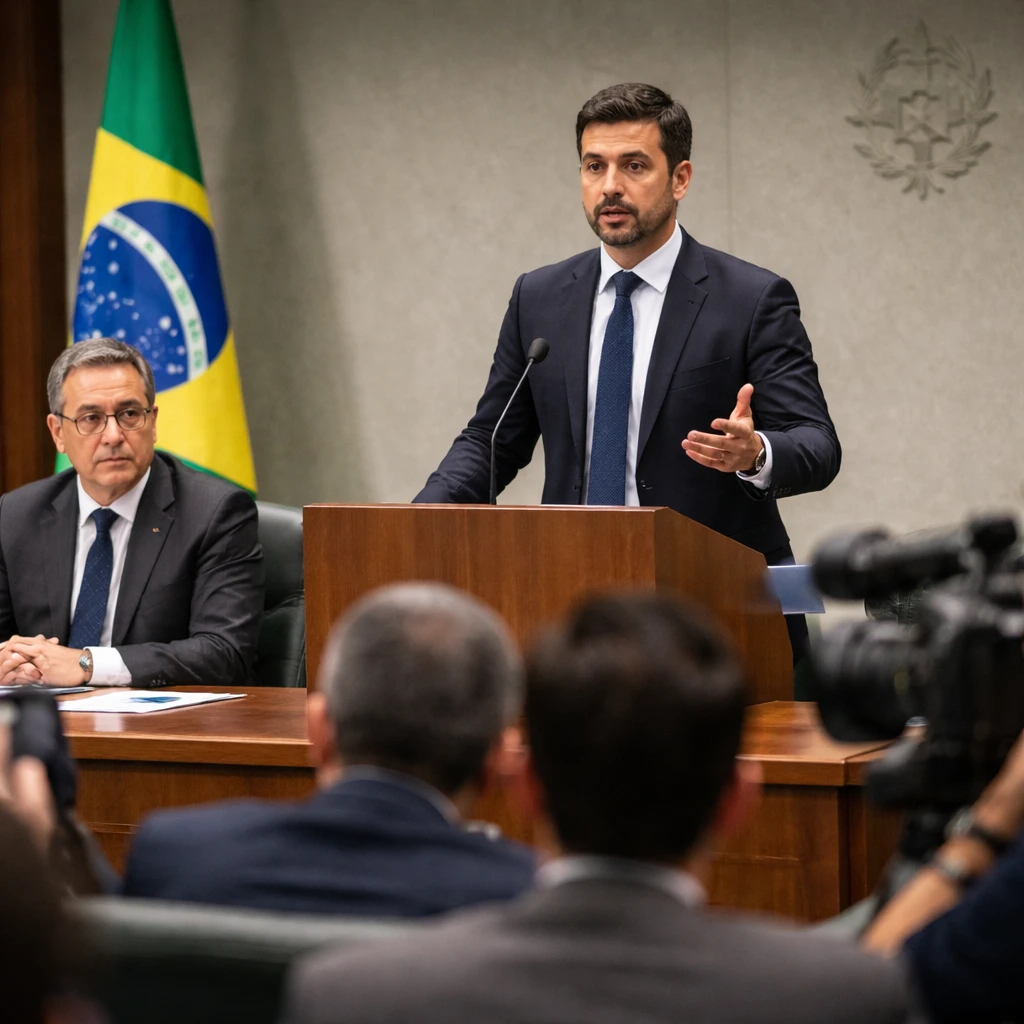
Brazil's central bank governor Gabriel Galipolo said today that the latest policy statement produced confusion among observers because the institution attempted to convey too much information within a compact document. Galipolo addressed the communication problem directly at a press conference, framing it as an overreach in explanation rather than a shortfall in transparency.
According to Galipolo, the changes introduced into the policy statement should not be interpreted as signaling any alteration of monetary policy. He told reporters that the confusion stemmed from the desire to explain multiple points in a constrained space, and that the resulting wording created misunderstandings about the central bank's stance.
Galipolo noted that no other central bank is issuing the type of guidance that had appeared in the statement, and he said that the literature does not recommend providing such guidance given the current environment of uncertainty. He emphasized that, despite the wording issues, there is no change of any kind in monetary policy.
The governor also explained why the policy statement did not explicitly say the balance of risks was asymmetric. He said policymakers withheld that phrasing because they believed the asymmetry was obvious, and therefore did not require explicit restatement in the text.
Central bank director Picchetti elaborated on a separate point concerning inflation over the relevant horizon. He said the bank drew attention to inflation prospects in the first quarter of 2028 because doing so made the nature of the shock affecting inflation over that horizon very clear. Picchetti used vivid language to underline the limits of monetary policy in relation to certain external shocks - noting that simply doubling or tripling interest rates would not open the Strait of Hormuz or eliminate the effects of El Niño - and did so to stress that rate moves cannot address some types of disruptions.
Picchetti also clarified that the central bank is not extending the relevant horizon for its analysis and does not intend to do so. Both officials returned repeatedly to the point that the recent statement should not be read as a change in policy direction, but rather as an instance of awkward communication arising from attempting to compress extensive explanations into a short policy note.
While the remarks focused on how the statement was drafted and perceived, the officials maintained a consistent message: the central bank's monetary stance remains unchanged and the textual adjustments were a source of unintended confusion rather than an indication of new policy intent.
Key points
- Governor Galipolo said attempts to explain too much in a short policy statement caused misunderstanding rather than signaling a change in monetary policy.
- Officials emphasized that forward guidance is uncommon amid uncertainty and that the central bank is not altering its policy stance or extending its analytical horizon.
- Director Picchetti highlighted inflation in Q1 2028 to clarify the nature of the shock affecting inflation over the relevant horizon and warned that rate hikes cannot resolve certain external shocks.
Risks and uncertainties
- Communication risk - wording in concise policy statements can create market and public confusion if too many explanations are compressed into limited text, affecting how stakeholders interpret central bank intent.
- External shock vulnerability - certain shocks referenced by officials are outside the reach of monetary policy tools, underscoring limits to policy effectiveness.