
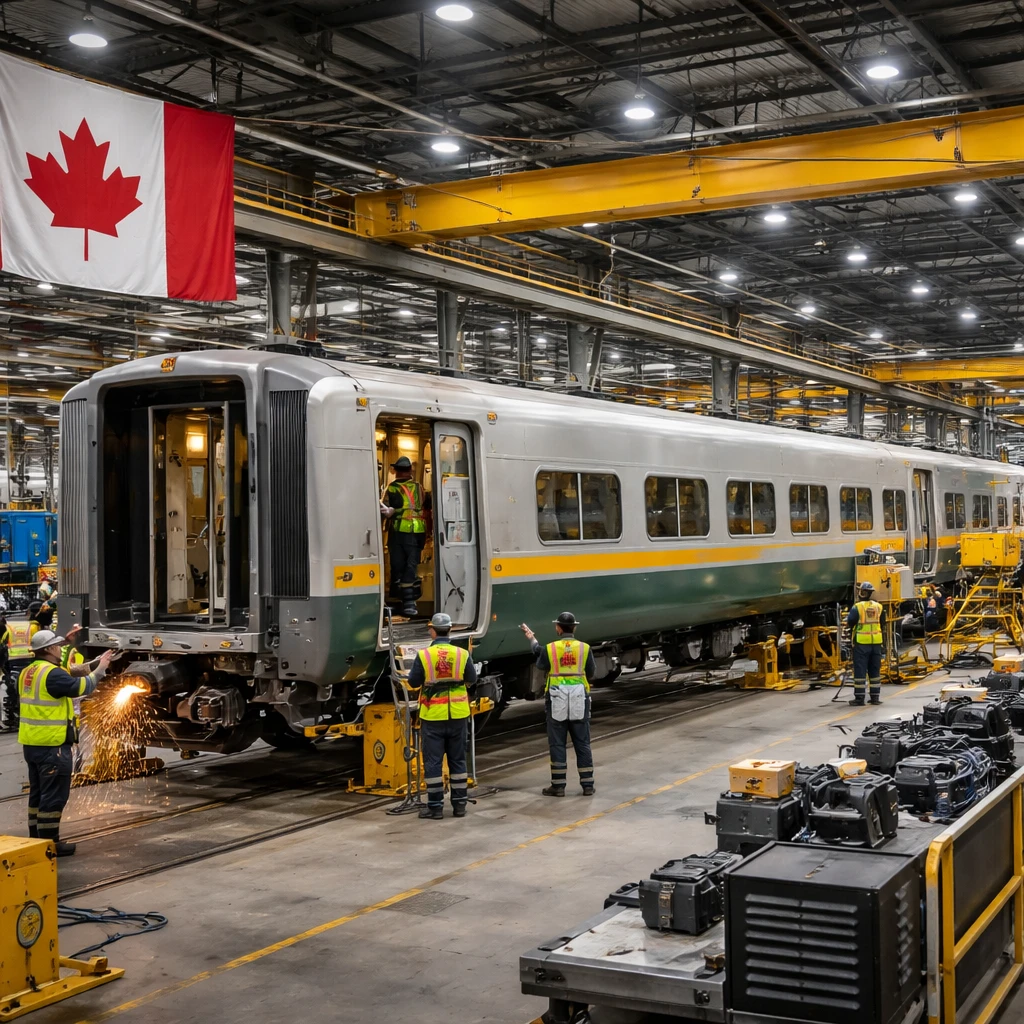
Canada will allocate C$4.7 billion ($3.41 billion) to build and service VIA Rail passenger cars within the country, Prime Minister Mark Carney said at a news conference in Thunder Bay, Ontario. The federal funding will underwrite the construction of 313 new-generation passenger cars and is expected to sustain almost 700 jobs spread across Ontario and Quebec.
Carney said the decision returns passenger-car manufacturing to Canadian soil for the first time in four decades. Until now, VIA Rail's passenger cars were produced in the United States; under the new plan, production work will take place at Alstom Canada's Thunder Bay facility.
The announcement arrives against a backdrop of escalating trade tensions between Canada and the United States. The government indicated that Canadian retaliatory tariffs on about $20 billion of U.S. annual imports are set to come into force on September 8. Those measures are a response to tariffs the United States imposed on Canada last month, which affected $20 billion of Canadian imports.
On the topic of resolving trade disputes, Carney said the government is prepared to enter negotiations with the United States when Washington is prepared to do so. He added that any such negotiation must be founded on stability and credibility, underscoring uncertainty around the timing and terms of future talks.
The investment's scope includes both construction and ongoing maintenance of the passenger cars, with Alstom Canada designated as the facility operator where the work will be performed. Officials highlighted the regional employment gains in Ontario and Quebec tied to the project, citing the nearly 700 jobs supported by the contract.
The federal announcement did not provide additional implementation details beyond the number of cars to be procured and the jobs supported. It also did not specify a delivery schedule for the 313 cars or further milestones for the Thunder Bay facility beyond its selection as the production site.
Context and immediate effects
The move shifts manufacturing from a prior U.S.-based supply arrangement to a domestic production model, reversing a four-decade pattern. The planned investment ties industrial policy, regional job support, and national procurement into a single package aimed at rebuilding VIA Rail's passenger fleet with domestically produced equipment.
Government statement on negotiations
While announcing the program, Carney stressed that Ottawa remains open to negotiating a trade agreement with Washington, but only under conditions that ensure stability and credibility. That phrasing highlights the government's emphasis on reliable terms in any future talks.
Note: The article contains only the facts disclosed by officials at the announcement and reporting on the related trade measures. Additional implementation details were not provided in the announcement.