
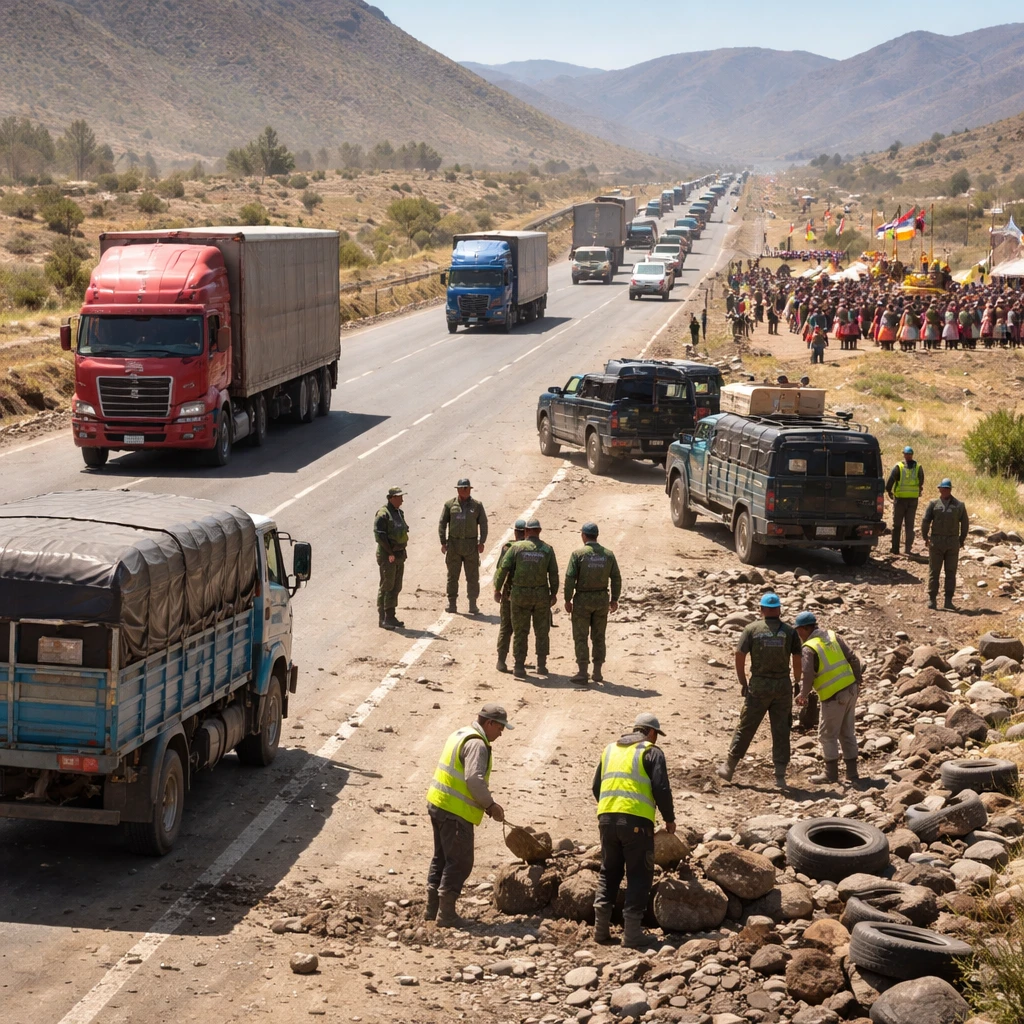
LA PAZ, June 21 - Signs of normalcy returned to parts of Bolivia on Sunday, a day after President Rodrigo Paz enacted a state of emergency to try to end a 50-day social crisis that had choked the country’s primary transport routes. Early Sunday, the Legislative Assembly gave sweeping backing to the presidential decree intended to reestablish transit and allow the delivery of essential supplies after weeks of road blockades that stranded trucks and constrained supplies of food, fuel and medicines in multiple regions.
The congressional vote came alongside a string of developments that reduced pressure on the national highway network. In the eastern department of Santa Cruz, officials and protest leaders reached an accord to remove a key blockade at San Julian. At the same time in La Paz, a prominent campesino federation announced it would pause its demonstrations, while making clear that its demands remained unchanged.
Police and military units continue to be deployed across affected areas, but the national highway authority reported that there were no active blockades remaining that were tied to the recent protests. Authorities warned, however, that many routes will need substantial cleanup and repair work following damage incurred during the demonstrations.
The unrest began after President Paz - who has been in office since November - abruptly ended longstanding fuel subsidies as part of measures to shrink the fiscal deficit amid a tightening dollar situation and negotiations with the International Monetary Fund. Although the government later took steps to stabilize fuel prices and rolled back contested land reforms, demonstrations grew in intensity.
Striking unions broadened the agenda of the protests, calling for higher wages, an end to shortages of fuel and dollars, and ultimately demanding President Paz's resignation. Those economic and political complaints combined to sustain the blockades that impeded the movement of goods and services across large swaths of the country.
Legal analysts and other experts have cautioned that the use of emergency powers carries the risk of further inflaming tensions if the measures do not address the underlying causes of the unrest. Such warnings underline the fragility of the current respite, given that some groups have only temporarily halted actions while maintaining their core demands.
The reported reduction in active blockades coincided with celebrations for the Andean-Amazonian New Year. Across the country, government officials and indigenous leaders participated in ceremonies that emphasized reconciliation and national unity. At an event in La Paz, Tourism Minister Cinthya Yanez expressed hope that "prosperity" and "bounty" would return and that Bolivians would once again "join hands."
While the immediate horizon shows fewer road obstructions, the combination of continued security deployments, outstanding grievances and substantial infrastructure cleanup requirements means that authorities and communities face ongoing challenges in fully restoring normal economic activity and supply chains.
Summary
Lawmakers approved a presidential state of emergency decree aimed at reopening main highways after 50 days of blockades. Local agreements, a temporary pause by a campesino federation and national festivities coincided with reports that there were no active protest-related blockades, though cleanup and political issues remain.
Key points
- Legislative Assembly ratified the state of emergency early Sunday to restore transit and supply lines disrupted by 50 days of protests.
- Local breakthrough in Santa Cruz lifted a crucial San Julian blockade; a campesino federation in La Paz paused protests but kept its demands.
- National highway authority reported no active protest-related blockades, but many roads require significant cleanup and repair.
Risks and uncertainties
- The emergency powers could deepen unrest if the measures do not resolve the protests' stated grievances - a political risk with implications for governance and investor confidence.
- Infrastructure damage and the need for substantial road repairs pose logistical and economic risks for transport, retail supply chains and the delivery of medicines and fuel.
- Paused protests and unresolved demands create uncertainty about the durability of the current lull, affecting sectors reliant on stable transport and fuel availability.