
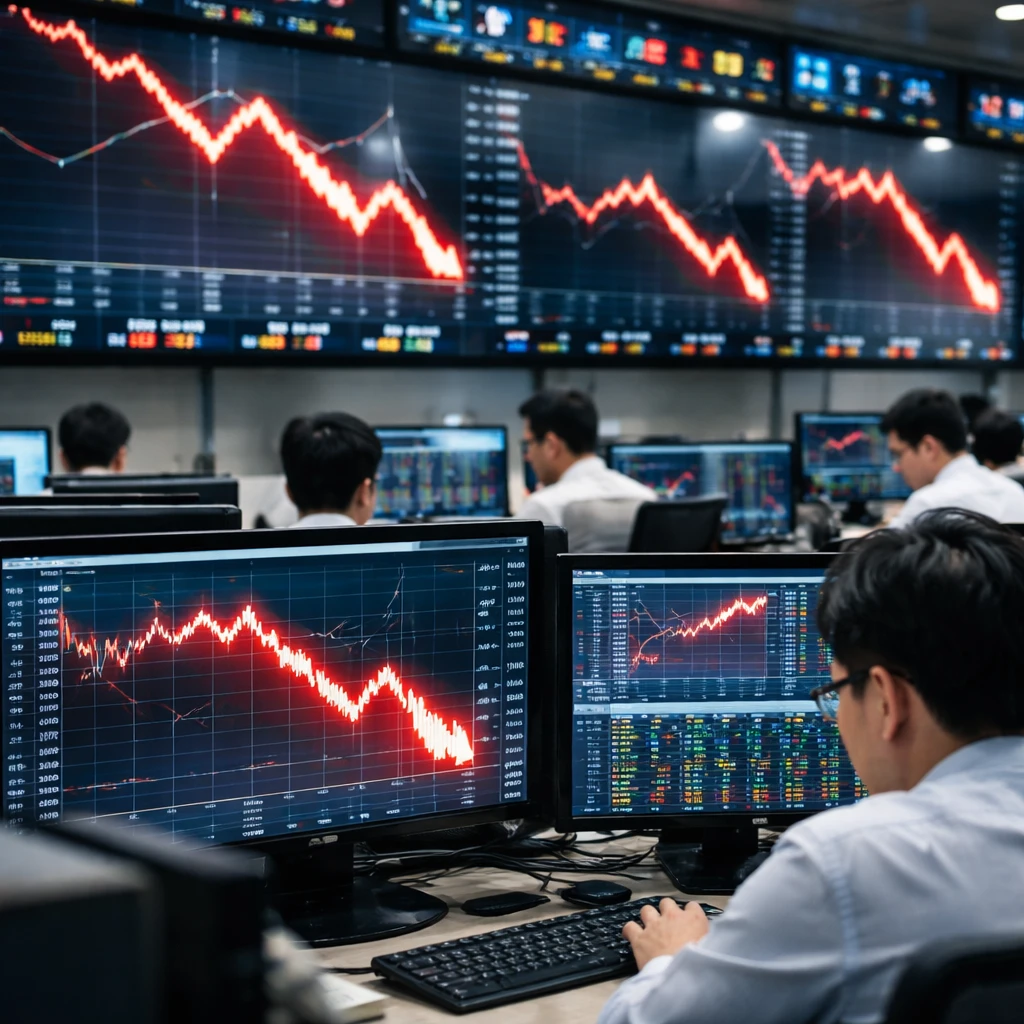
Asian equity markets registered a notable decline on Thursday as investors systematically rotated capital out of semiconductor and technology companies following a robust performance in the second quarter. This shift in positioning occurred against a backdrop of heightened caution in currency and bond markets, where participants prepared for upcoming U.S. employment data that may reveal indicators regarding the likelihood of future interest rate increases.
The broader regional benchmark, MSCI's Asia-Pacific index excluding Japan, decreased by 0.8 percent. Japan's Nikkei index also fell, dropping 1.1 percent and contributing to losses that began at the start of the quarter. South Korea's KOSPI index experienced a sharper decline of 2.7 percent, extending a previous 2 percent slide recorded on Wednesday. This downward movement followed a substantial 68 percent surge in the second quarter, driven by intense demand for memory chips related to artificial intelligence applications.
Major South Korean semiconductor manufacturers faced significant selling pressure. SK Hynix shares declined by 7.7 percent, while Samsung Electronics tumbled by 6.2 percent. This profit-taking occurred even as Meta Platforms reported plans to develop a cloud business aimed at selling excess artificial intelligence computing capacity. The announcement propelled Meta's shares up 8.8 percent in overnight trading, highlighting divergent investor sentiment within the broader technology sector.
In contrast to regional peers, Hong Kong's Hang Seng index posted a gain of 1.8 percent. Foreign investment flows into Asian equities have retreated at the fastest pace recorded in at least 16 years during the first half of 2026. This outflow reflects investors trimming positions in major winners from South Korea and Taiwan following an AI-driven rally, as they seek exposure to lower-priced stocks with limited recent appreciation.
Market attention is currently focused on U.S. non-farm payroll data scheduled for release this Thursday. The timing is significant as a Friday holiday for Independence Day, which falls on a Sunday this year, limits trading activity. Economists polled by Reuters project a gain of 110,000 jobs for June, although forecasts vary considerably from 25,000 to 200,000. This wide range suggests a high probability of the data deviating from expectations.
The unemployment rate is anticipated to remain steady at 4.3 percent. Chris Weston, head of research at Pepperstone, noted that equity traders lack a rigid playbook for this environment. He stated that market participants ideally seek a Goldilocks outcome characterized by respectable job creation and a stable unemployment rate. Any data that avoids increasing the implied probability of near-term interest rate hikes is likely to be favorably received by equity bulls.
At the Sintra Forum, Federal Reserve Chair Kevin Warsh indicated that inflation risks had recently eased, providing only temporary relief to Treasury markets. Warsh emphasized his commitment to the 2 percent inflation target, stating he would disappoint anyone expecting loose monetary policy. Current market pricing implies approximately 80 percent odds of a rate hike in September.
Treasury yields have been rising as traders prepare for a potentially strong jobs report that could accelerate bets on near-term rate increases. The U.S. 2-year yield increased by 1 basis point on Thursday to 4.1785 percent, adding to a 9 basis point rise for the week. The 10-year yield remained at 4.4811 percent after climbing 10 basis points during the same period.
Elevated Treasury yields provided support for the U.S. dollar. The euro declined 0.4 percent against the dollar following remarks by European Central Bank President Christine Lagarde, who stated that inflation and growth risks were becoming more broadly balanced. The euro held steady during Asian trading hours at $1.1379.
The yen traded little changed at 162.59 per dollar, following a 40-year low of 162.84 recorded on Wednesday. This depreciation prompted standard warnings from Tokyo regarding potential market intervention. However, previous interventions in April and May yielded only short-lived results despite Japanese authorities spending nearly 12 trillion yen.
Gold prices increased by 0.5 percent to $4,050 an ounce, bouncing back after a challenging quarter. Oil prices hit new four-month lows, with Brent crude falling 0.8 percent to $71 a barrel. This decline coincided with statements from U.S. President Donald Trump indicating that talks with Iran in Qatar had progressed well, alongside an increase in oil tanker transits through the Strait of Hormuz.