
The U.S. dollar capped a weak week on Friday, trading close to a three-month trough as investors grappled with deepening fiscal worries and the market response to an unexpected Treasury move aimed at cooling a sell-off in long-term government bonds.
At 15:33 ET (19:34 GMT), the U.S. dollar index - which measures the greenback against a basket of six major currencies - was at 98.80, down 0.1% on the session and tracking a weekly decline of about 0.9%.
Fixed-income dynamics in focus
Currency traders have spent much of the past week watching developments in the U.S. Treasury market. Long-dated Treasuries had been under substantial selling pressure since the Federal Reserve's July interest rate announcement, as concerns about higher inflation tied to rising oil prices combined with worries over the large volume of corporate debt issuance linked to artificial intelligence investment.
Earlier in the week, those pressures pushed the 30-year Treasury to a 19-year intraday peak of 5.337% on Tuesday, and the benchmark 10-year yield recorded a fresh 52-week high of 4.748% ahead of midweek. Meanwhile, shorter-dated maturities held up better amid recent economic reports that dented expectations for near-term Fed rate increases.
That dynamic changed on Wednesday when the U.S. Department of the Treasury said it would raise the size of repurchases of longer-dated government debt to at least $4 billion from $2 billion. The surprise step produced a rally in long bonds and sent yields lower. But the relief was short-lived: much of the gain in prices was given back on Thursday and into Friday, a pattern that market participants said suggested the buybacks were viewed as a temporary fix rather than a structural remedy.
By Friday the 30-year yield was last recorded up 3.9 basis points at 5.276%, while the 10-year was up 4 basis points at 4.738%.
Treasury Secretary Scott Bessent sought to calm nerves on Thursday, telling CNBC that the announced buybacks could end up being larger than the $4 billion and that the Treasury had a "big toolkit" to try to bring yields down.
Why bond yields matter for the dollar
Higher long-term yields can act similarly to rate increases by lifting borrowing costs for households and businesses, a mechanism that typically supports the dollar. But the scale of U.S. government borrowing has generated rising skepticism about fiscal sustainability. That skepticism has prompted some investors to shift capital into hard assets such as gold or cryptocurrencies - a move market participants refer to as the debasement trade - which can exert depreciation pressure on fiat currencies including the dollar.
Robin Brooks, senior fellow in economic studies at the Brookings Institution, said the Treasury's sudden announcement sent two clear messages: that the rise in long-term yields had reached a painful level for the U.S., and that authorities were unwilling to tackle the underlying fiscal imbalance head on. Brooks argued that the buyback action amounts to financial engineering that masks mounting stress in the Treasury market, and cautioned that such measures tend to push down the currency because investors do not receive the risk premium they require.
Attention now turns to the upcoming Jackson Hole Economic Policy Symposium for further signals on the outlook for interest rates.
Major currencies react
European currencies capitalized on the dollar's weakness. The euro was trading at $1.1679, close to its strongest level since May 14 and up about 1.0% for the week. Sterling was last quoted at $1.3646, its highest since February 13, and was rising roughly 0.8% on the week after United Kingdom data earlier in the week showed headline annual consumer inflation accelerated in July from June.
In Japan, the yen appeared poised to end the week with a halt to its earlier post-intervention decline. USD/JPY was down about 0.2% on the week. The yen received support from data indicating Japan's core consumer inflation rose to 1.8% in July, alongside sturdy private-sector purchasing managers' index readings, developments that strengthened markets' expectations for a Bank of Japan rate increase in September.
Emerging Asia: winners and laggards
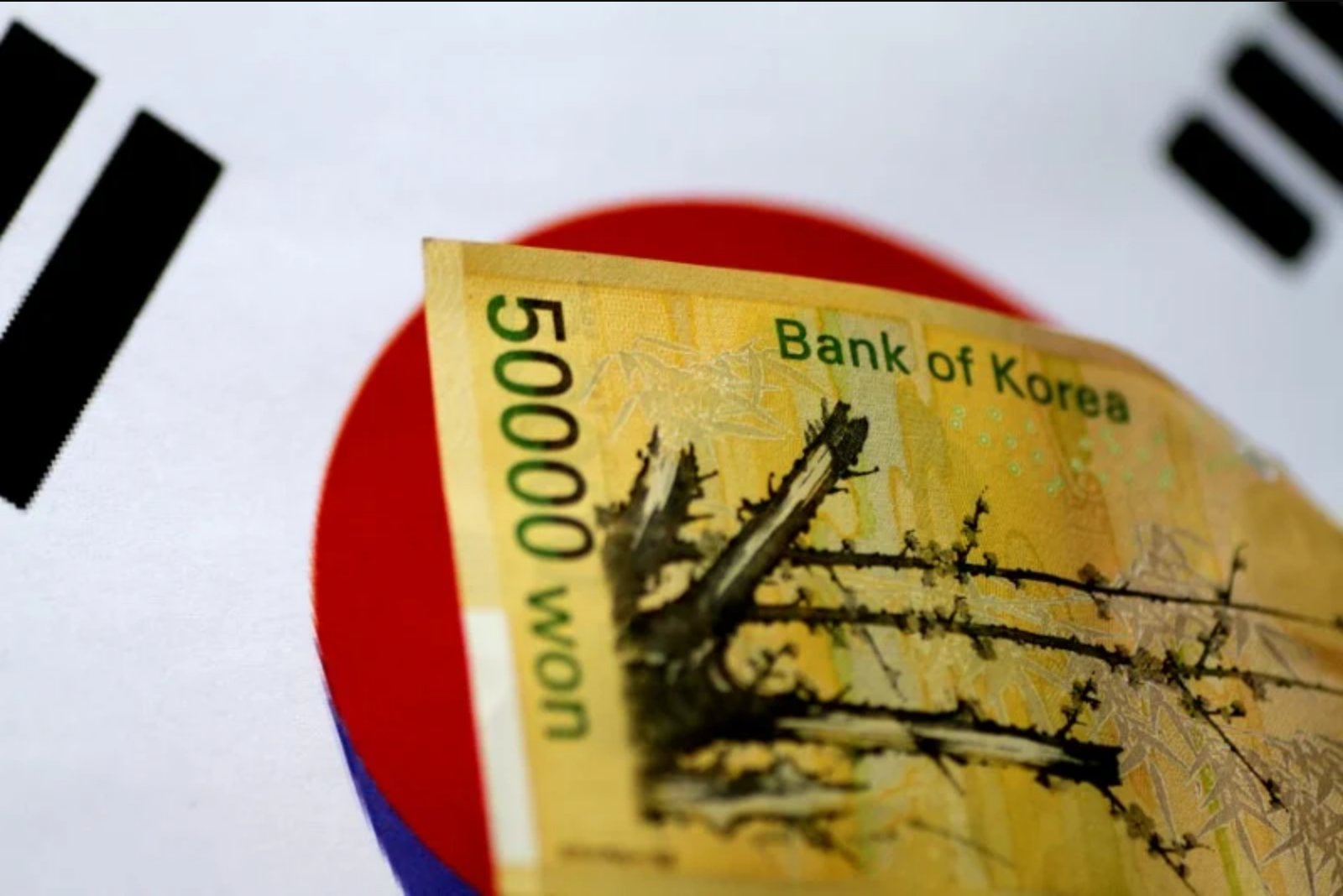
Across Asian emerging markets, currency moves diverged sharply between economies leveraged to technology exports and those that are net energy importers. South Korea's won led regional gains on Friday, with USD/KRW sliding 0.5% to its lowest level since September 18, 2025. The won completed a substantial weekly advance of 2.1%, supported by firm offshore demand for tech-exposed assets and a narrowing in U.S. yield spreads.
By contrast, the Indian rupee remained under persistent pressure. USD/INR was little changed on Friday but finished the week with a roughly 0.3% gain as heavy importer hedging and higher energy prices offset reported spot-market interventions by the Reserve Bank of India.
Brent crude futures were trading above $94 a barrel and were up about 6% for the week amid an ongoing impasse between the U.S. and Iran. Elevated energy and commodity costs continue to weigh on the currencies of net oil-importing countries across Southern Asia.
What this means for markets and sectors
- Fixed-income markets remain the central driver of currency moves this week, with volatility in long-term Treasuries spilling over into FX markets.
- Energy prices are a meaningful transmission channel for currency stress in net oil-importing economies, affecting importers' hedging behavior and balance of payments.
- Demand for technology-related assets is supporting currencies in export-heavy, tech-oriented economies such as South Korea.
For now, the market reaction to the Treasury's intervention and ongoing fiscal concerns has left the dollar on the back foot, while European majors, the South Korean won and a steadier yen have benefited. Traders will be watching central bank signals and policy discussions at Jackson Hole for further clues on the interest-rate trajectory that could reshape both bond and currency markets.