
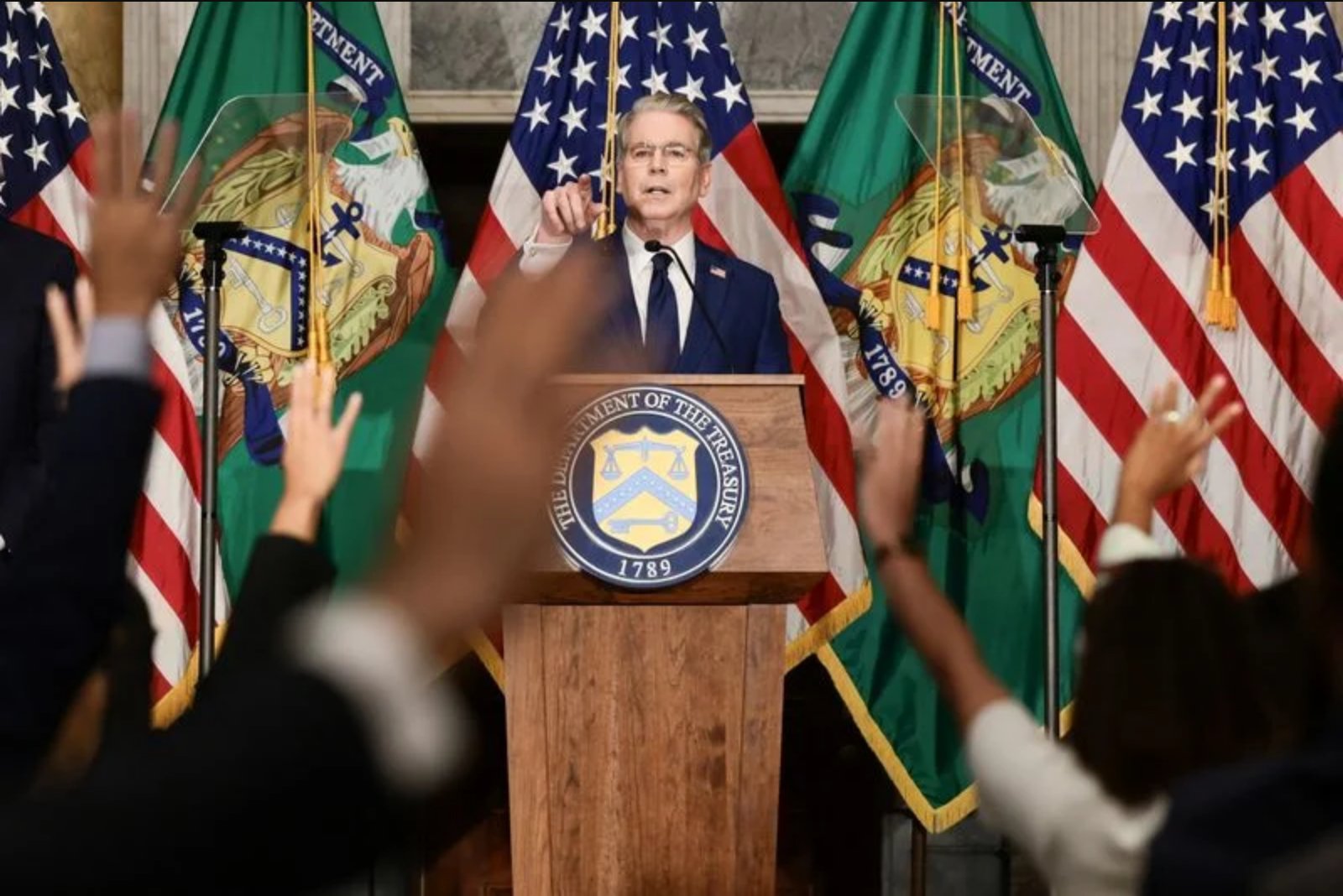
WASHINGTON - The U.S. Treasury will maintain its planned schedule of debt auctions, including those for longer-dated securities, while moving ahead with a larger program of quarterly buybacks in the 10- to 30-year sector, Treasury Secretary Scott Bessent said on Monday.
At a news conference that focused largely on Iran sanctions, Bessent was asked about how the department would balance a stepped-up repurchase program with its auction calendar. He replied that the Treasury would "continue with our regular program of auctions" that it announced in early August. He also noted that, to date, the Treasury has not purchased any bonds under the expanded repurchase plan, which is scheduled to start on Sept. 10 for 10- and 20-year securities.
Bessent, who has a background as a hedge fund manager and experience in sovereign debt and currency markets, surprised global bond investors last week by saying the Treasury would double the size of its quarterly buybacks of longer-dated securities. The Treasury said it would raise repurchase operations in the 10- to 30-year sector to at least $4 billion per operation over the coming quarter.
The step was taken after long-term yields climbed to levels not seen in nearly two decades. The initial announcement and subsequent repurchase announcement helped push down yields on 10-year Treasury notes and on 20- and 30-year bonds for a brief period, providing the administration with some easing of upward pressure on federal debt service costs. By the end of last week, however, yields on those longer maturities had largely given back the earlier declines. On Monday, those yields were down modestly.
Officials have not identified a specific funding source for the expanded buybacks. One available pool of funds is the Treasury General Account at the Federal Reserve. Using the TGA to finance repurchases would avoid the need to issue new, shorter-dated Treasury securities to raise cash for the purchases, but would reduce the government’s cash reserves.
Unlike the Federal Reserve, the Treasury cannot create money and therefore must pay for buybacks out of existing cash balances or borrow to raise the funds. If the Treasury were to borrow to fund the repurchases, any additional issuance would be structured toward shorter maturities so as not to hinder the stated objective of the buybacks - increasing liquidity in the market for longer-dated bonds.
The Treasury General Account functions as the federal government’s day-to-day cash account, used to meet routine obligations such as federal payrolls, defense contracts and interest and principal payments on Treasury securities. The TGA stood at about $940 billion as of last Wednesday. Over the past year the TGA has averaged around $840 billion, which officials note is the highest average outside of the rapid accumulation seen during the COVID-19 pandemic.
Part of the reason for the elevated TGA balance this year has been the need to fund approximately $166 billion in refunds owed to importers after the U.S. Supreme Court earlier this year ruled that a major portion of President Donald Trump’s import tariffs were illegal. The larger TGA balance can also act as a fiscal buffer in case political developments - such as a change in Congressional control - lead to a debt limit confrontation that could be used as leverage in negotiations.
Observers have characterized the escalation in Treasury intervention as increasingly interventionist. Bessent has publicly said the surge in yields to near two-decade highs was not warranted by the strength of the U.S. economy, and he has pointed to planned reductions in government spending under the administration as a factor shaping the nation’s rising stock of debt - which he described as moving past $40 trillion.
In recent weeks, the Treasury chief has taken an active role in market interventions. Earlier this month he led what was described as the first joint intervention in the Japanese yen in 15 years. The buyback expansion is the latest tool in that approach, aimed at supporting liquidity in portions of the market that are thinly traded, particularly during August, and at a time when those Treasury sales must compete with sizable corporate issuance that has been available at higher yields.
Separately during Monday’s appearance, Bessent pressed foreign companies to cut business ties with Iran, warning that those who do not could face secondary sanctions. He stopped short of announcing severe immediate penalties but said a significant sanctions action tied to a bank would be announced later in the week.
Implications for markets and policy
- Maintaining regular auctions while expanding buybacks is designed to preserve the Treasury’s issuance plan while addressing liquidity concerns in long-dated securities.
- Using the TGA as a funding source would reduce the government’s cash cushion but could avoid new short-term issuance that might otherwise be needed to finance buybacks.
- Bessent’s actions reflect a more interventionist posture toward market functioning, following other recent interventions such as coordinated currency action.