
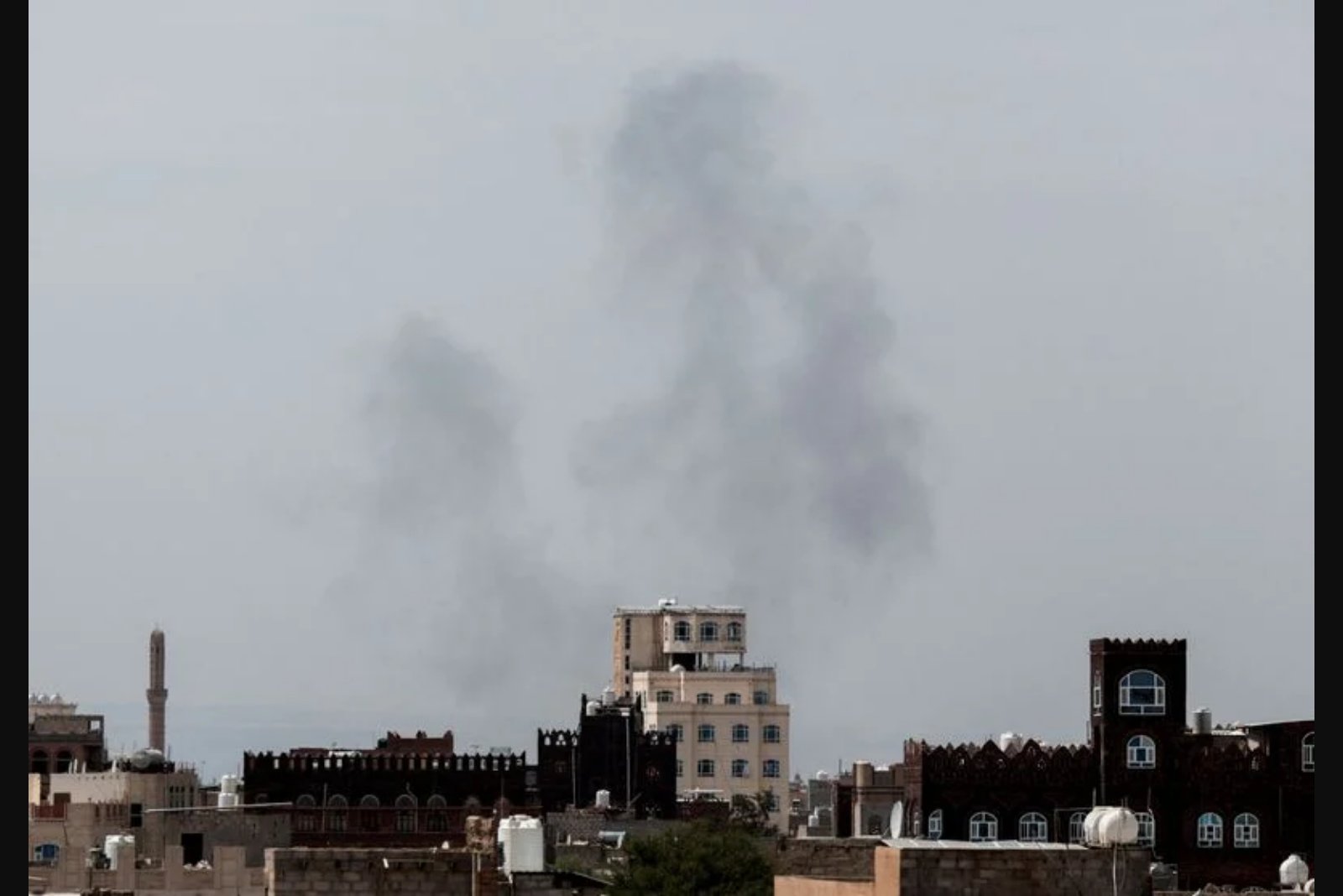
Saudi Arabian military spokespeople announced on Monday that the kingdom's air defence systems engaged ballistic missiles launched by the Houthi movement toward the southern region of Saudi Arabia. The coalition spokesperson described the projectiles as a threat and said forces dealt with the launches, which occurred after the Houthis accused Riyadh of striking the international airport in Sanaa.
Earlier in the day the Iran-aligned Houthi movement, which controls much of northern Yemen, said Saudi airstrikes had hit Sanaa International Airport. The Houthis characterised the reported strikes as "blatant aggression" and stated they marked an end to a recent period of de-escalation. Houthi military spokesperson Yahya Saree warned that Saudi Arabia would bear the consequences and said the attack would not go unanswered.
The Saudi government’s communication office did not immediately issue a response to the Houthi accusation. Separately, members of Yemen’s internationally recognised government, which is closely backed by Riyadh and whose leaders are based in Riyadh, also claimed responsibility for strikes on the airport.
Officials from the internationally recognised Yemeni government provided differing accounts on the intended target of the airport strike. One defence ministry official said the runway at Sanaa International Airport had been struck to prevent an Iranian aircraft from landing. A later statement from an armed forces spokesman said the aircraft ultimately landed at Houthi-controlled Hodeidah airport on Yemen’s Red Sea coast, roughly 150 km southwest of Sanaa. It remained unclear whether any effort had been made to prevent that landing in Hodeidah.
ICRC aircraft and temporary airport closures
Moammar bin Mutahar Al-Eryan, information minister in Yemen’s internationally recognised government, said the Houthis were detaining a plane belonging to the International Committee of the Red Cross at Sanaa airport and were holding its pilot and co-pilot. An International Committee of the Red Cross spokesperson for the Middle East told Reuters that all ICRC staff and the crew were safe and accounted for but declined to provide further comment.
In response to the security developments, the general aviation authority of Yemen’s internationally recognised government briefly ordered the closure of all airports nationwide. Hours later the authority announced that airports had reopened. The temporary closure and the reported detention of an ICRC aircraft fed into an already fraught environment around humanitarian and civilian aviation operations in Yemen.
Broader context and regional implications
Yemen has been mired in civil war and external proxy conflict for more than a decade, after the Houthis seized the capital and forced the internationally recognised government to relocate to the south. The Saudi-led coalition intervened in 2015 to counter the Houthis, an operation that has contributed to what is widely described as one of the world’s most severe humanitarian crises.
Despite years of fighting, a 2022 truce between Saudi Arabia and the Houthis has largely reduced the level of direct confrontation between the two sides. That truce has nonetheless been stressed by regional escalations linked to other conflicts, including incidents in the Red Sea and tensions tied to broader regional dynamics. The Houthis have been implicated in firing on ships traversing the Red Sea in recent months.
Monday’s exchanges - the reported airport strikes and the Houthi missile launches toward southern Saudi Arabia - represent a renewed strain on the arrangement that has so far kept direct hostilities at lower levels. Observers cited in the reporting noted that the Houthis’ alignment with Tehran could complicate diplomatic efforts to defuse the situation further.
Analysts have highlighted one strategic buffer for Saudi Arabia: the kingdom’s ability to continue exporting oil from its west coast on the Red Sea. That ability has been important given what was described as the effective closure of the Strait of Hormuz. However, the reporting warns that a widening confrontation between Saudi Arabia and the Houthis could challenge that export conduit.
Diplomatic and military rhetoric
Prior to Monday’s events, Yemen’s defence minister representing the internationally recognised government said diplomatic attempts to prevent what he described as Iranian aircraft violating Yemeni airspace had been exhausted. He added that government forces would respond to any hostile aircraft violating Yemen’s airspace "by all available means" and held Iran responsible for those violations.
Meanwhile, the breakdown of a recent ICRC-mediated prisoner exchange between the Houthis and Yemen’s internationally recognised government was cited as a proximate sign of rising tension, with both sides exchanging mutual accusations after the deal collapsed.
What remains uncertain
Key details remain unresolved in the public record from Monday’s incidents. The extent of damage at Sanaa International Airport was not specified in official accounts released during the day. It was also not clear whether any attempt had been made to prevent the Iranian aircraft from landing in Hodeidah, or what steps, if any, were taken by other parties to de-escalate after the reported strikes and missile launches.
The reported detention of an ICRC aircraft and its crew raised urgent humanitarian and aviation safety concerns, though the ICRC confirmed the safety and accounting of its staff and crew without offering additional detail.
As events unfolded on Monday, the incidents tested the durability of a truce that has held broadly since 2022. The complications from reciprocal accusations and military responses underline the fragility of that arrangement and highlight the risks for civilian aviation, humanitarian operations, and regional energy shipping routes.