
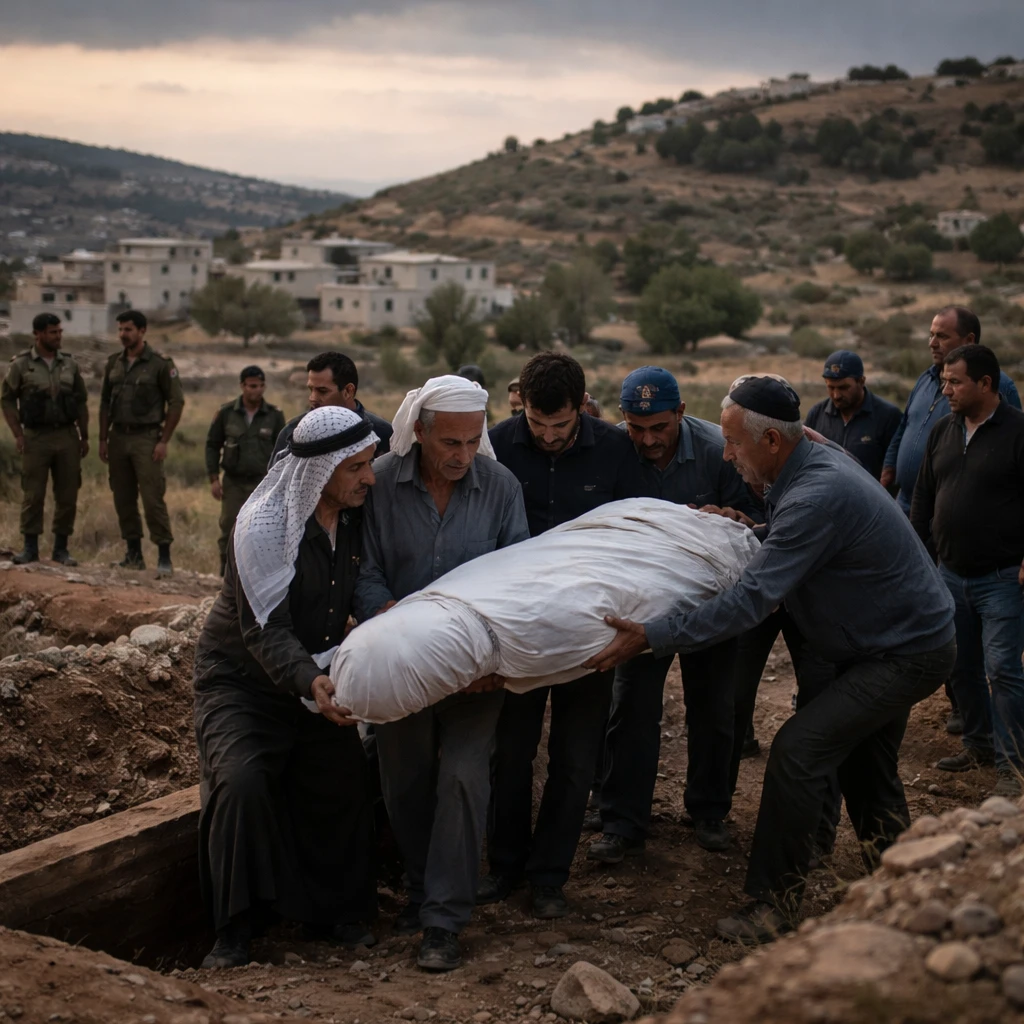
Residents of the West Bank village of Asasa say Israeli settlers forced them to exhume the body of their father and re-bury him elsewhere after he was laid to rest in the village cemetery.
The deceased was identified as Hussein Asasa, 80, who died of natural causes and was buried the same evening at the Asasa village cemetery near Jenin. His son, Mohammed, said the burial had been carried out with all the necessary permits from Israel’s military, whose forces were present at the site during the burial.
Shortly after the funeral, villagers contacted the family to report that settlers had arrived at the grave and were ordering it to be opened. "They said the land was for settlement and that burial was not allowed. We told them that this is the village’s cemetery, not part of the settlement," Mohammed Asasa said.
According to the family, the settlers then threatened to remove the body using a bulldozer. To prevent that outcome and an escalation, the family made the decision to dig up their father’s body themselves. Mohammed Asasa said, "We found that they already dug the grave and reached the body." He added, "We continued digging and got the body and buried him in another cemetery."
Video footage shared on social media showed people digging into a slope and then carrying away what appears to be a body, with Israeli troops walking behind them. The footage was identified as coming from Asasa.
The Israeli military issued a statement saying that the funeral had been coordinated with it and that it had not instructed the family to rebury their father. The statement said soldiers were sent to the scene after receiving a report about a confrontation with settlers who were "digging in the area." The military added that "The soldiers confiscated digging tools from the Israeli civilians and remained at the location in order to prevent further friction." It also said it condemns actions that violate the "dignity of the living and the deceased."
The incident drew condemnation from the United Nations human rights office. Ajith Sunghay, head of the OHCHR Palestinian office, said: "This is appalling and emblematic of the dehumanisation of Palestinians that we see unfolding across the OPT (Occupied Palestinian Territories). It spares no one, dead or alive."
Attempts to reach residents of the nearby Sa-Nur settlement for comment were not successful.
Sa-Nur was among 19 settlements evacuated under the 2005 Israeli disengagement plan, which also included Israel’s withdrawal of settlers and troops from Gaza. The current government approved the re-establishment of Sa-Nur a year ago, and construction at the site has advanced rapidly, according to the settlement watchdog Peace Now.
The broader context of the incident is the differing claims over the West Bank. Palestinians seek the territory as part of an independent state, while Israel cites historical and biblical ties and security considerations. The current government, which opposes the creation of a Palestinian state, has been accelerating settlement construction. Observers have noted a rise in attacks by settlers on Palestinians, which has raised international concern.
Most countries and the United Nations consider Israeli settlements on West Bank land captured in the 1967 war to be illegal, a position Israel disputes. The Asasa incident highlights how tensions over land and settlement activity can intersect with deeply personal and communal practices such as burial, creating flashpoints even when actions have been carried out with military permits.
Contextual note: The family and local villagers describe the sequence of events as they experienced it; the military released its account of coordination and subsequent steps taken at the site. Video of the disturbance circulated publicly and was attributed to the Asasa area.