
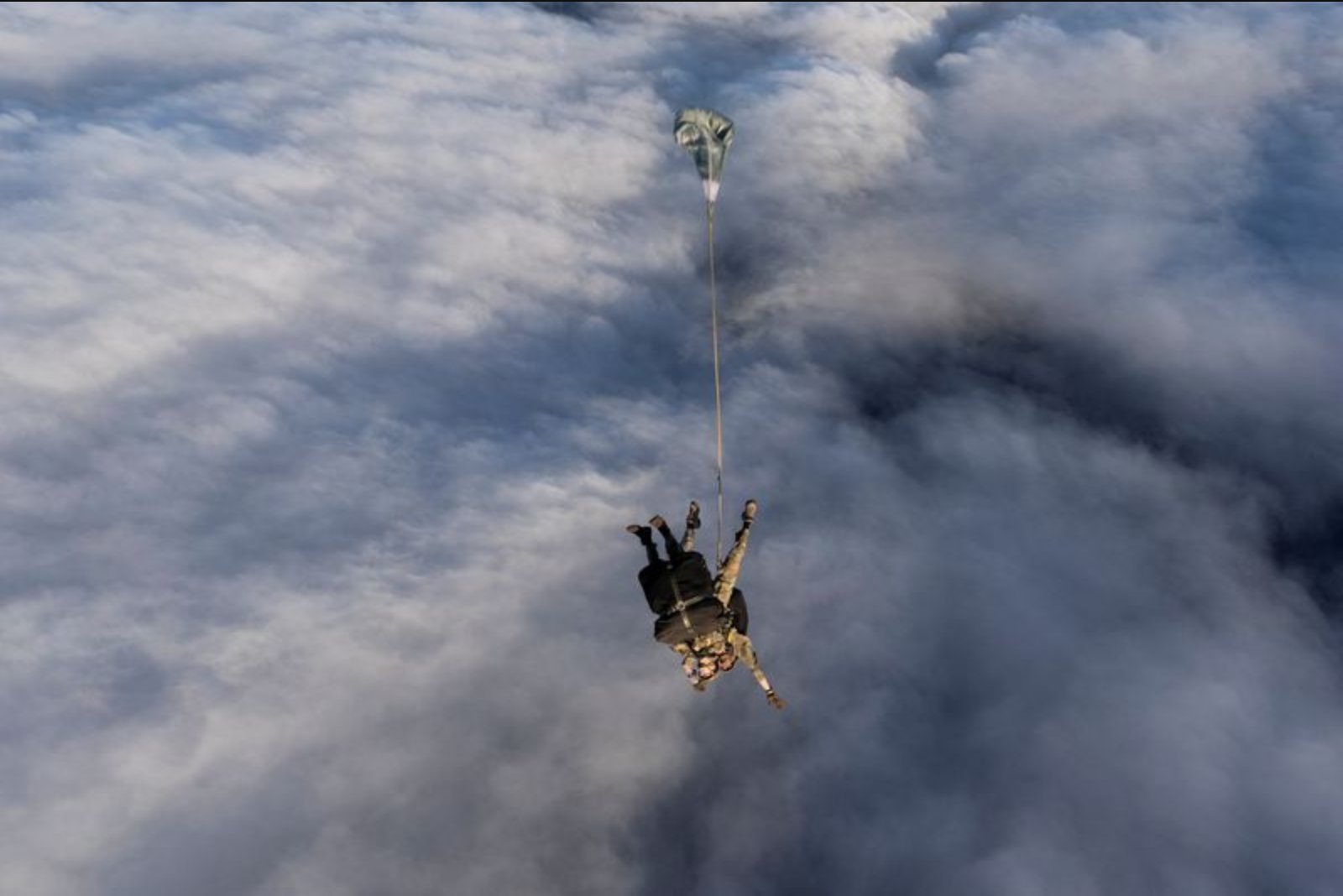
British paratroopers, supported by military clinicians and lifesaving supplies, parachuted onto Tristan da Cunha this weekend after health authorities confirmed a suspected hantavirus infection on the remote territory.
A team comprising six paratroopers and two military clinicians from 16 Air Assault Brigade left RAF Brize Norton in an A400M transport aircraft and executed a long-range mission that took the aircraft 6,788 km (4,218 miles) to Ascension Island before flying an additional 3,000 km due south to reach Tristan da Cunha. The aircraft was refuelled mid-flight by a supporting RAF Voyager tanker.
Oxygen supplies and other medical aid were dropped on Saturday alongside the personnel. The Ministry of Defence said the supplies were principally intended for a British man who UK health authorities report was aboard the cruise ship that experienced a hantavirus outbreak and stopped at the island between April 13 and April 15. The World Health Organization noted the man reported symptoms compatible with hantavirus on April 28 and that he is currently stable and isolated.
According to a Ministry of Defence statement, the island was facing critically low oxygen supplies. "With oxygen supplies on the island at a critical level, an airdrop with medical personnel was the only method of getting vital care to the patient in time," the statement said.
The operation marks the first occasion the UK military has delivered humanitarian medical assistance with medical personnel via a parachute jump, the Ministry of Defence added. Military-transported PCR test kits had previously been delivered on May 7 to Ascension Island, where another British man from the same cruise ship had disembarked before being flown to South Africa for further care.
Tristan da Cunha is home to roughly 200 inhabitants and is positioned in the South Atlantic halfway between South Africa and South America. It is recognised as the most remote inhabited island on Earth and lacks an airstrip, meaning access is normally by sea. The island lies more than 2,400 km and a six-day boat journey from St Helena, its nearest inhabited neighbour. Local medical coverage typically consists of a two-person team for routine health needs.
Brigadier Ed Cartwright, Officer Commanding 16 Air Assault Brigade, commented on the mission, saying: "The arrival of paratroopers, medical personnel and medical supplies from the sky has hopefully reassured the people of Tristan da Cunha." The statement suggests the airdrop was designed both to meet immediate clinical requirements and to provide assurance to the community.
Operational details underline the logistical complexity of the mission: a transcontinental A400M sortie with a mid-air refuelling and a parachute delivery of personnel and oxygen to an island with no airstrip. The action sought to bridge a gap in emergency care capacity created by the island's remoteness and the specific medical needs arising from a suspected hantavirus case linked to a cruise ship visit earlier in April.
UK authorities have combined air and maritime-based logistics in recent days to respond to the situation. PCR tests were transported to Ascension Island on May 7, and medical evacuation was carried out for at least one passenger to South Africa prior to the airdrop.
The incident highlights how limited local medical infrastructure and geographic isolation can require extraordinary military and logistical measures to deliver timely care and supplies.