
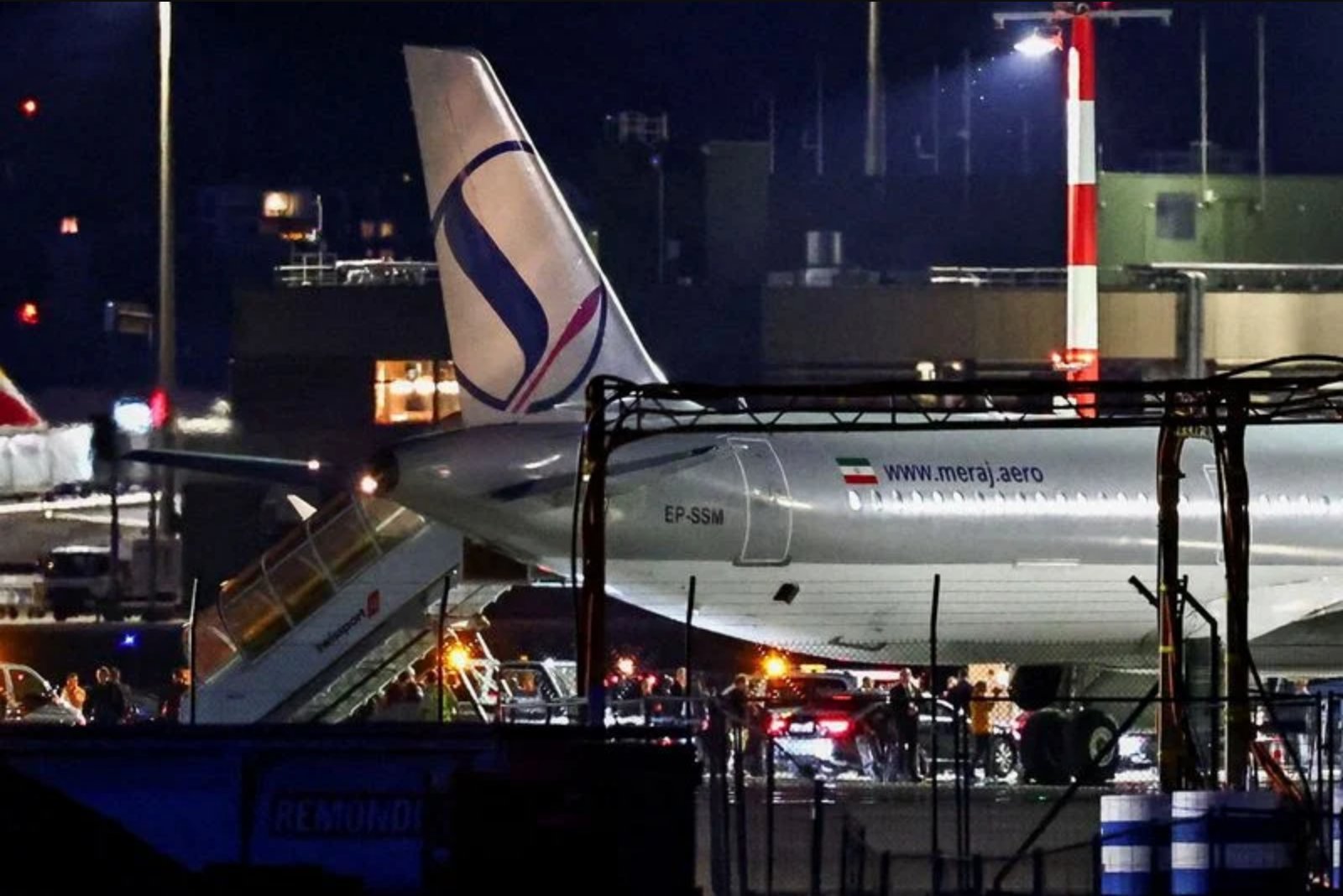
A high-level Iranian delegation arrived in Switzerland on Saturday to engage in peace talks with United States officials, Iranian state media reported, even as violence flared in Lebanon and Tehran’s Islamic Revolutionary Guard Corps (IRGC) announced the closure of the Strait of Hormuz.
The Iranian team was led by chief negotiator Mohammad Baqer Qalibaf and included Foreign Minister Abbas Araqchi along with senior security, central bank and oil officials, Iranian media said. The delegation’s arrival coincided with U.S. Vice President JD Vance departing Washington for meetings that Pakistan indicated would begin on Sunday.
Both Washington and Tehran had agreed to a 60-day ceasefire to allow negotiations to proceed, based on an interim deal brokered by Pakistan and signed on Wednesday by U.S. President Donald Trump and Iranian President Masoud Pezeshkian to bring an end to nearly four months of war. Despite that agreement, the IRGC on Saturday declared the Strait of Hormuz shut and warned that ships would be at risk if they approached the waterway.
Iran cited what it described as Israeli "crimes" in Lebanon and a U.S. violation of commitments to establish a ceasefire as reasons for the IRGC action. The announcement raised immediate concerns about the security of a critical channel for global oil and gas shipments.
U.S. Central Command reported that 55 merchant ships transited the strait on Saturday, carrying significant amounts of cargo and more than 17 million barrels of oil to global markets. The command said that U.S. forces would ensure that the flow of vessels continued.
President Trump posted on social media on Saturday that no toll will be charged for passage through the Strait during or after the 60-day ceasefire - unless the United States imposes one should peace talks fail. In the same post, he left open the possibility that a Hormuz toll might be levied by the United States "for services rendered as the Guardian Angel to the countries of the Middle East" if a negotiated settlement is not completed.
Adding to the diplomatic friction, Mohammad Mokhber, an adviser to Iran’s Supreme Leader Ayatollah Mojtaba Khamenei, accused the United States on X of failing to implement the first clause of the 14-point interim deal with Iran. That clause includes a ceasefire "on all fronts," including Lebanon, Mokhber said. He warned that as long as the agreement remained only on paper, the flow of Middle East energy would remain halted.
Momentum and positions ahead of Swiss talks
Iranian Foreign Ministry spokesperson Esmaeil Baghaei said Tehran would use the talks in Switzerland to press for the fulfilment of commitments, citing previous failures by the other side to honour agreements. In Washington, Vice President Vance expressed confidence that the ceasefire outlined in the 14-point deal would hold and said he had seen no evidence that the Strait of Hormuz was closed.
Vance left for Switzerland shortly after 4 p.m. ET (2100 GMT) on Saturday. Speaking to reporters at Joint Base Andrews in Maryland, he said negotiators would likely engage in "a couple days of talks." "I can only be there for a day or two," he added. "I think we’re going to hopefully make progress on the nuclear issue, make progress on the Lebanon ceasefire issue."
One of the conditions for initiating the 60 days of talks on Tehran’s nuclear program and other matters was a halt to fighting in Lebanon. Despite the truce language, violence there remained pronounced.
Fighting in Lebanon and fragile truce
Lebanese Civil Defence reported that 20 people were killed by Israeli strikes in Lebanon on Saturday, hours after a truce reportedly took effect. Israeli officials said those strikes were in response to attacks from the Iran-backed militant group Hezbollah, which in turn said it would not allow Israel "freedom of movement" in Lebanon.
Israel, which was not part of the United States-Iran agreement, has stated it is not a party to the deal and intends to keep its forces in the Lebanese territory it occupies. A U.S. official had said the truce took effect at 4 p.m. (1300 GMT) on Friday, and Israeli and Hezbollah sources confirmed the arrangement to Reuters.
Israeli broadcaster Channel 12 reported that the prime minister and defence minister had instructed the military to hold fire in Lebanon, but that forces would not withdraw from areas already captured.
Lebanon’s National News Agency (NNA) said Israeli warplanes and drones struck locations across southern Lebanon and the Bekaa Valley on Saturday, both areas identified as Hezbollah strongholds. An Israeli military official said Hezbollah fired more than 50 projectiles at Israeli forces in southern Lebanon overnight, and that Israel had attacked what it described as Hezbollah targets in response. A military statement reiterated Israel’s commitment to the ceasefire while also saying it would continue to act against any threat to Israel or its forces.
Residents on both sides described continued explosions. Ofri Valfer, a resident of northern Israel, said, "All night we heard explosions. We got kind of excited by those statements about a ceasefire, but everything is continuing as usual. You can hear very loud blasts here, and life goes on alongside that. Hopefully better days will come."
Human toll reported
Lebanon’s health ministry reported that 4,057 people have been killed in Israeli attacks since March 2, and specified that among the dead were medics, women and children, while not detailing how many were combatants. Israeli authorities reported that at least 32 soldiers and four civilians have been killed in fighting with Hezbollah.
The arrival of Iranian negotiators in Switzerland and the departure of the U.S. vice president for talks mark a critical diplomatic moment intended to convert an interim paper agreement into an actionable ceasefire and broader settlement. Yet the IRGC announcement regarding the Strait of Hormuz, continued lethal exchanges in Lebanon, disputed compliance claims and differing interpretations of the interim deal underscore the challenges that remain as both sides prepare for direct discussions.