
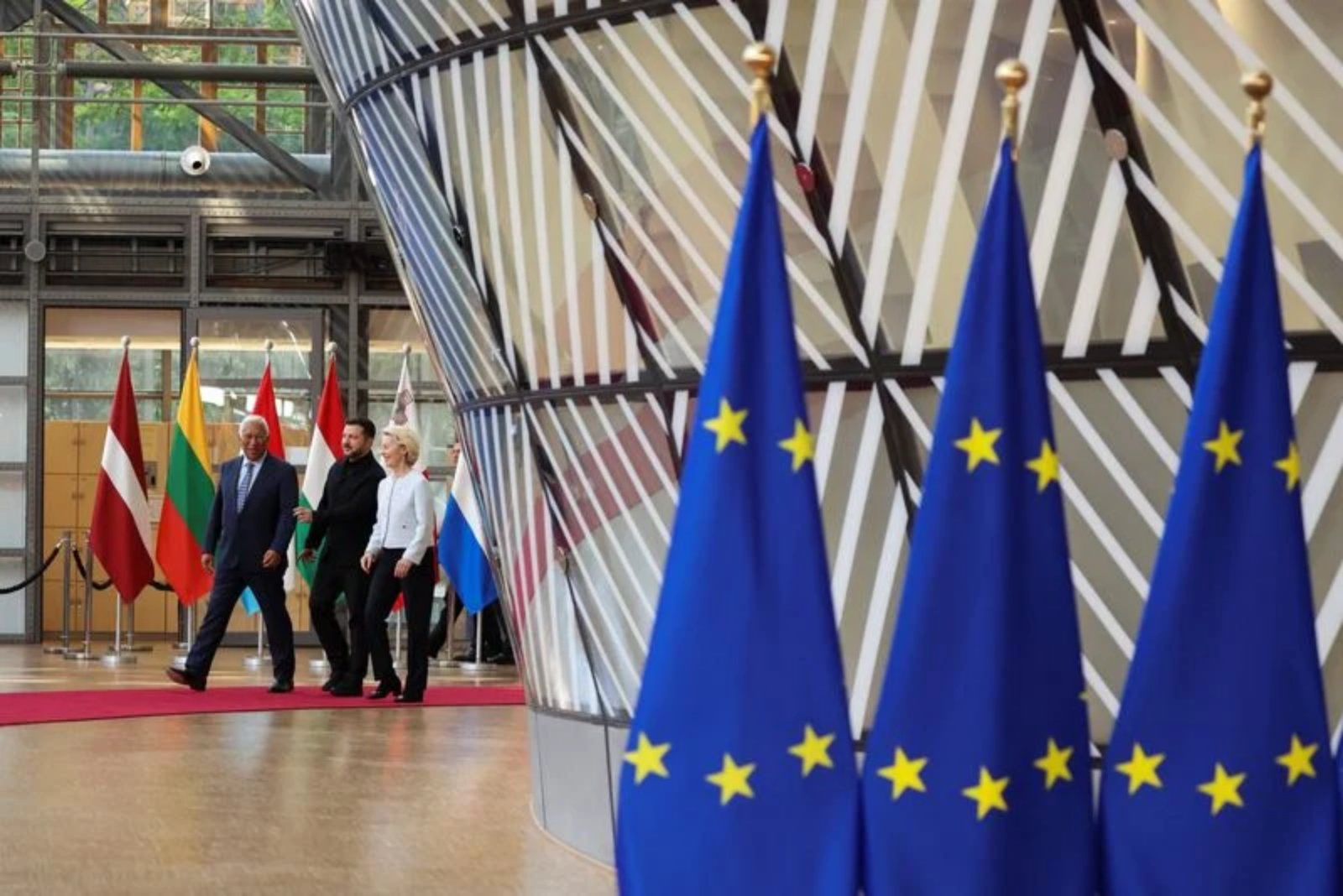
BRUSSELS, June 18 - European Union leaders gathered in Brussels on Thursday voiced differing opinions about whether to pursue direct talks with Russia over its war with Ukraine, following disclosure that the office of the European Council president had made "brief contacts at diplomatic level" with the Kremlin.
Until recently, EU governments have maintained a posture of diplomatic isolation toward Moscow after the February 2022 attack on Ukraine. In recent weeks, however, internal discussions have increased about whether and when to engage in direct dialogue with Russia. No single position emerged at Thursday's summit.
Arriving for the meeting, Latvian Prime Minister Andris Kulbergs made the case that contact is pointless unless the other side is genuinely interested in ending the conflict. "First of all, there has to be someone on the other side willing for peace," Kulbergs said. "Unfortunately no one wants peace on that side ... there is no point for contact if the other party (Russia) doesn’t want (peace)."
Lithuania's President Gitanas Nauseda told reporters he favored engaging only if Moscow gave clear signs of readiness to halt hostilities or to begin negotiations. "It is much better to step in if we see some positive signals from Russia, showing that Russia is willing to start the peace negotiations, or they are willing for a ceasefire," Nauseda said. "So far I do not see any positive signals from Russia, so my question is what we want to achieve."
Echoing skepticism, Dutch Prime Minister Rob Jetten said he had not seen indications that Moscow is prepared to negotiate. "We do not have that impression at all from the Netherlands. We see that the Russians have not shown any serious interest recently," Jetten said, suggesting that formal talks are unlikely to begin in the near term.
Officials in Brussels said the contacts initiated by the European Council president's office were limited in scope. One EU official, speaking on condition of anonymity, described the exchanges as intended "to open communication channels" and said that "nothing was discussed on substance."
Not all leaders advocated waiting for changes in Moscow's posture. Austrian Chancellor Christian Stocker said he supported keeping lines of communication open regardless of the level at which exchanges take place, while remaining doubtful that the Kremlin, and President Putin specifically, is prepared to negotiate a peace settlement. "I do not have the impression that Russia, and Russia’s President Putin in particular, is coming to the negotiating table in order to negotiate a peace solution," Stocker said.
Earlier in the week, Italian Prime Minister Giorgia Meloni proposed appointing a single EU envoy to coordinate contacts with Russia on matters related to Ukraine. The idea reflects a desire among some member states to centralize and streamline any future contacts, although no consensus on such an approach was reported at the summit.
Meanwhile, Ukrainian President Volodymyr Zelenskiy, speaking to reporters before his meetings with EU leaders, emphasized Kyiv's progress toward deeper ties with the bloc, welcoming the opening on Monday of the first phase of EU membership talks. That development was presented by Zelenskiy as a step toward anchoring Ukraine in Western political structures as it continues to repel Russia's invasion.
Context and takeaways
- EU leaders are divided on whether to pursue direct talks with Russia; many argue for waiting until Moscow shows meaningful signs of a ceasefire or willingness to negotiate.
- Some officials favor keeping diplomatic channels open at low levels as a contingency, even if substantive negotiations are not currently possible.
- Ukraine is simultaneously advancing into the first phase of EU membership talks, underscoring Kyiv's push for closer integration with Western institutions.