
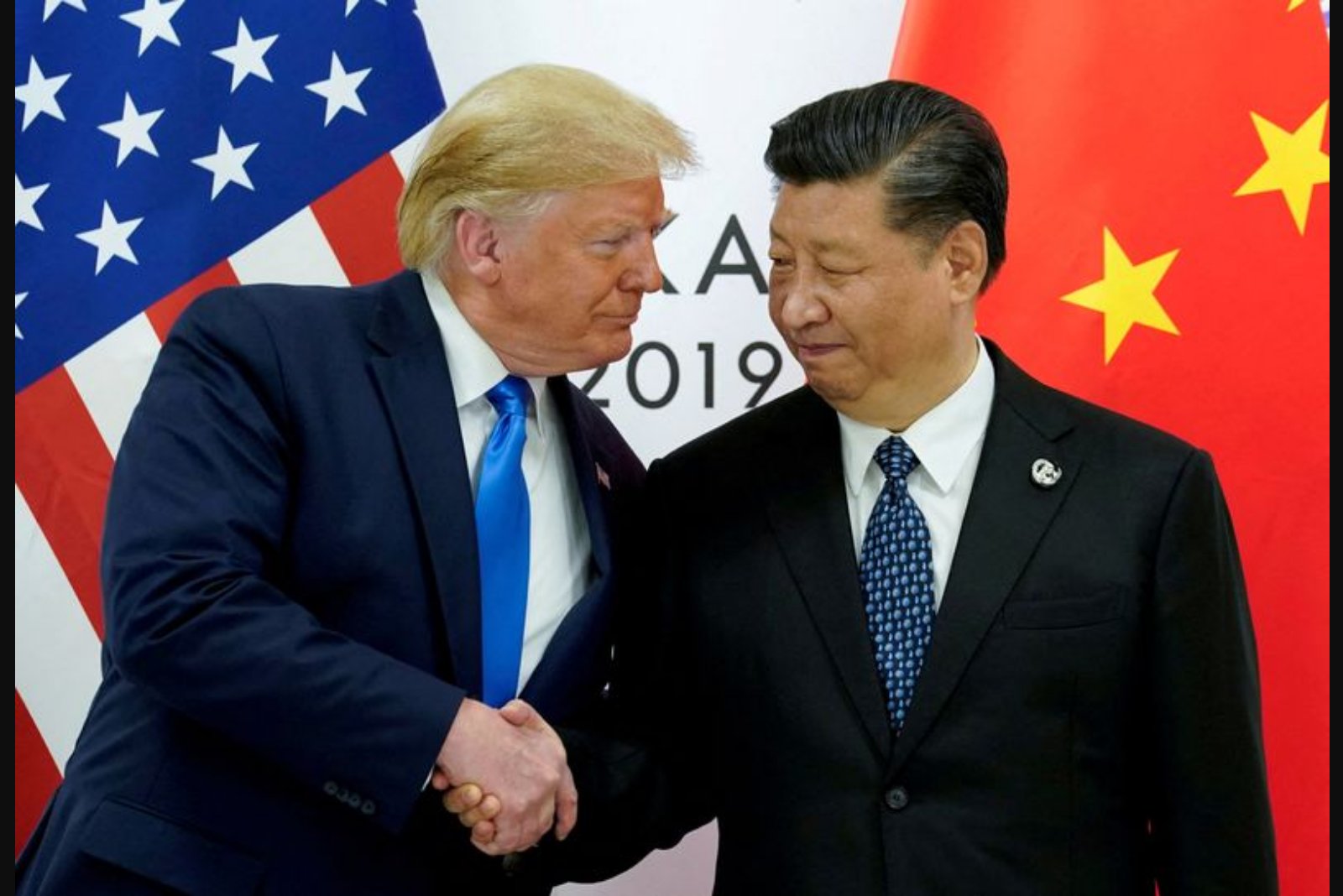
President Trump arrives in Beijing for summit talks with Xi Jinping on May 14-15 following a period in which the effectiveness of his tariff strategy has been diminished by a combination of legal challenges and geopolitical setbacks. What had once been framed as a campaign to use towering tariffs to bend China to U.S. will now centers on a narrowly defined set of deliverables - agricultural purchases, some commercial contracts and mechanisms to manage future trade frictions - and a high-stakes request: that China help persuade Iran to make a deal to end a conflict that has dented his domestic standing.
The upcoming meetings - the first substantive encounters since a truce halted an intense tit-for-tat trade war last October - will be staged with ceremony. The leaders are scheduled to hold a summit at the Great Hall of the People, visit the Temple of Heaven, participate in a state banquet and take tea and lunch together. Yet the scene-setting contrasts with the muted expectations for substantive breakthroughs.
Analysts note that the present dynamic gives the United States less leverage than once hoped. "He kind of needs China more than China needs him," said Alejandro Reyes, a professor specialising in Chinese foreign policy at the University of Hong Kong. Reyes added that Trump is seeking "a kind of foreign policy victory: a victory that shows that he is looking to ensure stability in the world and that he’s not just disrupting global politics."
Since their last brief meeting at a South Korean airbase - where Trump suspended triple-digit tariffs on Chinese goods and Xi retreated from restricting rare earth supplies - Beijing has been slowly expanding its own set of economic pressures on Washington. At the same time, Trump has spent months contending with U.S. court rulings contesting his tariffs and managing a war with Iran that has taken a toll on his approval ratings ahead of November elections.
Officials involved in planning have characterized the possible economic outcomes of the summit as limited: a handful of deals, mechanisms to better handle future trade issues, and an uncertain prospect of formally extending the trade truce reached last autumn. Trump is expected to be accompanied by a delegation of business leaders, including the CEOs of Tesla and Apple, although the delegation is smaller than the one that accompanied him during his 2017 visit to Beijing.
Beyond trade and commercial agreements, Trump said he intends to raise arms sales to Taiwan and the case of a jailed media tycoon, and families of two Americans imprisoned in China for more than a decade are pressing for progress on those cases. "We used to be taken advantage of for years with our previous presidents, and now we’re doing great with China," Trump said. "I respect him (Xi) a lot, and hopefully he respects me."
The tone of the U.S. campaign on China has shifted since a Truth Social post in April 2025 in which Trump vowed that tariffs would end the "days of ripping off" the United States. That tariff posture provoked Chinese countermeasures, including a decision to restrict rare earth exports - an action that highlighted Western dependence on elements critical to manufacturing items from electric vehicles to weapons - and ultimately helped produce the fragile truce between the two leaders.
Since that sequence of events, Trump has confronted a stream of foreign policy and political challenges. The agenda has included operations involving Venezuela’s leader, threats regarding Greenland, and above all a war with Iran that has plunged parts of the Middle East into turmoil and contributed to a global energy squeeze. Public opposition to the Iran conflict is notable: a Reuters/Ipsos poll last month found that more than 60% of Americans disapprove of the war.
One central aim of the trip is to secure China’s assistance in convincing Tehran to negotiate with Washington. China maintains diplomatic and economic ties with Iran and is a major consumer of Iranian oil. Observers note that Beijing, while not indifferent to a weakening of U.S. influence, is also sensitive to the broader economic costs of a prolonged Middle Eastern conflict and thus has incentives for de-escalation.
Still, Beijing is likely to seek concessions. Analysts and advisers suggest Xi will place Taiwan high on his list of priorities in return for any engagement on Iran. Wu Xinbo, a professor at Fudan University who sits on China’s foreign ministry policy advisory board, said Trump should make clear that he "won’t support independence or take actions that encourage a separatist political agenda." Experts warn that even subtle changes in Washington’s language on Taiwan could raise alarm in Taipei and among U.S. allies in the region.
On trade policy, Beijing reportedly wants commitments that the U.S. will refrain from future retaliatory measures such as technology export controls, and also desires rollbacks of existing controls on chipmaking equipment and advanced memory chips. Since October, China has bolstered its leverage through new laws aimed at penalizing foreign entities that shift supply chains away from China and by tightening its rare earth licensing regime.
Public sentiment toward engagement with China appears to be shifting in the United States. A survey by the Chicago Council on Global Affairs published in October found that 53% of Americans now favor friendly cooperation and engagement with China, up from 40% in 2024. That change in public mood means that preserving a stable bilateral relationship and extending the trade truce could be presented by the U.S. as an achievement.
Given these dynamics, analysts judge the most likely summit outcome to be limited in scope and tilted toward China’s advantage. Scott Kennedy of the Center for Strategic and International Studies described the probable result as "a superficial ceasefire that is largely to China’s advantage." The summit may thus yield small, discrete wins the White House can highlight while leaving the larger structural tensions unresolved.
Implications for markets and sectors
- Agriculture: Potential agreements on soybean and beef purchases could benefit U.S. exporters and agricultural supply chains.
- Aerospace and defence: Hopes for deals involving commercial aircraft could affect the aerospace supply chain and corporate relations, while discussions on arms sales to Taiwan bear on defence policy and industry geopolitics.
- Technology and manufacturing: Talks on export controls and chip equipment could influence semiconductor supply chains and technology exports.
Conclusion
The Beijing meetings will be notable for their ceremony and the spotlight they place on a U.S. president whose leverage has been weakened by domestic legal battles over tariffs and by the political costs of a war in Iran. With negotiators on both sides aware of mutual dependencies and political constraints, the summit appears poised to produce modest, targeted results rather than sweeping breakthroughs. Whether those outcomes will be sufficient to satisfy domestic political imperatives in Washington or strategic priorities in Beijing remains unclear.